Welcome to a site where we sometimes provide food for thought, and often provide information about the Western Canada Professional Hockey Scouts Foundation.
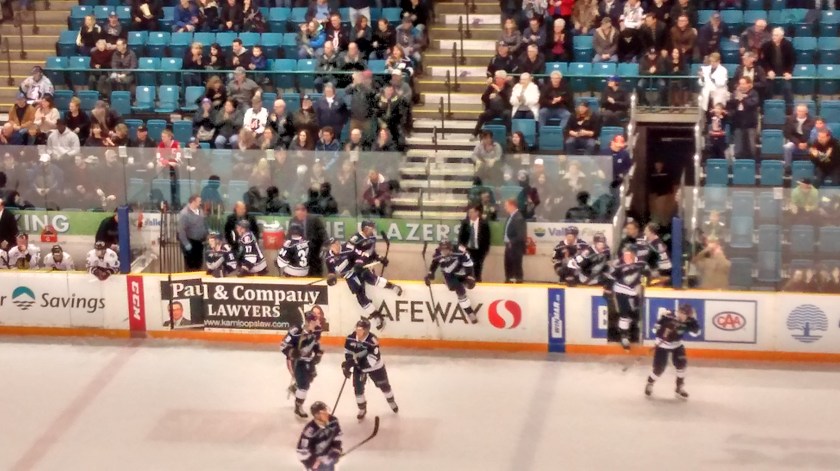
Kamloops head coach Don Hay (third from left) accepts congratulations from forward Carson Denomie at the bench as trainer Colin Robinson (left) and assistant coaches Dan DePalma, Aaron Keller and Mike Needham wait to greet him.
Down below, the arena had emptied as the mostly satisified fans headed out into the Kamloops night.
The cleaning staff was sweeping and picking up bottles, getting ready for another day and another game.
In the press box, Don Hay pulled up a chair, the radio interview finished and most of his responsibilities done for the night. He undid his tie, took a deep breath and offered up a satisfied smile.
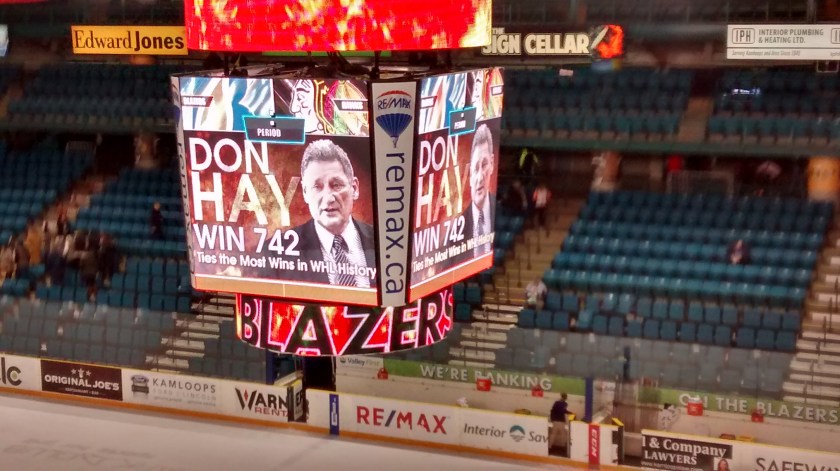
Hay’s Kamloops Blazers had just beaten the Portland Winterhawks, 5-2, for what was the 742nd regular-season coaching victory of his WHL career.
That tied Hay with Ken Hodge as the winningest regular-season coaches in WHL history. Hodge had held the record since retiring as a coach after the 1992-93 season. Hodge spent the first three seasons (1973-76) of his WHL coaching career with the original Edmonton Oil Kings, and the remainder with the Winterhawks, the franchise having moved to the Oregon city after the 1975-76 season.
Hay will have an opportunity to break the record tonight as the Blazers and Winterhawks complete a doubleheader in Kamloops. They will play again Sunday, too, this time in Portland.
Hay, who will be 63 next month, and Hodge, 71, are hockey lifers.
Hodge’s playing career was cut short by an eye injury while with the Moose Jaw Canucks of what was then the Western Canada Hockey League, and he turned to coaching. He may have been the youngest head coach in junior hockey history when, at 21, he took over the QMJHL’s Sorel Eperviers in 1968.
As a result, Hay and Hodge were never opponents as players, but they certainly were as coaches.
Their paths did come within a couple of seasons of crossing at one point. Hodge was the head coach of the International league’s Flint Generals for four seasons (1969-73). Hay played one season with the Generals, 1975-76, by which time Hodge was with the Oil Kings.
On Friday, when Hay looked back, the first memory came from Oct. 9, 1992 . . .
Hay, then 38, had gotten his first victory on opening night, Sept. 26, 1992, when the Blazers beat the host Tacoma Rockets, 7-6 in overtime. “Yeah,” Hay says, “we were losing after two periods and Hnat Domenichelli got a hat trick in the third.”
The Blazers went on to lose 7-3 to the Chiefs in Spokane on Oct. 2, then dropped a 4-3 OT decision in Portland the next night.
But it’s that Oct. 9 game that sticks in Hay’s memory.
It was his first home game as the Blazers’ head coach. A Kamloops native, he spent seven seasons as an assistant coach with the team, before taking a leave of absence from the city’s fire department and signing on as head coach.
This game also was the first in the history of what was then Riverside Coliseum and now is the Sandman Centre.
“The building was full and we raised a banner,” Hay says.
The Blazers had won the WHL championship and the Memorial Cup in 1991-92.
“After the game, I’m in my office, my assistants don’t come in,” Hay continues. “We lost about 8-2. We got taught a lesson by Mr. Hodge.”
Aaron Keller and Chris Murray, both of them now on Hay’s coaching staff, were in the Kamloops lineup that night.
“I asked Aaron, ‘Do you remember that game?’ ” Hay says. “He told me, ‘Oh yeah, we lost 8-2.’ ”
Hay chuckles again. He loves the stories and the memories.
“I can remember sitting in that room going, ‘Did I make the right decision leaving the fire hall? Maybe I should go back to the fire hall.’
“(General manager) Bob Brown came in and he was really good. He said, ‘You’re the guy to coach us. We have a lot of faith and belief in you.’ ”
Hay spent two more seasons as the Blazers’ head coach, winning back-to-back Memorial Cups in 1994 and ’95, before giving the pro game a try.
He later spent two seasons (1998-2000) as head coach of the Tri-City Americans before trying the pro game again.
He returned to the WHL in 2004 and spent 10 seasons with the Vancouver Giants, before coming back to his hometown over the summer of 2014.
By the time Hay returned to the WHL, Hodge had retired from coaching. He spent the next 15 seasons as the general manager, and was an owner for part of that time.
“I didn’t coach a lot of games against him, but when I was an assistant those seven years we had a lot of playoff series with him,” Hay says. “I really respect the job he did . . . it’s a pretty special record to tie.
“And it was nice to do it at home.”
Hay also tied the record with a good friend working the other bench.
Mike Johnston, Portland’s vice-president, general manager and head coach, and Hay have been friends since they were together on the coaching staff with Team Canada as it won the 1995 World Junior Championship in Red Deer.
“He was a big help on that coaching staff,” Hay says, “and we’ve been friends ever since.”
They are close enough that they try to to spend at least one day each summer playing golf, having lunch “and talking hockey,” Hay says. They also connect at various coaches’ conferences.
When was the last time they spoke?
Hay chuckles and says: “I talked to him (Friday) morning . . . we’ll probably talk (this) morning.”
Later today, their teams will meet as Hay gets his first shot at becoming the winningest regular-season coach in WHL history.
At the same time, Johnston, who turns 61 next month, will be trying to become the 23rd head coach in WHL history with 300 victories.
No matter the outcome, the friendship will endure. Johnston, like Hay, is a hockey lifer.
Don Hay, the head coach of the Kamloops Blazers, goes into this weekend with 741 regular-season WHL coaching victories. That is one off the record of 742 that has been held by Ken Hodge since 1993.
Hodge was a long-time head coach with the Portland Winterhawks, who will play in Kamloops on Friday and Saturday nights. The teams then will head for Portland and a Sunday date.
At the same time, Mike Johnston, the Winterhawks’ vice-president, general manager and head coach, is in search of his 300th regular-season victory, all of the with Portland. He will become the 23rd coach in WHL history with at least 300 victories.
On top of that, the Winterhawks will be playing their 3,000th regular-season WHL game on Friday night.
Before the 2015-16 WHL season began, Hay and I sat down for coffee and a chat. What follows is the I wrote for The Coaches Site.
There was pandemonium in Riverside Coliseum, the home arena of the WHL’s Kamloops Blazers, who had just beaten the Detroit Jr. Red Wings, 8-2, to win their third Memorial Cup championship in four years.
Don Hay, the Kamloops native who was the Blazers’ head coach, stood in their dressing room and watched the celebration carrying on around him.
More than 20 years later, he recalls: “I was in the dressing room going, ‘What am I going
Don Hay, the head coach of the Kamloops Blazers, has held a lot of media scrums during his lengthy coaching career. (Photo: Gregg Drinnan)
to do now? What am I going to do now? Am I going to quit the Blazers?’ ”
Hay had been on the Blazers’ coaching staff for 10 years at that point, the last three as head coach. Earlier, when he was an assistant coach, he also was a Kamloops firefighter.
“Coaching was different then,” he says. “Believe it or not, there’s more security now than there was then, and I had a good job (with the fire department).”
History shows that Hay didn’t get out of the coaching game, and he never returned to the firehall. He moved on to the NHL, came back to the WHL, and then returned to the NHL before once again coming back to the WHL.
He’s back in Kamloops now, as the Blazers’ head coach, and he is really comfortable being back home.
In a lengthy conversation with the 2015-16 WHL season on the horizon, Hay touches on a lot of things and tells some stories.
—————
Tom Renney had been the head coach when the Blazers began that Memorial Cup run by winning the 1992 championship in Seattle. After that victory, Renney signed a two-year contract with the Blazers. However, he wasn’t in Kamloops long enough to get it started.
During the summer, Dave King left Hockey Canada, where he had been head coach of the national men’s team. Hockey Canada asked Renney if he wanted that job.
“That was always Tom’s dream job, to coach the national team,” Hay says. “He grew up in Nelson watching the (Trail) Smokies and teams like that, and his dad was into that. So he left in the middle of July.”
That’s when Blazers general manager Bob Brown asked Hay, a seven-year assistant coach, if he wanted to succeed Renney.
Interestingly, Hay actually had taken a bit of a step back from the Blazers. His children were old enough that they were getting actively involved in sports and he was able to spend more time with them. And, of course, there was the job with the Kamloops Fire Department.
“I had to take a two-year leave of absence from the firehall,” Hay recalls. “I wasn’t going to go anywhere else to coach. I wasn’t going to leave the security of the firehall. I actually took a paycut to come and coach the Blazers.”
Hay signed a two-year contract as the Blazers’ head coach. That contract was up after the Blazers won the 1994 Memorial Cup in Laval, Que.
“That was the end of my two years,” Hay says. “We had just won the Memorial Cup and I had to make a decision whether I’m going to go back to the firehall.”
Except that the Blazers were to be the host team for the 1995 Memorial Cup tournament.
“So,” Hay says, “they said, ‘Take another year but this is your last year.’ ”
—————
After the Blazers won the 1992 Memorial Cup, they went young with, Hay says, “I think five 16-year-olds.” He also pointed to a “key trade” that Brown made in acquiring goaltender Steve Passmore from the Victoria Cougars “to stabilize our group.”
Passmore returned as a 20-year-old for 1993-94.
“The team to beat that season was Portland,” Hay says. “They had (Adam) Deadmarsh and (Jason) Wiemer and (Scott) Langkow in goal. They had a good team. Langkow got hurt during the season so we had jumped them in the standings.”
Kamloops and Portland met up in the West Division final, with the Blazers, who had finished seven points ahead of the Winterhawks, holding home-ice advantage.
“Game 1 and 2, we won,” Hay remembers. “Game 3 and 4, they won. Game 5, back here, we won that to go up 3-2. Down in Portland for Game 6, Jarome Iginla, who was 16, got the first goal and then Scott Ferguson scored late in the game and we ended up winning the series. It was something that wasn’t expected.”
The Blazers then took out the Saskatoon Blades in a seven-game championship final.
“We went to Laval and it was like, ‘Boy, it all came together.’ So we unexpectedly won in ’94.”
The following season, as Hay puts it, “We had a really strong team. I think we went wire-to-wire as the No. 1 team in the country.”
In the end, they came up against the Brandon Wheat Kings in the WHL final. With the Blazers the host team for the Memorial Cup, both teams knew they would be advancing. Still, as the series progressed, Hay found himself having to make a key decision.
With the series using a 2-3-2 format, the Wheat Kings won the opener in Kamloops.
“The second game,” Hay explains, “we were down and we make the decision to pull the goalie, Roddie Branch, and we put in Randy Petruk.”
Petruk, a 16-year-old from Cranbrook, had gotten into 27 games as a freshman, going 16-3-4. Still, he was 16 years of age. Branch was 20.
“Petruk won eight straight games after that,” Hay says. “We were down 2-0 going to Brandon. We won all three games in Brandon and came back here to win Game 6 in our building. He won those four games and then he won four games at the Memorial Cup as a 16-year-old.”
That was the last time Hay turned to a 16-year-old goaltender. Still, he says that experience is why he didn’t have any problem turning to 17-year-old Tyson Sexsmith in 2006-07 when he needed a goaltender with the Vancouver Giants the host team for the 2007 Memorial Cup. Hay went to Sexsmith early on, and the kid got into 51 regular-season games and 22 more in the playoffs.
The Giants lost to Willie Desjardins and the Medicine Hat Tigers in seven games in the WHL final that year — “That playoff against Medicine Hat was as good as any playoff I’ve been in,” Hay says — but later beat the Tigers 2-1 in the Memorial Cup final in Vancouver’s Pacific Coliseum.
The Giants had won the 2006 WHL title under Hay, but lost a semifinal game at the Memorial Cup in Moncton.
—————
When Hay ended a three-season professional playing career, he returned to Kamloops and was prepared to work as a firefighter and coach minor hockey.
He also was in on the ground floor with the Kamloops Cowboys, a short-lived senior team that played in a league with the likes of the Quesnel Kangaroos, who featured the legendary Gassoff boys, Prince George Mohawks and North Delta Hurricanes.
Hay’s coaching career began innocuously enough when the Cowboys’ coach skipped a practice.
“One day our coach got mad at our group and didn’t show up,” Hay recalls. “We’re sitting in the dressing room, going, ‘Who wants to run practice?’
“I said, ‘Well, I’ll give it a try,’ and I became kind of the player-coach.”
As he got involved in coaching minor hockey, he worked hard to get his coaching levels. As he says, “They wouldn’t give me a head-coaching job because I didn’t have my levels.”
He got the levels and was quite content coaching minor hockey. Then came the phone call that would change everything. It was the summer of 1985 and Ken Hitchcock was preparing for his second season as the Blazers’ head coach.
“I didn’t know him at all,” Hay says. “He said, ‘Come on down for a coffee. I want to meet you.’ I went down there and by the time I left he offered me a part-time assistant-coaching job.”
Hay’s head was spinning as he went home. He was 31 years of age and knew he wanted to give it a shot.
He remembers going home and saying to his wife, Vicki: “Just let me try this for a year. I can work it around my shifts.”
It was a part-time gig and he wouldn’t be making road trips. At least that was the plan at the start.
“But the more you got into it,” Hay says, “the more you were there all the time. I said, ‘Just let me try it for a year’ and it’s been ever since.”
Of course, if Hay thought he was a coach then, he admits that he quickly underwent an attitude adjustment.
“I remember my first practice with Hitch,” Hay says. “I thought being an ex-pro player, I knew everything. I found out I didn’t know anything.
“He was a student of the game. He had gone to watch the Oilers practice with Glen Sather. He had spent time with Clare Drake in Edmonton. Hitch used to watch Sather with Gretzky, Kurri, Coffey . . .”
Hay spent five years working with Hitchcock, and they made two trips to the Memorial Cup — 1986 in Portland and 1990 in Hamilton.
“That 1990 team . . . it was a good team,” he says. “Lennie Barrie. Dave Chyzowski. We got Clayton Young in a trade from Victoria. He got 100 points. He was our fourth-line centre. We had an awesome team. We had some great teams here.”
It was Hitchcock who pushed Hay towards Hockey Canada. It was Hitchcock who prodded Hay until he got involved in the U-17 program that was in its infancy. Hay was one of the coaches when some B.C. teams gathered at Memorial Arena in Kamloops.
“That was the first year of the program,” Hay says. “Bob Nicholson was the head of B.C. amateur hockey. I can remember we were representing Okanagan and we were playing a Lower Mainland team. The first period was all penalties.
“Bob was there and he said, ‘If you guys can’t get this thing straightened out we might not have this program.’
“It was a startup program; they wanted to identify the best players. It obviously ended up fine and things moved on.”
—————
A lot of ice has been made since Hay got into the coaching game. When he first started coaching, who would have seen cell phones and social media on the horizon?
“The players have changed. The coaches have changed,” Hay says. “At one time you had one coach. Now you have an assistant coach . . . some people have two assistant coaches. We have a couple of part-time guys. . . .The players have so many resources now . . . video, YouTube.
“At one time we had nothing. Then we had VHS for a long time. My first year in Vancouver we had a computer and I was a little leery about how this thing all worked.”
Hay pauses, and then he chuckles.
“In 1990, Len Barrie had the first cell phone. He was in the back of the bus with this great big cell phone like this,” Hay says, and he holds his hands about a foot apart.”
Yes, even the t-shirts have changed.
“In ’94 in Laval, we had Stanfield underwear that we would write things on with a Sharpie,” Hay says. “Now you get a new t-shirt with something written on it.”
The way Hay sees it, everything has changed.
“The kids have really changed,” he says, but he adds that a lot of that is because “technology has changed. . . . Society has changed.”
He thinks back 15 or 20 years and remembers when coaches and players read The Hockey News on the bus “to find out what was going on” in the NHL and the three major junior leagues.
Hay was the head coach of the Canadian team that played in the 1995 World Junior Championship in Red Deer. He remembers attending a summer session in Red Deer . . .
“The Quebec guys sat over there. The Ontario guys sat over there. The Western Hockey League guys sat over there. Nobody knew each other,” he says. “The only guy they knew was Brett Lindros because he was such a recognizable guy. People didn’t know who Bryan McCabe was. Nobody knew what was happening.”
These days, thanks at least in part to social media, everyone knows everyone and many players are in regular contact with each other.
This, of course, has led to rules regarding the use of phones and social media.
“We have no phones at meals,” Hay says. “When you come in the dressing room, you put your phone away.”
When the Blazers travel to Vancouver, for example, the players have to turn off their phones once they reach Chilliwack.
“You have to explain why you’re doing it,” Hay says. “You’re doing it so they can focus and concentrate.”
A chuckle follows.
“I remember one time when we were playing in Swift Current and staying in Medicine Hat,” he says. “We got back and I was upset after we lost.”
Hay ordered his player to go “straight to your rooms.”
Except that Darcy Tucker chimed in with: “I have to phone my mom and dad.”
So, as Hay recalls, “They all lined up at the pay phone.”
Another pause. Another chuckle. He has asked players what they would rather give up — a hot shower or the cell phone.
“They would all rather shower in cold water than give up their cell phones,” he says with a laugh.
Hay also points out that dealing with cell phones and social media is “part of the discussion” at all levels of hockey, including the World Junior Championship. “How are we going to handle cell phones and computers and things like that? You want the focus to be on the task at hand, but the phone has become such a big part of their lives.”
Helping players learn to deal with social media, as Hay points out, is part of a coach’s responsibility. The WHL has rules regarding the use of social media because, as Hay says, “We don’t want the players embarrassing themselves.”
He adds: “They’re young people. They have to learn the right decision-making. I always tell the players ‘my job is to not only teach you hockey skills, but to teach you life skills.’
“The biggest life skill is making good decisions.”
—————
If Hay has learned one thing in his coaching career, it is that the only constant in hockey is change. That is something that he doesn’t see changing, either.
“The kids are more educated; they’re more aware,” he says. “They’re well coached. They’re probably not as coachable . . . not open to change at times. That’s probably the biggest thing.
“As coaches, we have to change with the times and the players. The players have got to change and adapt, also. Sometimes there’s stubbornness to change on both sides.”
However, as he is quick to point out, it is “the coachable guys who have a chance to become players.”
He quickly names four former WHLers who went on to play in the NHL and in a couple of sentences he explains how they got there. “Chris Murray, Darcy Tucker, Milan Lucic, Brendan Gallagher . . . those guys would come to the rink every day wanting to get better,” Hay says. “They wanted to know, ‘What can you teach me today?’ If they got corrected, they would try to do it (better) and please you. That’s what coachability is all about. They had to work to get where they wanted to get to.”
Of course, nothing is like it used to be. Hockey didn’t use to be all about systems. Oh, sure, coaches worked on defensive zone coverages and such, but . . .
“It wasn’t like it is now; no doubt about it,” Hay says. “Games were like 8-6 and 9-7. There were systems, but not as detailed as they are today and not as structured as they are today. That’s probably the biggest change I’ve seen in my time.”
When Hay left for the first time after the 1994-95 season, he left behind a WHL that, as he puts it, “was still a pretty explosive league with lots of goals.” It’s not like that now and one of the main reasons, he suggests, is that the “coaches are more educated now.”
Hockey coaches, as a rule, love to share. They spend their summers attending coaching clinics, either as presenters or participants. Hay is no exception.
“I learned from Hitch to give back,” Hay says. “Give back to the community that helps you. Every summer I try to either present at a coaches clinic or go to a coaches clinic. It’s important to continue to learn. You pick up one or two things that you think can help you have success and I think that’s important.”
As for the future of the game, he sees hockey “going to more of a development model.” It starts with the increase in the number of coaches being hired in the pro game.
“You look at the (Chicago) Blackhawks and their farm team,” he says. “They had a head coach, an assistant coach . . . they had special assignment coaches. They had a faceoff guy, a goalie guy, a defence guy, a forward guy, a penalty-killer guy. They’re trying to teach their players as much as they can because of the salary cap . . . they have to replace these guys with younger guys.”
The people who run junior teams are paying attention, too. In the case of the Blazers, Hay says they spent the first two days of their training camp on skill development. They brought in Dallas Stars goaltending coach Jeff Reese.
“We also did defencemen development. We did forward development,” Hay says. The focus on skill development has meant one other thing, too.
“You want to get to your group as quick as possible so you can start working with them and start developing them,” he says.
—————
Hay returned to Kamloops as the Blazers’ head coach over the summer of 2014. He had spent the previous 10 years as the head coach of the Vancouver Giants. Ron Toigo, the Giants’ majority owner, let Hay out of the final year of a contract in order to allow him to return to his hometown.
“I had 10 really good years in Vancouver,” Hay says. “The opportunity came probably at the right time for everybody. I didn’t think the opportunity would come, to be able to come back. Things just didn’t match up along the way. When I was looking for a job, the Blazers had a quality coach. When they needed a coach, I had a job.”
Hay seems completely at peace with where he is at this stage of his life. He is 61 now, and he’s back home and surrounded by family.
“It feels different,” he says of being back in Kamloops. “It feels good but it feels different.”
These days, with Hay into his second season in his second stay with his hometown Blazers, he seems really comfortable with his lot in life.
While son Darrell continues to play professionally — he is a defenceman with the Sheffield Steelers of Great Britain’s Elite Ice Hockey League — Hay is in close proximity to his and Vicki’s twin daughters. Angela, who is married to former WHL goaltender Thomas Vicars, lives in Salmon Arm, while Ashly, who was married in July, lives in Kamloops.
“This is home. I was born and raised here. I came back every summer. It’s not like I left Kamloops and never came back. I have always felt that Kamloops is home. I enjoyed my time in Vancouver and the people I met there and the people I worked with there. I just didn’t think the opportunity would ever present itself.”


 we won that to go up 3-2. Down in Portland for Game 6, Jarome Iginla, who was 16, got the first goal and then Scott Ferguson scored late in the game and we ended up winning the series. It was something that wasn’t expected.”
 TAKING NOTE