Mondays With Murray: The Terror of Indy, at a Terrorized 22 m.p.h.

The 109th running of the Indianapolis 500 is scheduled for Sunday, May 25, at the Indianapolis Motor Speedway. Today, we feature one of Jim Murray’s funniest columns about his racing debut 50 years ago at the Brickyard in May 1975. Here’s ‘Goggles’ Murray, the scourge of the Speedway.

Enjoy!

——

FRIDAY, MAY 23, 1975, SPORTS

Copyright 1975/THE TIMES MIRROR COMPANY

JIM MURRAY

The Terror of Indy — at a Terrorized 22 m.p.h.

INDIANAPOLIS — Some people never sample the wine of life. Some people stay down in the valley. Some people opt for the rocking chair, the crossword puzzle, the briefcase and 9-to-5 job.

  Not your correspondent. The blood of adventurers courses through these veins. The scent of excitement runs through my life. Let others pine for the safe, the comfortable. Give me the ramparts, the unclimbed, the mysterious beauty of the unknown.

  I have never faced Sandy Koufax’ fastball, Muhammad Ali’s left jab, Larry Csonka’s rhinoceros charge. I have never hunted the lion, rode the shark or walked a jet wing.
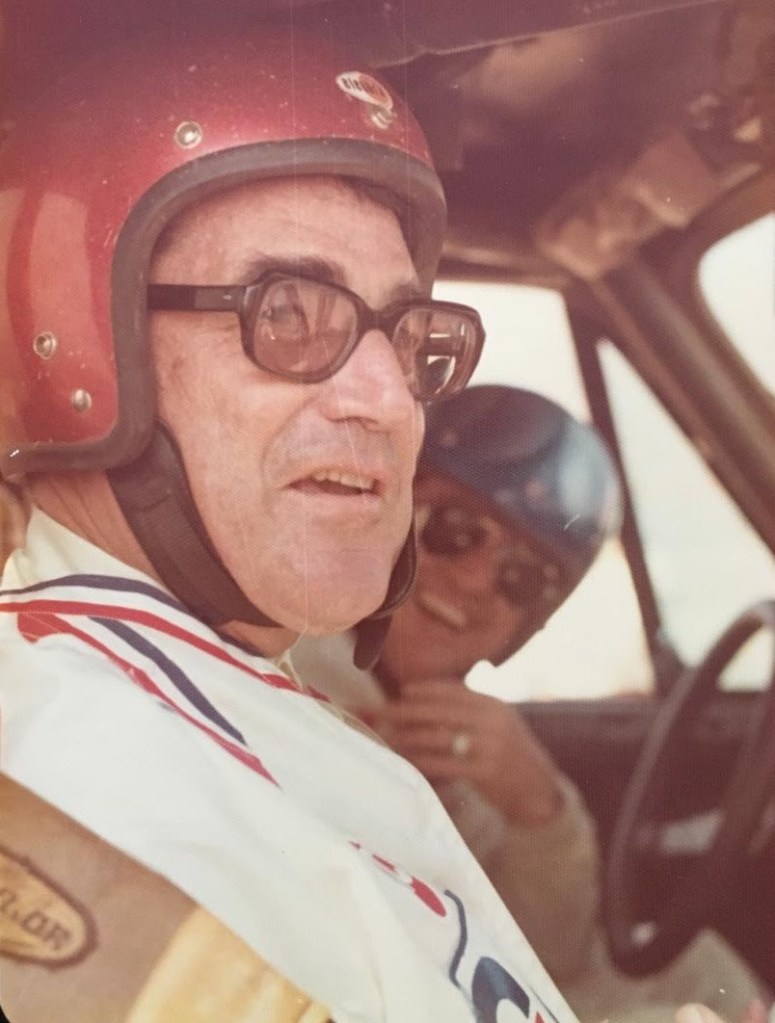
Jim ‘Goggles’ Murray straps in as he prepares for his Indianapolis Motor Speedway debut in May 1975.

  But I have braved the terror in the corners of Indy. I have joined the Knights of the Roaring Road. I have gone hell-bent down the terrible straights of the Brickyard. I have joined the immortals of racing, the Rickenbackers, Barney Oldfields. They may make a movie about my life — starring Jim Garner or Paul Newman. I drove the dreaded Indianapolis Motor Speedway, the graveyard of many brave young men.

  “Goggles” Murray, the scourge of the Speedway. Foyt turns pale at the sound of my engines revving up to speed. Rutherford would rather see a train bearing down on him than catch old Goggles in his rear-view mirror.

  I went through the turns at a fearsome speed of 12.5 m.p.h. I was a blur on the straightaways at 22.5. I came near to frying the clutch in my pit stop.

  The car I climbed into was the one Mario Andretti set the world speed record in a couple of years ago, a closed-circuit mark of 214.158 m.p.h. I quickly ascertained that the temperature of the track wouldn’t handle that kind of speed, that I had to save the car and not run too lean a mixture. All the great drivers save their cars.

  As I was strapped in the car by Andretti and Parnelli Jones, I heard a hush fall over the Speedway. Stopwatches clicked along the pit wall. People came out of every garage in Gasoline Alley. Old Zero was on the track.

  I checked out the pedals carefully like all the great ones do. “Where’s the cigarette lighter?” I asked. Like Foyt, I’m a perfectionist. “You’re going to smoke?!” demanded Parnelli. “In a ‘Viceroy’ car?” I asked. “I thought it was required. Well, if I can’t smoke, how about a bottle of champagne?”

  I was soon out of the pits and onto the track. I waved one finger exultantly in the air. I checked my instruments. The car was handling nicely at a steady 15 m.p.h.

  Suddenly, in my rear-view mirror I saw a track sweeper truck bearing down on me. I realized unless I did something he would dive under me in the groove and take the lead. I upped the boost to 22 m.p.h. and held him safely in my sights.

  I went past Hell’s Corner where Pat O’Connor was killed in ’58, past the crash sites of a dozen drivers, brave men, all.

  I lapped the track sweeper coming dangerously close to the wall — 80 feet. Into the short chute. I charged. I had to make several split-second decisions — whether to eat the peanut-butter sandwiches I had brought aboard, whether to abort the run (I could tell one of the cylinders was running raggedly and the wing wasn’t holding the car on the track).

  As I pitted, I climbed out of the car the way Foyt does when things aren’t going right, slammed my helmet to the ground, unbuttoned my flameproof suit and said “Dammit! I told you to check that boost. The car was fishtailing like a salmon as I got up to speed – 22 m.p.h.”

  “Congratulations,” said Parnelli. “You have just completed the first Speedway run in history that could be timed by a sun dial and a calendar.”

  “Listen, Jones!” I told Parnelli. “Don’t you realize there’s an energy crisis?! Just ask yourself — did I conserve on fuel and tires? Did I punish the chassis? Did anybody slip in my oil? Was the yellow light on any part of my trip?”

  “Yellow light?!” screamed Parnelli. “I thought we were going to have to go out and look for you!”

  Of course, there’s more to race driving than just standing on it in the turns.

  “There’s a million things to check in that cockpit. Tires, heat gauge, oil pressure, wind direction, the groove.” I told him.

  “You could have read a book!” protested Parnelli.

  I wasn’t about to give up. “Did you ever have to blow off a track sweeper in Turn Three?” I asked him.

  When you make it at the Speedway, the United States Auto Club acknowledges you have arrived by printing up a small bio of you in its USAC sanction book. Mine will now read:

  “Murray, James (‘Goggles’)

  “Age: 55, height 6 feet, weight, refuses to give.

  “Marital standing: Dubious. Wife. Four children.

  “1967 — Won the pole on the Santa Monica Freeway off-ramp at Harbor in a brown Cougar with front-end suspension.

  “1968 — Rear-ended a 1947 Ford driven by an uninsured pensioner with a hard-luck story.

  “1969 — Black-flagged by wife after noisy party for throwing oil and trying to put key in cigarette lighter.

  “1970 — Got lost while running 15th, phoned Auto Club for directions.

  “1971 — Set record for getting up hill from Rose Bowl after New Year’s Eve Day game, breaking old mark of 6 hours and 5 minutes by 10 seconds.

  “1972 — Found a parking spot in Beverly Hills the first time around the block.

  “1973 — Saw and reported a car in Westwood NOT driven by a woman.

  “1974 — Got to a destination on directions given by sister-in-law.

  “1975 — Ran out of gas on Hollywood Freeway during rush hour.

  “May 22 — Ran the slowest lap on the Indianapolis Speedway by any car not steered by tiller or any four-wheeled vehicle not pulled or pedalled.”

  I am super-qualified.

  I braved THEIR track. I’d like to see them on mine — the dreadful stretch from the Harbor to the Santa Monica at 5 o’clock at night with your glasses sweaty, your shocks worn — and two California highway patrolmen in your rear-view mirror behind on their quotas.

——

Jim Murray Memorial Foundation | 25 Main St | Cooperstown, NY 13326 US

Mondays With Murray: Political Barkley Is Too Incorrect

On April 13, 1996, the final two spots on Dream Team III, the team that competed at the 1996 Olympics in Atlanta, were filled by Phoenix’s Charles Barkley and Sacramento’s Mitch Richmond.

Today, we bring you Jim Murray’s April 3, 1994 column on Barkley.

ENJOY!

—————

SUNDAY, APRIL 3, 1994, SPORTS

Copyright 1994/THE TIMES MIRROR COMPANY

JIM MURRAY

Political Barkley Is Too Incorrect


  I hate to say this — he’s going to hate me for saying it — but I have to tell you Charles Barkley is a fake, a fraud.

  How do I know this? Well, I’ve made a kind of study of the man. I read his biography, watched him play, sat in on his interviews, even urgently recommended him to Clippers owner Donald Sterling once when he came on the open market.  

  Look, Charles Barkley would have you believe he’s the baddest dude in basketball, gives no quarter, takes no prisoners, defies convention. He’s at pains to portray this image. He slugs barflies, spits at members of the audience, feuds with coaches, bad-mouths owners, snarls at media, takes pride in being his own man. A don’t-mess-with-me attitude. 

  Fine. He’s done all of those things. He’s an intimidator. On and off the court. He’s outspoken. Controversial, even. It’s not advisable to come up and slap him on the back. 

  But, having said that, let’s take a look at the man. He’s not really Big Bad Barkley. He’s not a pussycat, but neither is he a mountain lion. He’s a sheep in wolf’s clothing. 

  Watch him on the floor. He smiles a lot. He has a nice smile. He laughs easily. He shakes hands with the courtside customers he knows. Says hello to opponents before tipoffs. 

  He’s a politician, for crying out loud! He’s going to — get this! — run for governor of Alabama. Next stop, who knows? The White House? 

  Does that sound like the antisocial dude you’ve been reading about? The Charles Barkley who mugs the opposition, his own team or the paying customers with the same degree of skill and enthusiasm? The man you love to hate? 

  Barkley’s big problem is he has trouble with the diplomatic lie. He might be governor, but he could never be secretary of state. World War III would ensue. Barkley would tell Yeltsin to sober up, tell the queen mother she was fat. 

  Barkley has great difficulty with the truth. Which is to say, he tells it. Which creates difficulty. The truth always does. 

  The other night at the Sports Arena, his team beat up a docile, uninterested bunch of L.A. Clippers so easily Barkley didn’t have to play but 27 minutes. 

  The Phoenix Suns played him so little because they didn’t need him to beat so inconsequential a bunch as the Clippers, Barkley told the reporters. 

  “You don’t use your Mercedes-Benz to go to the grocery store. You save it for long important trips,” he said, dismissing the Clippers. “Their team doesn’t try hard enough. Someone should tell them winning takes effort.” 

  Vintage Barkley. In your face. Don’t sugarcoat it. If the Clippers don’t like it — well, it’s a matter of complete indifference to Barkley. 

  Is Derrick Coleman a great player? 

  “Not as great as he should be,” Barkley has evaluated. 

  Aren’t the Knicks great on defence? 

  “They have to be,” says Barkley. “They have no offence.” 

  Barkley could spot the warts on the Mona Lisa. He never temporizes, says “No comment,” or even claims he was misquoted. He was named to the all-interview team five years in a row by the beat writers. A dull game? Go find Barkley, he will liven it up for you. An open microphone and Barkley were like the iceberg and the Titanic. Once when he was criticized by an adversary, Byron Scott, Barkley said Scott was “last seen on the side of a milk carton.” He once led an on-court brawl that set a league record for finea — $162,500, of which Barkley’s share was $57,000 in fines and lost salary for suspension. 

  Reputation meant little to Barkley. He took over for Julius Erving in Philadelphia, where Dr. J was second only to Ben Franklin in community esteem, but it wasn’t long before Erving was turning over the team leadership to the brash young Barkley — at Barkley’s insistence. And Barkley once held Larry Bird with his arms pinned to his side while Dr. J belabored him with blows. Bird wore the wrong color uniform. 

  Sometimes, even the uniform didn’t matter. When Barkley got traded to Phoenix, he chose the first practice to bounce teammate Cedric Ceballos on the floor as the team screamed at him. 

  In the Olympics, it was the Dream Team teammates who screamed at him when he elbowed a player from Angola in the ribs and stomped on his foot. 

  But for a guy who can dish it out, Barkley can also take it. When Bobby Knight cut him from the Olympic team in 1984, many thought it was because Barkley twitted the coach. The Barkley of those days was widely perceived to be a talented kid who was going to eat his way out of the game despite his undeniable genius for it. The “Round Mound of Rebound” was his nom-de-court in the better press releases. Knight wanted him to lose weight, but all Barkley did was lose interest. 

  But when Knight cut him, Barkley, astonishingly, defended him. 

  “I wasn’t even close to the player I had been at the (Olympic) trials,” he was to write. “I was just hanging out, having fun.” 

  He actually thought Knight agonized over the decision to cut him. 

  “It’s when I finally gained respect for Knight — realized we were very much alike — he couldn’t take less than the best from anyone.” 

  Barkley is also delighted when anyone stands up to him, which is not part of the image, either. 

  Now that I’ve blown his cover, shouldn’t he rob a train, drown a canary or bad-mouth Mother Teresa to get his film-villain image back? First thing you know, he will be getting the basketball equivalent of hockey’s Lady Byng Trophy, annually awarded to the player who passes out the fewest subdural hemorrhages, who uses his stick on a puck, not an ear. 

  But Barkley is the nearest thing to a megastar in the game, now that Michael Jordan has left. He put 16,005 fans in the seats at the Sports Arena the other night, and there was no doubt they were there to see him. Sir Charles. They booed him, of course. That’s part of the pact. 

  If his team prevails and wins the championship this year, will he try out for the Chicago White Sox next year? 

  Barkley laughs. “No. I’m going to be trying for governor.” 

  Will he make it? 

  “No doubt! By acclamation,” he predicts. 

  “There’s a sickness in our society today. Our idiots have given a message to our children that your life has no meaning unless you have a big house, a big car, expensive clothes and a lot of money. We’ve taught them that being a cop, an honest workman, a trash man or a carpenter, any of the useful things in life, are not meaningful. That needs to be addressed. The system isn’t working. We need to root it out, remake it.” 

  But can he kiss babies, eat the rubber chicken, make the promises and evade the pressing questions it will take to get to the state house? Can he get there by being Charles Barkley? Won’t a couple of Charles Barkley answers torpedo the whole campaign? 

  Maybe so. But the fact of the matter is that despite his mouth, Barkley is — come closer, I wouldn’t want him to know I’m spreading this around — a nice guy!

Jim Murray Memorial Foundation, 25 Main St., Cooperstown NY, 13326

Mondays With Murray: He’d Rather Get Fruitcake!

From all of us at the Jim Murray Memorial Foundation, we wish you a very Merry Christmas, Happy Holidays and a Happy New Year!

It is tradition here at the JMMF to share with you at Christmas time a 1995 Jim Murray column we like to call “the fruitcake column.”

Enjoy!

—————

December 24, 1995, SPORTS

Copyright 1995/THE TIMES MIRROR COMPANY

JIM MURRAY

He’d Rather Get Fruitcake

 Stop me if you’ve heard this, but are you as tired as I am of the upbeat Christmas letters, the look-at-us, hurray-for-our-side family chronicles you get this time of year?

 You know what I mean. The ones that start out something like this:

 “Well, it’s been a banner year for the Mulligans. Christin finally had our first grandchild, a bouncing baby girl, 9 pounds 7 ounces, who’ll probably grow up to be our first woman President.

 “John has taken over the Federal Reserve System. Paula is still working on a cancer cure at Johns Hopkins and we expect a breakthrough any day now. A Nobel Prize, perhaps?

 “Dad and I are enjoying our retirement. He has produced a new hybrid rose for our garden that is hailed by horticulturists everywhere.

 “I am still busy with my charity work, saving the whales, protecting the spotted butterflies, supporting a Hottentot village in the South Pacific, and still have time to combat illiteracy in our universities and lobby for outlawing the death penalty but legalizing abortion. Dad thinks I take on too much but I was on Howard Stern twice last year and am taking dead aim on Oprah Winfrey.

 “Phil got his PhD in optical engineering and is working on the telescope with which they hope to bring in Heaven by the end of the century. Rita is in the Peace Corps some place where they can only get a message out by bottle but finds her life fulfilling and thinks the dysentery is only temporary. Harriet is still into archaeology and they have found the lost city of an Aztec sun god of the second century BC, but she can’t find her car keys.

 “So, all in all, it’s been a joy and we look forward to more of the same in 1996 and hope you all are enjoying the happiness and success that has been our fortunate lot this year.”

 Well, when I read those, I have this irresistible urge to pen the kind of letter I dream of receiving:

 “Well, it’s been a good year on balance for the Mulligans. Clarence got out of prison in time for Christmas and the good news is, he likes his parole officer.

 “Hilda got another divorce, her ninth, and she has moved back home with her 11 kids. We don’t know where her ex-husband is. Neither do the police. He’s two years behind in child support to Hilda and 10 years behind to his other five wives.

 “Paul has stopped sucking his thumb. We’re proud of him. He’s only 16.

 “Carl is doing better. He’s happy to say he cleared $30,000 last year begging from cars at the corner of Crescent Heights and Santa Monica Boulevard. He is buying a new Mercedes. He loves it when they yell at him, ‘Get a life!’

 “Frank lost his job at the factory. They’re downsizing. Particularly with guys like Frank who they said was late 47 times last year, didn’t show up at all on 20 other days and got caught making book in the company cafeteria.

 “Tom goes around burning flags. He’s not unpatriotic. He says it’s a good way to meet girls.

 “Alice’s movie career is progressing nicely. She got to wear clothes in her last flick — a garter belt. She also got a speaking part — all moans. It’s not Shakespeare but it’s a start.

 “Jonathan flunked out of another college. The dean explained, ‘Jonathan missed the question “What year was the War of 1812?” but he only missed by 2.’ We tell him if he had a good jump shot, he could miss it by a century and still graduate cum laude.”

 Face it. Wouldn’t a letter like that be a welcome relief? So, have a great New Year. Just don’t tell us about it, eh?

Jim Murray Memorial Foundation | 25 Main St | Cooperstown, NY 13326 US

Monday’s With Murray: Wonderful Willie

Willie Howard Mays Jr. (May 6, 1931 – June 18, 2024)

WEDNESDAY, MAY 23, 1962, SPORTS

Copyright 1962/THE TIMES MIRROR COMPANY


JIM MURRAY

Wonderful Willie

The first thing to establish about Willie Mays is that there really is one.

He’s 5 feet 10, weighs 183, has five fingers on each hand, five toes on each foot, two eyes, all his teeth and a nice smile. He’s quite mortal. He makes $90,000 a year but gets to keep only enough to pay off the alimony and the rent on time and is made up like the rest of us of about 87 cents’ worth of iron, calcium, antimony and whatever baser metal a human being is composed of. Only in his case, it’s put together a little better than in the rest of us.

All this is important to know in talking to baseball people because when you mention Willie Mays, several things happen: A film comes over their eyes, their cheeks flush and flecks of foam appear at the corners of their mouths. Listening to them, you half expect to see the Angel Gabriel running around with No. 24 on his back. At the very least, you think they are describing one of their own hallucinations — a combination of Babe Ruth, Ty Cobb and Elmer the Great, a comic strip character 28 feet tall pasted together out of old clippings of The Sporting News or conjured out of a pot of reheated Welsh rarebit.

Willie Mays is so good the other players don’t even resent him. They have his name in standing type in Cooperstown’s Hall of Fame ever since he was a rookie. Leo Durocher started to drool the first time he saw Willie Mays, and he hasn’t stopped since. “If he could cook, I’d marry him,” Leo once announced.

The only thing he can’t do on a baseball field is fix the plumbing. As a batter, Bill Rigney once said, his only weakness was a wild pitch. But he hit one of those in spring practice for a clean single from a semi-prone position. As long as gravity is working they boo him in San Francisco. This makes strong men cover their ears because around the rest of the league they figure anyone who would boo Willie Mays would kick in a stained-glass window.

Part of the trouble is when the Giants transferred to San Francisco, the press there and in New York gave the impression that Willie Mays and the Seven Dwarfs were coming to the Coast with Horace Stoneham and two lame-armed pitchers. They didn’t expect Willie Mays to land there; they expected the waters of the Golden Gate to part and let him walk ashore. Or, if he flew, they didn’t think he would need an airplane. The first time he struck out, there was a gasp as if someone had just let the air out of the town.

It was said his life used to be 95 percent baseball and 5 percent cowboy movies. Then he got married, and the ratio went down. His life became only 93 percent baseball.

He can do one more thing than any other great slugger in the history of the game — steal bases. He is the only man in history to hit more than 30 home runs and steal more than 30 bases a season — and he does it habitually.

He has been shy most of his life. He needs constant reassurance. The product of a broken home in Alabama, raised by an aunt, he never takes anything for granted. He doesn’t drink or smoke and scandal has never touched his life.

Off field, he is a pleasant, rather lonely young man. He had his 31st birthday dinner alone in a St. Louis hotel room with a newspaperman, Harry Jupiter of the San Francisco Examiner. In spring training, he was a frequent dinner guest of a busboy. So far as is known he has never done an unkind thing in his career — except hit four home runs in one day off Milwaukee pitchers. That’s as many as anyone ever hit in one nine-inning stretch.

He is modest. When he was with Minneapolis in 1951 and a Giants official got on the phone to send for him after the Giants had just lost 11 games in a row, Willie demurred. “I’m not ready yet. I’m not coming,” he protested. There was a thud on the other end of the line as the man fainted.

The Giants won the pennant that year, but Willie went hitless his first 22 times at bat. Manager Leo Durocher came upon him in the clubhouse. Tears were streaming down Willie’s cheeks. “I can’t help it. I can’t hit them cats, Mistah Leo,” he sobbed. Leo put his arm around him. “I brought you up here to play center field. You are the greatest center fielder I have ever seen, probably that the game has ever seen. Get out there and play it!”

Willie Mays did. The first pitch the next day — off Warren Spahn — he put over the roof. He’s been doing it ever since. “I think I’ll steal less from now on,” he told me Tuesday night, “because I hope I can play for 10 years more,” I got news for him: Baseball hopes so, too.

——

Jim Murray Memorial Foundation | 25 Main St, Cooperstown, NY 13326

Mondays With Murray: Yogi Berra, the Legend

SUNDAY, OCTOBER 8, 1961, SPORTS

Copyright 1961/THE TIMES MIRROR COMPANY

JIM MURRAY

Yogi Berra, the Legend

CINCINNATI – If you turn on your television set this weekend to watch the World Series and suddenly come upon what appears to be a large, shaggy bear in baseball uniform trying to roller-skate up an icy hill, don’t switch channels.

  This will be Lawrence Peter Berra trying to match wits with the left-infield incline in Crosley Field, a ballpark designed either by a man with the sense of humor of an urchin who puts banana peels on sidewalks or one who just hates outfielders as a class.

  The outfield in this ballpark is so steep in places the players should have oxygen and a Sherpa guide to scale it. It has produced more pratfalls than Mack Sennett in his heyday, and the sight of Yogi Berra and this incline coming together in combat should be funnier than watching Jackie Gleason and Elsa Maxwell trying to cha-cha.

  Yogi Berra, it happens, is funny just standing still. In many respects, he is the most famous baseball player the game has had since Babe Ruth.

  He is ageless — and changeless. He came upon the scene so many years ago and looked so old even when he was young there are those who think he was Columbus’ cabin boy.

  The day he leaves baseball 2 million fans may leave it with him. He is as much a part of the legend of America as Paul Bunyan or John Henry. He is the patron saint of three generations of American kids with catchers’ mitts in their hands, and no churchman could seriously object. Yogi Berra is a man who has remained a boy — a rich man who remembered what it was like to be poor.

  The face is sad. It has been said it is ugly but it is not, lit in the center by large, sad and curiously gentle eyes. It is the color of gray paste — a city face. It is a comforting face, the kind one trusts. “Hey, Yogi,” yell people with a chuckle who have never seen him before. A lineman outside the ballpark laughs delightedly when he looks over the fence and sees the familiar face and figure.

  It is a silhouette baseball didn’t know whether to believe or not when they first saw it. This lumpy man, a perfect 50 in measurements — 50-inch chest, middle and two 25-inch calves — with the two protruding ears, the head that seems to grow, neckless, right out of the shoulders, couldn’t possibly be an athlete. Baseball didn’t know whether to turn him over to the minor leagues or Clyde Beatty.

  Yogi, of course, turned out to be one of the most superbly skilled athletes of his time. He came to symbolize the New York Yankees, the haughtiest team in the annals of sports.

  He outlasted derision by his own simple dignity and friendliness. The bench jockeys at first hopped about the dugout on all fours, scratched themselves busily like caged primates, called out “Hey, Berra, what tree did they pull you out of?” and offered him peeled bananas. It was that kind of ridicule that made a Ty Cobb behave forever afterward on the field with insensate rage and vengeance but Yogi ignored — and forgave. His own dignity (and his bat) at first silenced and then made ashamed his ridiculers.

  Yogi was unique. He is probably the only guy in history who wrote a book but never read one. The jokes were endless. But there was no cutting edge to them. Sometimes they even illustrated Yogi’s innate kindness to his fellow man. Like the fellow who rousted him out of bed in the early morning, “Did I wake you up, Yogi?” he chirped. “Oh no,” apologized Yogi. “I had to get up to answer the phone anyway.”

  Then there was the balloon salesman in Washington who had a fistful of dirigible-sized balloons. “Want one, Yogi? For the kids.” “Oh, no,” said Yogi. “I’d never be able to get them in the suitcase.”

  People smile when his name is mentioned. Housewives who are not sure what city Yankee Stadium is in feel a glow of affection for Yogi Berra. Their kids know a cartoon character named “Yogi Bear” who owes his existence to Yogi Berra’s, and they laugh with and love them both.

  Yogi was a catcher who was as chatty as a Bronx housewife behind the plate. He’s lonelier now in the outfield. So he chats with the fans.

  The New York Yankees came into Cincinnati on their special train at 9 o’clock in the morning on Friday. Yogi Berra was out at the ballpark at 11:30. He was practising catching fly balls on the left-field incline, a professional to the core even after so many World Series and so many records it takes calculation machines the size of election coverage computers to list them all.

  There was a curiously sad tableau taking place in the park as Yogi arrived. High in the back of the stands as Yogi Berra, a study in perseverance, chased thrown fly balls, a lonely, frightened man stood poised, naked, on the roof’s edge threatening to jump. He didn’t. He was coaxed down. But you wonder, watching Yogi Berra, how a man could give in to despair.

  Yogi Berra thinks he’s lucky to be in baseball. I think it’s the other way around.

——

Jim Murray Memorial Foundation | 25 Main St, Cooperstown, NY 13326

Mondays With Murray: A Peek at 1984

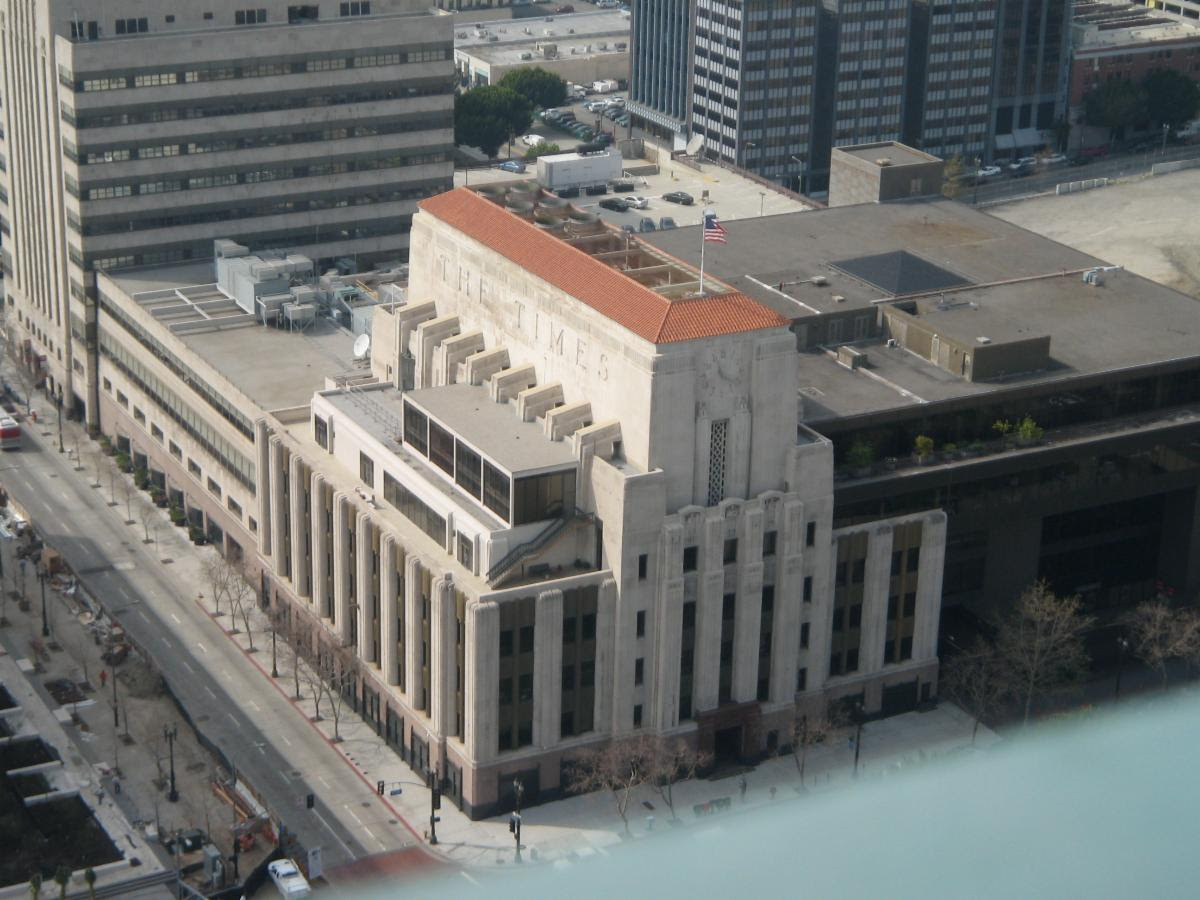
FormerLATimesBuilding
The former Los Angeles Times building in the city’s downtown area.

“What a sad day for sports journalism (and journalism in general). The New York Times announced it has scrapped its sports section entirely. The Los Angeles Times (with which I cut my teeth in journalism) will no long carry baseball box scores and standings. The Southern California News Group just bought the San Diego Union-Tribune, which will diminish the quality of that paper. I hate to say it, though I’ve thought it for awhile, newspapers are dead. They just don’t yet know it.”

— John Strege, veteran journalist

——

Today, for your reading enjoyment, we have Jim Murray’s 1978 column that was headlined ‘A Peek at 1984’ — ”noting that “a computer programmed to crank out sports stories is just a couple of transistors away.”

ENJOY!

——

WEDNESDAY, AUGUST 9, 1978, SPORTS

Copyright 1978/THE TIMES MIRROR COMPANY

JIM MURRAY

A Peek at 1984

  They changed the phone system and numbers at The Los Angeles Times for the first time since the days of the crank telephone the other day. It’s all in the name of automation, but you’ll pardon all of us ink-stained wretches if it mondaysmurraymakes us a little nervous. I mean, today the phones, tomorrow the staff. 1984 is a little nearer. Big Brother is coming. If they automate the phones, when will they automate the stories? What will become of Hildy Johnson? Will Grantland Rice be made out of tin in the future? Damon Runyon a data bank? Richard Harding Davis just a lot of circuitry with a passport?

  A computer programmed to crank out sports stories is just a couple of transistors away. Of course, it will have to be programmed. First, if they listen to us, it will have to learn a few basics. Such as the questions:

  “What kind of a pitch did he hit?” Which must be asked of a pitcher who has just lost a World Series in the bottom of the 12th, 1-0. The computer must be programmed to duck as it asks. Otherwise, the paper is stuck with the biggest hunk of scrap metal this side of the stretch at Indy.

  The computer will have to learn to enter the dressing room of a fighter who has just been carried in with (1) a broken nose, (2) broken ribs, (3) black eyes, (4) a dented Adam’s apple which will make him sound like a ransom call the rest of his life, (5) hemorrhages on both arms, (6) blood trickling out of an ear, (7) teeth trickling out of his mouth. It will have to ask: “Did he hurt you at any time, Bat?” If the fellow is still conscious, or at least alive, teach your computer to lean down and ask, “Would you like to fight him again?”

  Your computer will have to learn to be resourceful. Look for the pithy quote even when you don’t get it from the athlete. If a golfer shoots 80 and says, “I kept hitting it into sand traps,” you quote him for the headline, ‘Needed Camel, Not a Caddy’ Says One-Putt Of His 80. The quote will make all the anthologies, and within a week, One-Putt will think he actually said it.

  When you go into the locker room with a guy who just went 0-for-5 and struck out in the bottom of the ninth with the bases loaded and he says, “Get outta here, you four-eyed hunk of tin before I take a can opener and make you look like a totalled Toyota!” you make a few subtle changes. “Your headline: ‘Feeling So Strong it Frightens Me,’ Says Slugger, Despite 0 for 5.”

  Your story quotes the guy, “‘Tomorrow we turn these guys into pumpkins. Hope he throws me that knuckler one more time. He’ll be eating it for a week.’”

  Stories without quotes will be even easier. Just keep a stock of standing headlines. “Rams Blow Super Bowl to Minnesota Again” is good any December. Even the story accompanying it will just need blanks to be filled in: “The Los Angeles Rams blew their chances for the Super Bowl again this year when the Minnesota Vikings defeated them because of (choose one) a blocked field goal, intercepted pass, rainstorm, sunshine, heavy overcast, superior coaching, or all six.”

  And with baseball, remember that the fans like figures, and give them to them: “The Los Angeles Dodgers drew their 4 millionth fan, sold their 16 millionth hot dog, tapped their 5 millionth barrel of beer, sold their 3 millionth bobblehead doll and had their 2,709th straight overflowing parking lot yesterday. The message board saluted the 2 millionth septuagenarian couple from Nepal, welcomed the 150,000th Rotary Club, and announced that next Saturday will be ‘Mafia Night,’ with everyone carrying a violin case or horse’s head to be admitted free.”

  Basketball will be no problem. Keep this standing story: “The (leave blank name of franchise) today signed All-American center Tom (Treetop) Tarheeler, the all-time Atlantic Coast Conference scorer with 1,000 points a game, to a multiyear, no-cut contract believed to call for Rhode Island, downtown Dallas, parts of Wilshire Boulevard and the mineral rights to the Gulf of Mexico.

  “The deal also includes his parole officer, the judge who validated the three previous contracts he put his ‘X’ on and the playground director who taught him not to bite people on court.”

  Auto racing? Easy. Just remember death is a mar in auto racing. As in, “Leadfoot Lonergan won the 57th running of the Fireball 500 today in a race marred by the death of . . .” You just have to fill in the number of drivers and/or spectators.

  In bullfighting, remember death is not a mar, it’s a must. If the bull doesn’t die, well, he gets bad notices.

  Don’t worry about statistics. Just feed your machine a daily diet of bubble-gum cards and it will know more sports trivia than a Boston cop.

  After a year or so on the beat, though, your machine will begin to act strange. It will keep its hat on in the office. It will begin to drink. It will begin to speak of the home team as “we.” It will get sick of people asking, “What’s wrong with the Rams?” It will start to complain about box lunches, the Rams offence, and the amount of space it gets for its story. Its mate may start to hope the home team doesn’t make the playoffs so it can stay home for Christmas for a change.

  And then will come the day when it will start to write about a mark being set for right-handed, half-Portuguese, half-Italian third basemen, about the “Z-outs” run by the tight ends, and it will start storing up non-winning fractions in dual meets — and you’ll know it’s the beginning of the end.

——

Jim Murray Memorial Foundation | 25 Main St, Cooperstown, NY 13326

Mondays with Murray: Aw, Shucks, City Slickers Win It Again

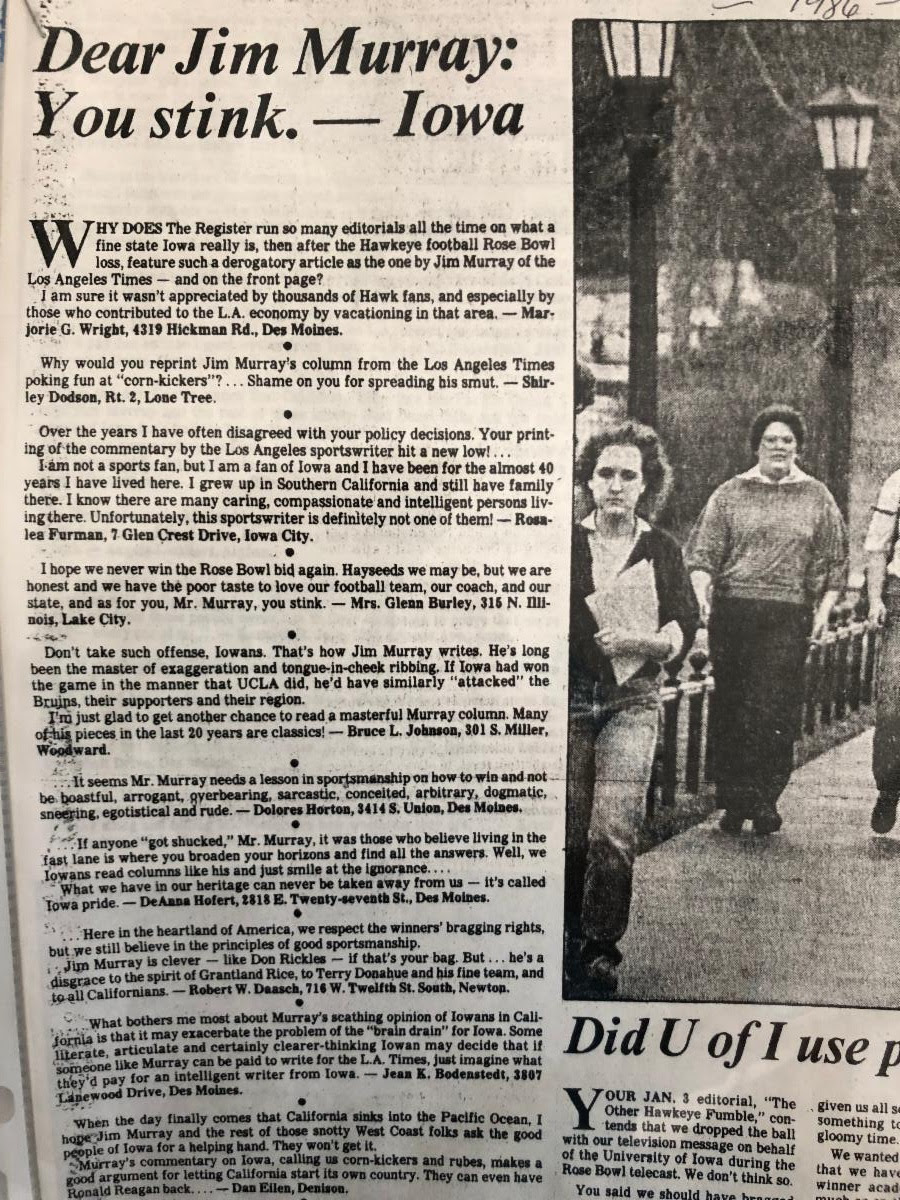
Today we take you back to Jan. 2, 1986 when Jim Murray took on the state of mondaysmurray2Iowa in his column and created a backlash that not only got him banned from the state by the governor but also made him the target in a news article headlined ‘Dear Jim Murray: You Stink — Iowa’.
ENJOY! 

——

Murray

THURSDAY, JANUARY 2, 1986, SPORTS

Copyright 1986/THE TIMES MIRROR COMPANYJIM MURRAY

Aw, Shucks, City Slickers Win It Again

Well, I guess the good old American farmer is in worse trouble than we thought.

A bunch of corn-kickers from Iowa came out to the big city for New Year’s and got shucked again.They came out with the egg money and blew it on the wrong shell again. They’re going home, so to speak, with a deed to the Brooklyn Bridge and a watch that loses an hour a day and turns green on their arm.

It’s getting embarrassing. Another defeat for home cooking and mom’s apple pie. Quiche is better for you.Throw away the fudge. We’re beginning to wonder what’s so great about the Fourth of July, picnics in the park, rhubarb and homemade jelly.

I mean, you’re going to have to start covering your eyes when these guys come to town in the family Winnebago with their pacemakers and the chicken salad. I bet they didn’t even get Bob Hope’s autograph or get to see Tom Mix’s footprints in the Chinese Theater.

These people are the salt of the earth. They feed the world.They just can’t play football.

They can butcher hogs, grow grain. Why, we wouldn’t have frosted corn flakes if it weren’t for them.

But when they get to the Rose Bowl, they act like guys who just got off a truck with a straw suitcase and the rent money sewn into their jackets. They’re ripe for the old pigeon drop and other bunco games the city slickers put on them in wicked old L.A., where people take their clothes off in the picture shows and drink beer from a bottle. You folks all know the kind of things they do right there in L.A. And with the shades up, too.

Whatever happened to Midwest verities, to Big Ten football? Don’t they go down in the coal mines for players anymore? Don’t they fan the corn rows for the boys who can plow without a horse and lift a tractor with one hand anymore? Doesn’t anybody make biscuits and gravy anymore?

It’s enough to make you afraid of America. How you gonna keep ’em down on the farm if they keep getting beat, 45-28?

It isn’t as if they hit the bright lights. Iowa’s coach kept his football team from visiting the fleshpots of L.A., like Knott’s Berry Farm and Marineland and other dens of iniquity. He wouldn’t even let them eat out. Iowans don’t hold with going where you’ve got to order off a menu. I never saw so much potato salad in my life.

Rodeo Drive got a good leaving-alone from them, too. They don’t buy anything that doesn’t come in a catalogue — or give coupons.

But, this time, they thought they really had the team that was slick enough to make them proud. Iowa doesn’t come to the Rose Bowl that often that it can afford to get its hat pulled down over its ears and a note pinned on its back reading “Kick me.”

The last time Iowa came to the Rose Bowl, it didn’t even score (28-0), but its coach, Hayden Fry, thought he could spot the trouble right away. It was going to Disneyland and all that honky-tonking, as he called it. Also, eating roast beef in a place that had tablecloths. I mean, how could a guy keep his mind on football in a place that had merry-go-rounds and monorails and Mickey Mouse? The biggest threat to morals since pictures started to talk.

That kind of surprises you about Hayden, who looks like a pretty good city slicker himself. I mean, he’s not Broadway Hayden, but he does look like a guy who has peeked at a hole card himself now and again. In fact, he might have known what it was when he dealt it. Hayden is a traveling man from Texas, and people who have played with him there say you better be sure to cut the cards.

But, Hayden not only sheltered his team from the temptations of the magic kingdom, he didn’t even bring his team out here till the dark of night, five days before kickoff. He didn’t land in wicked L.A., he chose a windsock airport out in the boonies, and his team came in wearing dark glasses like spies.

Now, any man who chooses to prepare his team for a game in 80-degree temperature in a state where 20-above is a balmy day has got to be a guy who would let you bring your own deck. Getting ready for a game in a field house you have to steam heat to 85 in preference to a place where to get 85, you only have to open the doors, is missing a point somewhere. Practicing indoors is smart only if you’re going to play indoors. And something other than football.

But Hayden Fry didn’t lose the game, a guy named Eric Ball won it.

The history of the Rose Bowl is fecund with tales of second-stringers who came in and turned the game around and on its ear. Doyle Nave comes to mind with last-second heroics in the 1939 game, but nobody ever took over a Rose Bowl game any more thoroughly than Eric Ball did Wednesday. All he did was rush for 227 yards and four touchdowns. He put the ball in position for the fifth touchdown, which was inches away from the goal line on third down, when the coaches let the quarterback sneak it over, for reasons best known to themselves. Five TDs would have been a record.

The extraordinary thing about Eric Ball is not what he does, it’s where he’s from. He was raised in Ypsilanti, Mich., and for those of you unfamiliar with the geography there, that’s about a two-mile walk from the University of Michigan Stadium and a local call from coach Bo Schembechler’s office.

Eric probably saw something in Big Ten football before the rest of us, because he didn’t stop going till he got 2,000 miles from it. “He came in with his father to visit — it wasn’t a tough recruit at all,” UCLA coach Terry Donahue revealed.

Eric was a candidate for a rubber room on the last day of the season when, with the ball on the USC goal line and the winning touchdown and Rose Bowl in full view, he tried to dive across the line. He made it. The ball didn’t. The ball popped so high in the air it came down with snow on it. It came down in the arms of USC’s Marcus Cotton and, if Arizona State hadn’t lost that night, Eric Ball might have spent New Year’s in hiding instead of in spotlights.

Coach Fry seemed to think in a complete state of shock after the game. “We were completely annihilated,” he whispered. “That (UCLA) is the finest group of athletes we have ever played against. We couldn’t stop them. Nobody could stop them. Obviously, if they played all season like they played tonight (sic) they’d be the national champions. We held Michigan to nine first downs. UCLA made, what, 29 first downs? Michigan was supposed to be No. 3, but Michigan couldn’t hold a light to this bunch.”

What of Eric Ball? He was asked. “Ball?! Hell, I couldn’t tell him from the rest of them. What’d they have — a hundred? They all ran by us.”

Should he have let his team visit the sin palaces of Disneyland and the berry patches? “Do you realize what the score would have been if I let them go honky-tonking around?” demanded Fry, indignantly.

Actually, he probably should have brought his players out in August and let them have the run of Sunset Boulevard and the Playboy Mansion and wear a neckful of gold chains and shoes without socks and smoked glasses and eat quiche. Down Home America ain’t what it’s cracked up to be anymore. River City better wise up.

Reprinted with the permission of the Los Angeles Times

Jim Murray Memorial Foundation P.O. Box 661532, Arcadia, CA 91066

——

After a successful 20-year run, the JMMF dissolved and distributed its remaining financial assets to the National Baseball Hall of Fame in Cooperstown, N.Y., to create the Jim Murray Sports Communications Scholars Program at the National Baseball Hall of Fame and Museum.

The National Baseball Hall of Fame and MLB share significant and timeless overlapping history with Jim Murray. He wrote more columns on baseball than he wrote on any other sport, bringing baseball’s history and legends to life through sports journalism.

The Jim Murray Sports Communications Scholars Program at the National Baseball Hall of Fame and Museum is expected to continue in perpetuity or until contributions to the program are exhausted. The HOF’s development team created a special link specifically for donations designated to this program.  Please note that this page will exist in tandem with a new webpage to come this spring ’23 with all info necessary for prospective students to apply.

CLICK HERE TO VISIT THE NEW HOF/JMMF WEBPAGE supporting its new Jim Murray initiative.

Meanwhile, for those of you wishing to make a donation by check, please make payable to: 

National Baseball Hall of Fame 

and mail to:

National Baseball Hall of Fame and Museum, 25 Main Street, Cooperstown, NY 13326

Please specify: Jim Murray Scholars Program

The JMMF is extremely grateful to all our donors over the past two decades.  You have helped ease the financial burden of a college education while helping to share the work of one of, if not THE best sportswriters in the world.

Baseball Hall of Fame non-profit 501(c)(3) #15-0572877 

Preserving History. Honoring Excellence. Connecting Generations.

Mondays With Murray: The One and Only

The 2022 FIFA World Cup is scheduled to take place in Qatar, Nov. 20 through Dec. 18. This will be the first World Cup to be held in the Arab world, and the second held entirely in Asia, after the 2002 tournament in South Korea and Japan. In addition, the tournament is scheduled to be the last with a 32-team field; it is to increase to 48 teams for the 2026 tournament in the United States, Mexico and Canada. 

 Pelé Pelé, born Edson Arantes do Nascimento on Oct. 23, 1940 in Três Corações, Brazil, is likely the most famous and possibly the best paid athlete in the world. Pelé was part of Brazilian national teams that won three World Cup championships — 1958, 1962 and 1970.

Today we bring you Jim Murray on the legendary Pelé, the’Black Pearl of the Brazilian Planalto.’ 

ENJOY! 

——

SUNDAY, APRIL 9, 1978, SPORTS

Copyright 1978/THE TIMES MIRROR COMPANY

JIM MURRAY

The One and Only

They may be the best-known four letters in all sport. P-E-L-E.

Certainly, R-U-T-H was never known in places where P-E-L-E is. A-L-I may mondaysmurray2give him a run for it but there are parts of the world where, if the two of them were together on a platform, the audience would wonder “Who’s up on that platform with Pele.”

They used to scribble in the high school annuals or class autograph books “Fate tried to conceal him by naming him ‘Smith.’ ” Fate tried to conceal Pele by naming him “Edson Arantes do Nascimento.” But the first time they saw him kick a soccer football, he was “Pele,” one of the most felicitous fittings of word to deed in the annals of athletics.

“Pele” doesn’t mean anything in Brazil. Or, rather, it means everything. It means only the man who owns it, the world’s greatest soccer player, maybe the world’s greatest athlete.

Kings’ hands trembled when they shook hands with him. The Pope was awed. The Shah of Iran waited three hours in the rain just to shake his hand. He is an honorary citizen of the world. Wars have been halted when he came to town. Chinese border guards put down their rifles when he passed through.

**********

More than 140 countries worldwide take part in the World Cup of soccer. Only 16 get to the finals. Which are held every four years. Pele’s teams have won three World Cups, and astonishing performance. Pele is the only man in the world to play on three world championship teams in his career.

He has scored almost 1,300 goals, almost three times as many as anyone else who ever played the game. They knighted a guy in England once for reaching the incredible plateau of 500 goals. Pele scored virtually a goal a game through his career. He scored his first on Sept. 7, 1956. He may score one last time on the night before his funeral. Pele will die in front of a net — of very old age.

Because a goal in club soccer is like a home run in major league baseball, Pele’s goal-a-game pace, translated to more-understandable (to Americans) sports, boggles the imagination. Babe Ruth would have had to hit 2,503 home runs instead of the 714 he did. Henry Aaron would have had to hit 3,298 instead of 755.

**********

You would think from the foregoing that Edson Arantes do Nascimento would be built along the general lines of Godzilla or the-creature-that-ate-Topeka, that he would have three or four eyes, one more leg than anyone else and would be able to jump 80 feet straight up in the air.


Actually, he’s a little nearsighted. He’s barely 5-9. He weighs 160 pounds. To be sure, he can see 360-degrees around him, he has Olympic sprinter speed. He can kick a ball through a designated window of a moving train from 90 yards, he can curve it around a goaltender like Koufax could throw it around a bat. He could kill a squirrel with a football from 60 yards and he could dribble a cannonball through the whole West German team — or army — from goal-to-goal in 15 seconds.

He pioneered the so-called “bicycle kick” in which the player turns his back to the direction he’s going to shoot the ball, then levitates with the ball on his instep until he’s lying parallel to the ground like a body on wires in a magic act — and then sends the ball sizzling accurately back over his head into a net or at a teammate.

His ball travels just slow enough not to ignite in flight.


Pele, at 38, has been a man with-a-mission. His job is to take the world’s most popular outdoor sport and make it popular in the one land that had resisted it. It was a little as if they asked Babe Ruth to spend his declining years popularizing baseball in Tibet but, as usual, Pele delivered the ball safely to the net. Sellout crowds came out to see this “Black Pearl of the Brazilian Planalto” as if he were a living King Tut exhibition.


Pele doesn’t need soccer, soccer needs him. He is one of the richest men in Brazil, he’s on more TV commercials than Ford cars. He is Madison Avenue’s dream, good-natured, personable, dependable, doesn’t drink or smoke, is happily married, has no interest in Disco 54, is a practicing Catholic. He smiles all the damn time.

In Brazil, he ranks just below coffee as a natural resource. He’s the only guy in the country with a statue without a gun in his hand or a ball under him instead of a horse.


He is in town to appear when the New York Cosmos play at the Rose Bowl today against the L.A. Aztecs and to promote his biography, “Pele, My Life and The Beautiful Game” with Robert L. Fish.


He won’t play, only appear. But not going to see Pele is like not getting up to see a solar eclipse, pulling the shades going past Niagara Falls, not looking up when a great man passes, or not going to Paris on a trip through Europe. It’s your loss. You’re going to hate yourself someday. Because there’s nothing like him on the horizon.

Reprinted with the permission of the Los Angeles Times

Jim Murray Memorial Foundation P.O. Box 661532, Arcadia, CA 91066

——

The Jim Murray Memorial Foundation’s mission is to establish a permanent legacy to Jim Murray. The JMMF has joined forces with the National Baseball Hall of Fame in Cooperstown, N.Y. The National Baseball Hall of Fame and MLB share significant and timeless overlapping history with Jim Murray. Jim Murray wrote more columns on baseball than he wrote on any other sport, bringing baseball’s history and legends to life through sports journalism.

The JMMF will continue its “Mondays with Murray” posts indefinitely with a link to the Cooperstown Baseball Hall of Fame website supporting its new Jim Murray initiative. The JMMF will dissolve its 501(c)(3) status and distribute its remaining financial assets to the Hall of Fame.

Baseball Hall of Fame non-profit 501(c)(3) #15-0572877

Preserving History. Honoring Excellence. Connecting Generations.

info@jimmurrayfoundation.org|

www.jimmurrayfoundation.org

Mondays With Murray: Merv Picked Right Racket? Oh, Really? 

Merv
The late, great Merv Griffin.

Two sporting events wrap up on Sunday — the 2022 U.S. (Tennis) Open and the Del Mar racing meet.

Today, we pay tribute to TV host and media mogul Merv Griffin (July 6, 1925 – Aug, 14, 2007), who loved tennis and race horses. Merv raised thoroughbred horses at his ranch in La Quinta, Calif. His colt Stevie Wonderboy, named after Stevie Wonder, won the 2005 Breeders’ Cup Juvenile.

Jim Murray’s column from Sept. 17, 1987, throws the spotlight on Merv’s love for the game of tennis.

ENJOY!


THURSDAY, SEPTEMBER 17, 1987, SPORTS

Copyright 1987/THE TIMES MIRROR COMPANY

JIM MURRAY

Merv Picked Right Racket? Oh, Really?

The richest man on Sunset Boulevard was driving along it, idly listening to the car radio. The announcer broke for a commercial message, promising to come right back with the name of the man who, according to Forbes Magazine, was currently the richest man in the entertainment industry. The driver vagrantly mondaysmurray2wondered who it might be. Bob Hope? Aaron Spelling? Bill Cosby? A moment later, he almost crashed into a curbside tree.

“It was me!” recalls Merv Griffin in wonderment. “I had to pull off to the side of the road and sit there hyperventilating. I thought, ‘How dare they?!’ I glanced into cars going by and wondered whether they were listening to the same program. I hoped not.”

Merv Griffin arrived at his high estate, driving along and finding himself one of the richest men in town, from a standing start as a guy who used to stand in front of Freddy Martin’s band in the Coconut Grove and sing “I Got a Lovely Bunch of Coconuts.”

Actually, Merv is the black sheep of the Griffin family. He comes from a long line of championship tennis players and they thought he might follow in the tradition. Uncle Clarence was three times U.S. men’s doubles champion with the storied William (Little Bill) Johnston, and another time was runner-up at Forest Hills with John Strachan. Uncles Milton and Elmer were world-class players, as was his father, Mervin, Sr.

“We all had lace curtain Irish names,” explains Merv.

The family parlor might have had muslin, but the lace curtain Griffins were very big in the ad court.

Merv Griffin Jr. drifted south from his San Francisco and abandoned his tennis roots. He became the band singer for Martin’s long run at the Grove. “It was the place for Hollywood in those days. Howard Hughes was there every night. Van Johnson used to grab the mike and sing. Bing Crosby used to dance by and say ‘Don’t pronounce your words so carefully, San Francisco. Slur them a little bit.’ ”

********
Hollywood as they say, beckoned, and Merv became the lead in such non-Academy epics as “Cattle Town,” “So This Is Love” and “By The Light Of The Silvery Moon.” Winces Merv: “I was supposed to be Doris Day’s co-star. But I photographed too young.”

It was tennis that got him out of films. “I hated the movies. One day, Uncle Elmer had a chance to play Jack Warner in tennis. ‘I can let him win and save your job,’ his uncle warned Merv. “Kill him!” instructed his nephew. The uncle mowed the Warner brother down in straight sets, love-love, and Merv was suddenly in New York on daytime television.

It was the day of the quiz show scandals in New York, but Merv’s shows were as honest as Uncle Elmer’s tennis and he was soon whisking from his run on Broadway’s “Finian’s Rainbow” to center stage on such classics of the game-show genre as “Play Your Hunch,” “Keep talking,” and “Word For Word.”

It was when he sat in for Jack Paar on the Tonight Show (pre-Carson) that his career took off. Merv Griffin had such a disingenuous air about his questioning that his guests frequently found themselves blurting their most intimate secrets and emptying all their closets with an alacrity that fascinated audiences.

“Merv was so disarming they would forget they were on national TV and get to thinking they were talking to Merv on the bar car of the New York-New Haven-and-Hartford,” an associate remembers. “Merv would just sit there and say ‘Oh, really!’ and ‘You’re kidding!’ and they would fall all over themselves to tell him things they never told anybody.”

Once, when Merv had on the deposed vice president, Spiro Agnew, his producer came to him in despair. “We can’t talk about anything!” he wailed. “Look at the list of things that are off-limits! The most controversial thing on the show will be ‘Hello!’ ”

Merv just smiled. “Don’t worry,” he soothed. “Just start the camera.”

Viewers remember that, but the end of the show, Merv was getting away with questions like “And then what did you steal?”

The Merv Griffin Show was an American institution. Congressmen, thieves, athletes, movie queens, diplomats took his couch. Merv acted as if he were in awe of all of them and played a part that was part autograph-seeker and part prosecutor. The show was more fun than a bugged confessional. It was impossible not to watch — like seeing a guy walk a ledge in a snowstorm.

Merv tried to maintain his little-boy-in-the-big-city approach, but he was as sophisticated as any of his film-star guests. Once, when he was singing at the Palladium, a young Hollywood High student was president of his fan club. A girl named Carol Burnett.

But Merv never forgot the fantastic popularity of the game show as a television staple. He put together a pair that were to become the biggest money-makers in the history of the breed and put Merv in the capital grouping that used to belong to guys who owned railroads or oil fields.

“Wheel of Fortune” became the most watched game show of all time before Merv sold it to Coca Cola for a quarter of a billion dollars. “Jeopardy” was a favorite game show from the White House to the firehouse.

Merv picked Vanna White out of a pile of photographs to dress “Wheel of Fortune.”

“Which face looks out at you?” he challenged his staff.” You can’t have a guy with a ladder going out there changing letters.”

But Merv never got too far from his serve-and-volley background. Like all the Griffins, he yearned for a spot on center court. He played life as if the point were always deuce, but he played tennis to relax.

His involvement took the form of organizing some of the earliest celebrity tournaments (he credits Clint Eastwood with pioneering them) and this weekend he hosts the Merv Griffin Tennis Tournament at the Riviera Tennis Club as part of the week-long Mita Festival, which annually raises more than a million dollars for United Cerebral Palsy. Bjorn Borg, Stefan Edberg and John McEnroe (if his baby is born) are expected.

For Merv, it’s a natural outgrowth of a lifetime of being able to say “Oh, really?” and “No kidding?” on TV with a perfectly sincere straight face. It’s the show biz equivalent of the high lob which the opponent smashes into the net. That shot is a Griffin family tradition. Not only puts you in the finals at Forest Hills but on the cover of Forbes Magazine.

Reprinted with the permission of the Los Angeles Times

Jim Murray Memorial Foundation P.O. Box 661532, Arcadia, CA 91066

——

The Jim Murray Memorial Foundation’s mission is to establish a permanent legacy to Jim Murray. The JMMF has joined forces with the National Baseball Hall of Fame in Cooperstown, N.Y. The National Baseball Hall of Fame and MLB share significant and timeless overlapping history with Jim Murray. Jim Murray wrote more columns on baseball than he wrote on any other sport, bringing baseball’s history and legends to life through sports journalism.

The JMMF will continue its “Mondays with Murray” posts indefinitely with a link to the Cooperstown Baseball Hall of Fame website supporting its new Jim Murray initiative. The JMMF will dissolve its 501(c)(3) status and distribute its remaining financial assets to the Hall of Fame.

Baseball Hall of Fame non-profit 501(c)(3) #15-0572877

Preserving History. Honoring Excellence. Connecting Generations.

info@jimmurrayfoundation.org|

www.jimmurrayfoundation.org

Mondays With Murray: 24 years later, Jim Murray’s final column

Jim Murray passed away on Aug. 16, 1998 — 24 years ago. . . . There are hundreds of columns that we could share with you on this day of memorial. . . . There really isn’t one column that could sum up the life and career of Jim Murray.  The folks at Columbia University agreed when they honored Jim with a Pulitzer Prize for his “body of work.”

Today we celebrate his legacy with the last column he wrote for the L.A. Times on Aug. 16, 1998, the day he died.

His final line:

“Anyway, it’s nice to know getting older has its flip side.”

ENJOY!

——

SUNDAY, August 16, 1998, SPORTS

Copyright 1998/THE TIMES MIRROR COMPANY

JIM MURRAY

You Can Teach an Old Horse New Tricks

Del Mar — Well, it was a slam dunk for Free House, a “Where is everybody?” win.

The Bridesmaid finally caught the bouquet. The best friend got the girl in the Warner Bros. movie for a change. The sidekick saves the fort.

Free House just won’t fold the hand. Three times last year, in the most mondaysmurray2publicized races in the sport, he chased his competition across the finish line in the Kentucky Derby, Preakness and Belmont. In the money in all of them, in the photo in one of them, he was the hard-luck champion of horse racing.

He was expected to go quietly into the sunset. A game effort but no cigar.

He got a measure of revenge Saturday in the Pacific Classic here. He ran away from Touch Gold, who beat him in the Belmont. The horse who beat him in all three Triple Crown races, Silver Charm, didn’t make the dance or he might have gotten a different view of Free House, too.

The Pacific Classic is not your Run for the Roses. No bands play Stephen Foster as the horses come on the track. But it’s not your basic overnight allowance, either. It’s a $1-million race, major on the schedule. It’s a very big win for Free House. He’s not What’s-His-Name anymore. He’s Who’s Who.

You know, in most sports, the athlete gets a generation to prove himself. A Jack Nicklaus wins his first major at 22 and his last at 46. A George Foreman wins Olympic boxing gold in 1968, and 30 years later he’s still fighting. Babe Ruth hits his first home run in 1915 and his last in 1935.

But a racehorse has to act like he’s double-parked. He gets only months to prove he has been here.

And if his prime coincides with that of Man O’War, Citation, Secretariat or even Count Fleet, he might as well have been born a plow horse.

What did Free House do that turned him into a star? Well, he got older.

You know, it’s the public’s notion that the racing begins and ends with the Kentucky Derby and its Triple Crown satellites. Everything else is New Haven.

Trainers know better. Every real horseman knows a colt’s (or a filly’s) 3-year-old season is not indicative of real prowess. I mean, a Kentucky Derby is not only too early in the career, it’s too early in the year.

It has been won by a lot of horses who are just better than claiming horses. It has been lost by a lot of horses who were too good to have that fate. Native Dancer comes to mind. Gallant Man. Damascus. Bold Ruler.

Of course, a horse doesn’t know whether he won the Kentucky Derby or not. But his owner does. His rider does. History does.

But trainers as a class manage to hold back their enthusiasm. There’s even evidence a trainer resents a Triple Crown race.

That’s where a Pacific Classic comes in. It’s a trainer’s race. A real test of his skill in bringing a horse up to a race. The real business of racing.

A Kentucky Derby can be a crapshoot. Not a Pacific Classic. You win a Pacific Classic because you’re at the top of your game, not because eight other horses were still wet behind the ears. Many a Derby has been blown by an immature runner jumping shadows, spitting bits, lugging out, horsing around.

Not a Pacific Classic. Here, the horses are all grown up, professional. These are the true class of the sport, older horses. Dependable, crafty. Consistent. They don’t beat themselves.

There probably has never been a good older horse who couldn’t beat a good 3-year-old. It’s so taken for granted, they have to give the kids weight. Handicap horses used to be the glamour stars of the track anyway. They made a movie about Seabiscuit, who never ran in the Triple Crown and never got good till he got middle-aged. They wrote poems about John Henry, who never did either, even though he ran in 83 other races. They used to Equipoise “The Chocolate Soldier.” Exterminator, called “Old Bones,” ran 100 races.

They were the heart and soul of racing.

Free House bid fair to join them Saturday. He won so easily, jockey Chris McCarron should have brought a book. He rode him like the Wilshire bus. “You could have ridden him today!” he called out to Free House’s co-owner Trudy McCaffery.

McCarron rode such a confident race, he remembers thinking, “If I were a cocky individual, I would have turned to the other riders and said “Shame on you!”

Added McCarron, “This horse is so generous with his speed, I knew if he ran the way he trained, these guys were beat.”

He has one holdover from his misspent youth: He tends to kick out sideways and decelerate in the stretch, almost start to tap-dance. “He gets to wondering where everybody went and to want to slow down and wait for them,” McCarron explained. McCarron hustled him across the finish line four lengths ahead of second-place Gentlemen on Saturday and about 16 lengths ahead of Touch Gold.

Ironically, McCarron rode Touch Gold to victory in the Belmont.  

So, is he glad the order was reversed Saturday? Is yesterday’s jinx horse today’s king of the handicap division?

“Arguably,” said McCarron, “a case could be made.”

Anyway, it’s nice to know getting older has its flip side.

Reprinted with the permission of the Los Angeles Times

Jim Murray Memorial Foundation P.O. Box 661532, Arcadia, CA 91066

——

The Jim Murray Memorial Foundation’s mission is to establish a permanent legacy to Jim Murray. The JMMF has joined forces with the National Baseball Hall of Fame in Cooperstown, N.Y. The National Baseball Hall of Fame and MLB share significant and timeless overlapping history with Jim Murray. Jim Murray wrote more columns on baseball than he wrote on any other sport, bringing baseball’s history and legends to life through sports journalism.

The JMMF will continue its “Mondays with Murray” posts indefinitely with a link to the Cooperstown Baseball Hall of Fame website supporting its new Jim Murray initiative. The JMMF will dissolve its 501(c)(3) status and distribute its remaining financial assets to the Hall of Fame.

Baseball Hall of Fame non-profit 501(c)(3) #15-0572877

Preserving History. Honoring Excellence. Connecting Generations.

info@jimmurrayfoundation.org|

www.jimmurrayfoundation.org