
The Western Canada Professional Hockey Scouts Foundation will hold its second annual Wall of Honour induction dinner in Okotoks on July 29. This time, we will salute 29 past and present-day scouts during an evening that is being billed as A Night With the Sutters. Yes, members of the hockey-playing Sutter family will be on hand to take part in a hot stove session or two. Tickets for the dinner are available at tickets.hockeyscoutsfoundation.com. . . . As dinner time approaches, we are highlighting the Class of 2025. This time, we would like to introduce you to Tom McVie.

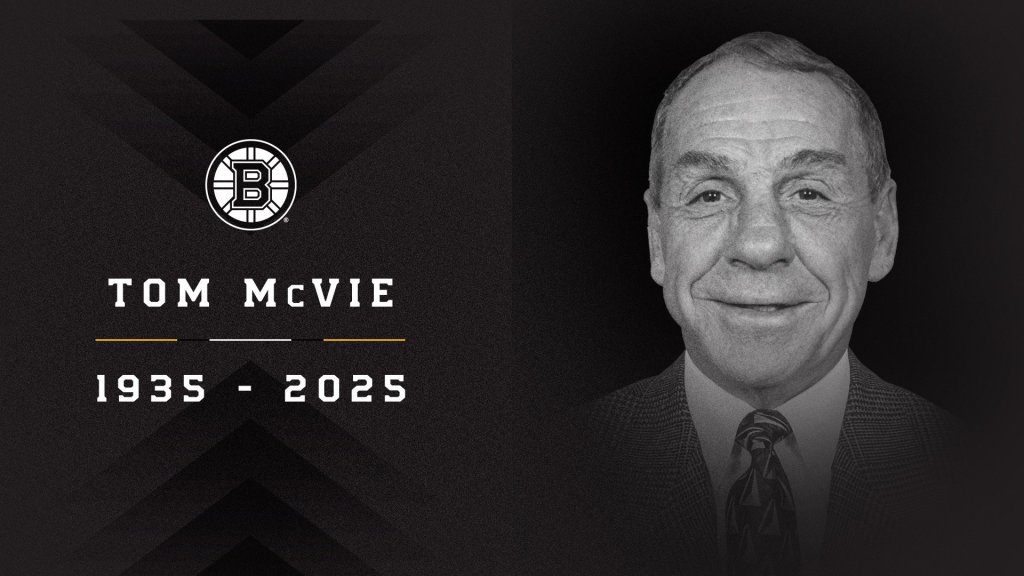
TOM McVIE
(June 6, 1935 — Jan. 19, 2025)
Born in Trail, B.C., he was long-time player and coach who didn’t go scouting until he was in his 60s. . . . Joined the Boston Bruins’ pro scouting staff in 1998 and worked through 2019-20. Won a Stanley Cup with the 2010-11 Bruins. . . . Got into 1,072 games over 18 seasons during his pro playing career, mostly in the WHL with the Seattle Totems, Portland Buckaroos, Los Angeles Blades and Phoenix Roadrunners. Also played in the EHL and IHL, retiring after 1973-74. . . . Coaching career that lasted 27 seasons began in 1971-72 as player/coach of the IHL’s Fort Wayne Komets. . . . Was NHL head coach with the Washington Capitals, New Jersey Devils and Boston. . . . Won the 1978-79 WHA championship (Avco Cup) as head coach of the Winnipeg Jets. . . . Was one of the game’s great storytellers.
———-
The Wit and Wisdom of Tom McVie
Tom McVie was a rink rat, a hockey lifer, and he was proud of it.
Once asked what he might be doing if he wasn’t coaching, McVie replied: “If I wasn’t coaching hockey, then I’d probably be driving the Zamboni.”
McVie, who will be inducted into the Western Canada Professional Hockey Scouts Foundation’s Wall of Honour on July 29 in Okotoks, Alta., died in Camas, Wash., on Jan. 19. He was 89.
(Tickets for the dinner — the evening will include a Hot Stove session or two involving members of the hockey-playing Sutter family — are available at tickets.hockeyscoutsfoundation.com.)
Camas is located across the Columbia River from Portland and became McVie’s adopted hometown following his retirement as a player.
He spent 14 seasons playing in the WHL, splitting time with the Portland Buckaroos, Los Angeles Blades, Seattle Totems and Phoenix Roadrunners.
McVie and the Totems won a WHL title in 1958-59, as he played on a line with Guyle Fielder, now 94, and Jim Powers, 89.
As Powers told Geoff Baker, the Seattle Kraken’s vice-president, editorial: “I don’t think there was a joke that he ever forgot. And he would keep repeating them from time to time.”
Indeed!
After ending his playing career, McVie coached from 1973-74 through 1997-98, making stops with the IHL-Dayton Gems, NHL-Washington Capitals, WHA-Winnipeg Jets, NHL-Jets, CHL-Oklahoma City Stars, AHL-Maine Mariners, NHL-New Jersey Devils, AHL-Utica Devils, NHL-Boston Bruins, ECHL-Wheeling Nailers and AHL-Providence Bruins.
After being fired by the NHL-Jets, McVie was quoted as saying: “I’ve been fired more times than General Custer’s pistol at the Little Big Horn.”
Later, after being fired by the New Jersey Devils, he said: “I’ve been fired more times than Clint Eastwood’s Magnum.”
By now you may have guessed that McVie knew his way around one-liners and also could tell a story. In fact, he was recognized throughout the hockey world as one of the game’s great story-tellers.
Here then is a look at some of those stories . . .
Former NHL D Rick Green was a rookie with the McVie-coached Washington Capitals in 1976.
“Tommy was the first man I ever knew who could put two pucks in his mouth at the same time,” Green told nhl.com following news of McVie’s passing. “That’s a talent. I guess his nickname was ‘The Clown’ back in the day when he played in the International league, so you needed a sense of humor back then.
“Someone told me about the puck trick so I went up to him and told him I didn’t believe it. Tommy just took his teeth out, grabbed two pucks and in they went.”
——
In October 1992, McVie talked luggage with Kevin Paul Dupont of the Boston Globe, explaining how he used one Samsonite suitcase for 32 years:
“My first two years of pro hockey, I never had a piece of luggage. I was playing for Seattle — Keith Allen was the general manager — and I got hurt in Calgary on a trip that was going to Edmonton. Well, they decide to send me home, and Allen takes my meal money; that’s the way it worked — no play, no meal money.
“Like I say, I never had a suitcase. Those first two years, I threw what I needed into a bag with Les Hunt — he played in the Detroit organization. I’ll never forget, I’m standing on this train platform in Calgary, and Les just hands me my clothes. They’re going on, and I’m going home. My clothes, all over the platform. I had to go get a paper bag and throw all my stuff in it.”
Upon being traded to Portland in 1961, McVie was given monogrammed luggage, which he still was using in 1992.
“I vowed that day, wherever I go, it goes,” McVie told Dupont. “It’s sort of a conversation piece, I guess. In 36 years of pro hockey, I’ll bet that I’ve received 20 sets of luggage, and I’ve given them all away — every one of them.”
——
Paul Friesen of the Winnipeg Sun remembers chatting with McVie about Dec. 15, 1979, the night of the Montreal Canadiens’ first visit to Winnipeg to face the Jets.
McVie was the Jets’ head coach and Bobby Hull was scheduled to play until he showed up late for the pre-game warmup, the game time having been moved for TV reasons.
Well, McVie had a rule about being on time; Hull was in violation of said rule so was scratched.
“He was mad . . . he pulled his tie off – I thought we were gonna go at it,” McVie told Friesen. “Out the (bleeping) door he went.”
And in came general manager John Ferguson.
“It’s not lit, but he’s got a cigar in his mouth,” McVie recalled. “His (bleeping) face is like tomato juice. He casually says to me, ‘Where’s Hull?’ I said, ‘Oh (bleep), he came in late so I told him he wasn’t playin.’ He said, ‘Hey, quit (bleeping) around. Where is he?’ I said, ‘I guess you didn’t hear me. I said he (bleeping) came in late and I told him he can’t (bleeping) play.’ ”
Ferguson reminded McVie that it was Hall of Fame night with a number of locals being honoured.
To which McVie replied: “I don’t give a (bleep) if I’m gettin’ an award. He ain’t (bleeping) playin’.”
What about the fact the game was being televised from coast-to-coast-to-coast as Hockey Night in Canada visited Winnipeg for the first time?
McVie told Ferguson: “I don’t give a (bleep) if it’s shown right around the world. He ain’t (bleeping) playin.’ ”
On his way out, Ferguson kicked at a door.
“And it’s one of those wooden, hollow doors,” McVie said. “His foot goes right through the (bleeping) door and comes out the other side. And now he can’t get his leg out, and he’s (bleeping) hopping around . . . he just goes (bleeping) crazy.
“And now he (bleeping) kicks the door again and he (bleeping) walks out and he’s (bleeping) red. And he comes back and he says, ‘OK, I’m (bleeping) leaving. But I’m going to ask you one more (bleeping) thing.’ I said, what’s that? He says, ‘Do you know he’s one of the (bleeping) owners of this (bleeping) team?’
“I said, ‘Well, geez, I didn’t know that.’ ”
Still, Hull didn’t play, and the Jets won, 6-2.
——
In his conversation with Friesen, McVie also recalled a time in the early 1960s when Portland Buckaroos coach Hal Laycoe called a noon team meeting for poolside at a Los Angeles hotel.
“I used to be a springboard diving champ,” McVie said. “So I’m on top of the hotel. He’s walking around, and I’m the only guy not there. He’s looking at his watch . . . the guys are sitting on the deck chairs. They know I’m (bleeping) up there. But he don’t know. With about a minute to (bleeping) noon, off the building I go. With all my clothes on. I hit the (bleeping) pool . . . and just scared the sh– out of him. And then up I come out of the (bleeping) water with all my clothes on and I sat down on the deck chair and said, ‘Well, I’m on time.’
“The (bleeping) team, they were literally laying on the (bleeping) deck, howling.”
——
“I never leave a job until I’m fired,” he said at one time. “It could happen any day. I’ve been fired seven times.
“One day, a guy’s interviewing me and he says, ‘I’m looking at your bio as a player and it says you were traded five times. And it says you’ve been fired seven times as a coach.’ He says to me, ‘You ever thought of quitting?’ I said, ‘Hell, no, hockey’s the only thing I’m good at.’ ’’
——
There also was this version of that anecdote, as told to The Athletic in 2018:
“This writer, a young fellow, comes along and I’ve never seen him before. He was carrying a recorder, comes in and sticks the microphone in the face and asked, ‘Are you Tom McVie?’ Like, who doesn’t know who I am? Everyone knows who I am (laughter). So, I said, ‘Yeah.’ He said, ‘Well, let me ask you something. Are you the Tom McVie that coached the Washington Capitals and they set a league record for losing games?’ I said, ‘Yes. I’m Tom McVie.’ He said, ‘Are you the Tom McVie that coached the Winnipeg Jets and you broke that losing record? Now, you’re coaching the New Jersey Devils and you’re in danger of setting a new losing record?’ I said, ‘Yeah.’
“He said, ‘Did you ever think of quitting?’ And I said, ‘F–k, no. This is the only thing I’m really good at.’ ”
——
Even as he turned 80, McVie didn’t mind the travel involved with scouting.
“Are you kidding? Gets me out of the house,” he said. “I can’t stay home. My late wife used to say, ‘You love hockey more than you love me.’ I said, ‘Yeah, but I love you more than I love baseball.’ ’’
——
There was a time, when he was coaching the New Jersey Devils’ AHL affiliate in Portland, Me., when home was a hotel room.
“Believe it or not,” he recalled, “I lived in the Holiday Inn, Room 424 in Portland, Maine, for five years when I was coaching there. When I coached the Jets in Winnipeg, I lived at the Viscount Gort for two years. Room 200. That’s seven years I spent in a hotel room.”
Jim Matheson of the Edmonton Journal asked: “Why didn’t you get an apartment?”
McVie’s response: “Why bother. I used to say, ‘If you fire me, I can have my stuff from my hotel room and be out of town in 30 minutes, unless I have stuff at the cleaners. Then maybe it’s an hour, and I’m gone’.”
——
Courtesy of Matheson, here’s a McVie story from a time when he was coaching the Devils . . .
“One day Bob Butera, president of the team, comes into the dressing room and asks who this guy helping out (trainer) Keith Parker is. Parker says, ‘his name’s Norman Bates . . . says he’s just working training camp. Says he doesn’t really need the job. Says he owns a motel with his mother outside of town.
“Next day, Mr. (John) McMullen, the owner, comes up and sees the guy go by him and asks Bob Butera who the new guy is. Butera says ‘He’s, uh, Norman Bates. He and his mother own a motel outside of town.’ Mr. McMullen says, ‘Are you bleeping crazy?’ A week later Butera, who was an attorney, was gone, and here comes Lou Lamoriello in (as president).
“Hockey wasn’t Butera’s business.”
——
Through all the stories and the jokes, it’s easy to lose sight of the fact that McVie influenced a lot of young men during his well-lived life. Yes, he really was more, a lot more, than a jokester.
Tim Lenardon, the Foundation’s co-ordinator, will be inducted into the Wall of Honour alongside McVie in July. Lenardon played for McVie with the AHL’s Utica Devils.
“Tommy was a great person and a great coach,” Lenardon said. “He knew how to get the best out of everyone. He was like a second dad to me . . . hard but fair.”
Lenardon recalls a couple of times when he was on the receiving end of coaching tips from McVie: “Hey, Kid, you gotta shoot the (bleeping) puck more . . . and when you shoot hit the damn net” and “Don’t go offside for F sakes; it’s like back-checking for the other team.”
Eric Weinrich, a defenceman who played 1,157 NHL regular-season games, began his pro career under McVie with Utica in 1988-89. All these years later, Weinrich would leave this message on McVie’s obituary:
“Tommy was one person who changed my life and career as a player. He taught me about being a professional and a good teammate. I wouldn’t have been the player or person I am today without his mentorship and guidance. I will miss him and his friendship dearly.”
—30—

 TAKING NOTE