
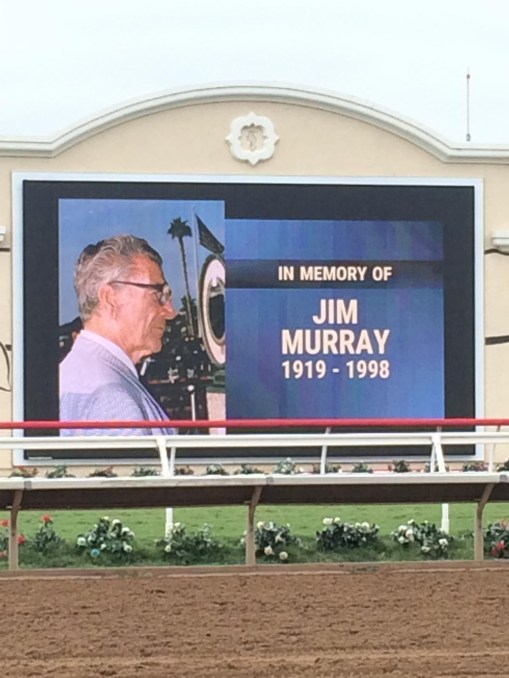
Twenty-two years ago today, the world awakened to the news of Jim Murray’s passing shortly after 11 o’clock the previous night — Aug. 16, 1998. He died of cardiac arrest at his West L.A. home after returning from Del Mar where he had covered the Pacific Classic. He wrote his final column on a horse named Free House ridden by jockey Chris McCarron.
From the first column to the last column, Jim kept his readers entertained for 37 wonderful years at the Los Angeles Times and before that at the L.A. Examiner, Sports Illustrated, Time Magazine and more. He brought humor to an otherwise statistics heavy section of the paper. He gave us a glimpse into the people (and sometimes animals) who played the sports we loved to watch.
——
Jim aspired to be Eugene O’ Neill. Hemingway, even Tolstoi. But Harry Luce, the publishing giant of Time and Life magazines, the blockbuster journals of their time, made Jim a sportswriter.
To quote Jim. “Harry knew everything there was to know about world politics, the domestic economy, Hollywood, Foggy Bottom, Whitehall and Park Avenue. But he didn’t know any more about sports than Mother Teresa.”
Harry traveled the world over, dinner conversation would invariably switch to sports. Demanding to know why, he was told, “. . . sports, like music, is a universal language. Everyone speaks it.” With that, Harry Luce retorted, “Well, then why don’t we have a sports magazine?”
On that chance remark, Sports Illustrated was born. Jim was a Time magazine cinema correspondent in Hollywood at the time.
Jim got to be a sports writer in his journalistic dotage “which is just the right time for it,” he said.
– Linda Murray Hofmans
——
Some classic Jim Murray quotes:
The Bears aren’t very genteel; some teams tend to remove the football from you, the Bears remove you from the football — it’s much quicker.
For those who know golf, no explanation is necessary. For those who don’t, no explanation is possible.
(Seattle) Slew was a compassionate horse. He never beat anybody more than he had to. He was like a poker player who lets you keep your watch and carfare home.
A racetrack crowd comprises the greatest floating fund of misinformation this side of the pages of Pravda, the last virgin stand of optimism in our century.
Pete Rose played the game for 24 years with the little boy’s zeal and wonder until, if you closed your eyes, you could picture him with his cap on
sideways, knickers falling down to his ankles and dragging a taped ball and busted bat behind him, looking for all the world like something that fell off Norman Rockwell’s easel.
Seeing a goal scored in hockey is like picking your mother out of a crowd shot at the Super Bowl.
——
What follows is Jim Murray’s final column, the one he wrote after covering the Pacific Classic at Del Mar. . . . ENJOY!
——
SUNDAY, AUGUST 16, 1998, SPORTS
Copyright 1998/THE TIMES MIRROR COMPANY
JIM MURRAY
You Can Teach an Old Horse New Tricks
DEL MAR — Well, it was a slam dunk for Free House, a “Where is everybody?” win.
The Bridesmaid finally caught the bouquet. The best friend got the girl in the Warner Bros. movie for a change. The sidekick saves the fort.
Free House just won’t fold the hand. Three times last year, in the most publicized races  in the sport, he chased his competition across the finish line in the Kentucky Derby, Preakness and Belmont. In the money in all of them, in the photo in one of them, he was the hard-luck champion of horse racing.
He was expected to go quietly into the sunset. A game effort but no cigar.
He got a measure of revenge Saturday in the Pacific Classic here. He ran away from Touch Gold, who beat him in the Belmont. The horse who beat him in all three Triple Crown races, Silver Charm, didn’t make the dance or he might have gotten a different view of Free House, too.
The Pacific Classic is not your Run for the Roses. No bands play Stephen Foster as the horses come on the track. But it’s not your basic overnight allowance, either. It’s a $1-million race, major on the schedule. It’s a very big win for Free House. He’s not What’s-His-Name anymore. He’s Who’s Who.
You know, in most sports, the athlete gets a generation to prove himself. A Jack Nicklaus wins his first major at 22 and his last at 46. A George Foreman wins Olympic boxing gold in 1968, and 30 years later he’s still fighting. Babe Ruth hits his first home run in 1915 and his last in 1935.
But a racehorse has to act like he’s double-parked. He gets only months to prove he has been here.
And if his prime coincides with that of Man O’War, Citation, Secretariat or even Count Fleet, he might as well have been born a plow horse.
What did Free House do that turned him into a star? Well, he got older.
You know, it’s the public’s notion that the racing begins and ends with the Kentucky Derby and its Triple Crown satellites. Everything else is New Haven.
Trainers know better. Every real horseman knows a colt’s (or a filly’s) 3-year-old season is not indicative of real prowess. I mean, a Kentucky Derby is not only too early in the career, it’s too early in the year.
It has been won by a lot of horses who are just better than claiming horses. It has been lost by a lot of horses who were too good to have that fate. Native Dancer comes to mind. Gallant Man. Damascus. Bold Ruler.
Of course, a horse doesn’t know whether he won the Kentucky Derby or not. But his owner does. His rider does. History does.
But trainers as a class manage to hold back their enthusiasm. There’s even evidence a trainer resents a Triple Crown race.
That’s where a Pacific Classic comes in. It’s a trainer’s race. A real test of his skill in bringing a horse up to a race. The real business of racing.
A Kentucky Derby can be a crapshoot. Not a Pacific Classic. You win a Pacific Classic because you’re at the top of your game, not because eight other horses were still wet behind the ears. Many a Derby has been blown by an immature runner jumping shadows, spitting bits, lugging out, horsing around.
Not a Pacific Classic. Here, the horses are all grown up, professional. These are the true class of the sport, older horses. Dependable, crafty. Consistent. They don’t beat themselves.
There probably has never been a good older horse who couldn’t beat a good 3-year-old. It’s so taken for granted, they have to give the kids weight. Handicap horses used to be the glamour stars of the track anyway. They made a movie about Seabiscuit, who never ran in the Triple Crown and never got good till he got middle-aged. They wrote poems about John Henry, who never did either, even though he ran in 83 other races. They used to Equipoise “The Chocolate Soldier.” Exterminator, called “Old Bones,” ran 100 races.
They were the heart and soul of racing.
Free House bid fair to join them Saturday. He won so easily, jockey Chris McCarron should have brought a book. He rode him like the Wilshire bus. “You could have ridden him today!” he called out to Free House’s co-owner Trudy McCaffery.
McCarron rode such a confident race, he remembers thinking, “If I were a cocky individual, I would have turned to the other riders and said ‘Shame on you!’ ”
Added McCarron, “This horse is so generous with his speed, I knew if he ran the way he trained, these guys were beat.”
He has one holdover from his misspent youth: He tends to kick out sideways and decelerate in the stretch, almost start to tap-dance. “He gets to wondering where everybody went and to want to slow down and wait for them,” McCarron explained. McCarron hustled him across the finish line four lengths ahead of second-place Gentlemen on Saturday and about 16 lengths ahead of Touch Gold.
Ironically, McCarron rode Touch Gold to victory in the Belmont.
So, is he glad the order was reversed Saturday? Is yesterday’s jinx horse today’s king of the handicap division?
“Arguably,” said McCarron, “a case could be made.”
Anyway, it’s nice to know getting older has its flip side.
Reprinted with the permission of the Los Angeles Times
Jim Murray Memorial Foundation P.O. Box 661532, Arcadia, CA 91066
——

 in attendance, at least at games in Quebec. . . . “Following our conversations with both the Provincial Governments and Public Health Agencies, it has been determined that the 2020-21 season will be played behind closed doors in Quebec, while details are currently still being discussed for the Maritimes,” the league said in a news release. . . . Training camps are to open on Aug. 30 with teams allowed to bring in 34 players. . . . With the league split into three divisions, each team will play 60 games without leaving its own division. . . . The league said it will release its playoff format in December. . . . Interestingly, the QMJHL operates under the CHL umbrella with the OHL and WHL. The OHL is aiming to start its regular season on Dec. 1, while the WHL is hoping to open on Dec. 4. . . . The WHL, however, is adamant that it won’t be playing without fans in the pews. . . . Keep in mind that the QMJHL season, including the dates of its open trading sessions, has close ties to the province’s education system. . . . The QMJHL’s news release is
  that it is postponing things. But it didn’t announce another proposed opening date. . . . Instead, it says it will “commence the 2020-21 campaign with a development season beginning Aug. 31.” . . . From the AJHL’s news release: “Within the current boundaries of Hockey Alberta’s Return to Hockey Plan and Stage 2 of Alberta’s Relaunch, the AJHL is unable to enter regular season competition at this time.” . . . More from the news release: “The Development Season will meet the needs of both the League and its athletes by allowing teams to actively prepare for the upcoming season while providing players an opportunity for high-calibre training and development. Training Camps will be permitted to begin as early as August 31st in all 15 AJHL communities and will run until the AJHL embarks on regular season play.” . . . The complete release is




 training camps in mid-September. The five teams from Vancouver Island are hoping to hold a tournament in Colwood, near Victoria, starting on Oct. 2. Cleve Dheensaw of the Victoria Times-Colonist reports that the Alberni Valley Bulldogs, Cowichan Valley Capitals, Nanaimo Clippers, Powell River Kings and Victoria Grizzlies each would play 12 games in a round-robin format leading to semifinals and a final. . . . Dheensaw writes: “The tournament will adhere to current B.C. guidelines and a maximum of 50 people — including players, coaches and scorekeepers — will be in the rinks for the games.” . . . Craig Didmon, the Grizzlies’ general manager and head coach, told Dheensaw: “This is all dependent on the health authorities. If it can’t happen, then we will continue practising and training until the start of the regular season.”


 general manager and head coach. He takes over from Phil Roy, who has moved on to the QMJHL’s Shawinigan Cataractes as an assistant coach. . . . Pilkington, 36, is from Calgary. He was a second-round selection by the Saskatoon Blades in the WHL’s 1999 bantam draft, but chose to go the NCAA route and played four seasons at Bowling Green. . . . Last season was his first with the Hounds. . . . Roy, who is from St. Leonard, Que., spent two seasons with the Hounds.




 playoffs — four rounds of best-of-seven series — beginning in late March.
 champions,

 Dec. 1. It would end on April 29, with 16 of its 20 teams moving into playoffs. . . . The OHL also revealed that the plan is for the 2021 Memorial Cup to be played from June 17-27 with either the Oshawa Generals or Soo Greyhounds the host team. . . . Here’s David Branch, the OHL commissioner, in a news release: “Players will remain at home until the season resumes and teams will work closely with them on both their academic studies and overseeing their on- and off-ice development. In addition, the league will liaise with our facilities to ensure that our venues are safe for our return to play.”