KKSG set for two meetings this week . . . The latest on Ferris and family . . . Meet a donor from Saskatoon

According to BC Transplant, 303 kidney transplants have been performed in the province in 2019, through Dec. 2. Of those, 109 involved living donors. There now are 600 people waiting for transplants.

If you are one of those people, or someone else who has been impacted by kidney disease, the Kamloops Kidney Support Group is here for you. We meet on the second Wednesday and the second Saturday of every month. We will gather on Wednesday, Dec. 11, 10 a.m., and Saturday, Dec. 14, 9 a.m., at Chances (Barside Lounge and Grill), 1250 Halston Ave.

The chances are good that in attendance will be: (a) someone who has had a transplant; (b) someone who is doing peritoneal dialysis while awaiting a transplant; (c) someone who is doing hemo-dialysis; (d) others in various stages of chronic kidney disease; and (e) people who have been there to support kidney patients through it all.

There isn’t anything formal about KKSG. We have coffee, maybe some breakfast, and talk about life and kidneys. You won’t get any medical advice, but we will be there to share our experiences and offer our support, whether you are pre-dialysis or on dialysis, a kidney donor or a recipient, a family member, or anything in between.

For more information, call Edna Humphreys at 250-376-6361 or Dorothy Drinnan at 250-573-2988.


Ferris Backmeyer has yet to turn three years of age, but she needs a kidney. Ferris, who is from Kamloops, and family members, including her Mom and Dad, Lindsey and Pat, have spent a whole lot of time at BC Children’s Hospital during her short life, and they were there again a short time ago.

Ferris has had trouble putting on weight and keeping it on, something that has slowed the process of getting a transplant.

Her mother, Lindsey, posted this update on Facebook after returning from Vancouver:

“They are already wrapping up her assessment for transplant. We will have our final meeting in early January. From there they will reach out to St. Paul’s (Hospital in Vancouver) to see if there are any living donors in the works!

“I got asked several times this trip about potential donors and the reality is I don’t know if there are any. Pat has a set back right from the first step with BC Transplant saying he might not hear anything for 5-7 weeks!! I’m not sure if anyone else has had a similar experience or not. It’s a yucky feeling knowing it’s completely out of our hands.

“The surgeon would prefer to have her grow more and specified he will be super picky on the kidney he takes for Ferris. He’s hoping for months of good growth. Size will be a major factor. This is unfortunate but will be critical for a successful transplant!

“A live donor is preferable as they typically do better and last longer, but also because the surgical date can be planned. They also typically happen faster than going on a deceased donor list.

“I can’t even think about how ‘getting the call’ would look like for our world, but know we will deal with it when the time comes. For now, I’m pretty jazzed to not have to go back for five weeks this time.”

Here’s hoping the Backmeyers can enjoy a quiet Christmas!


Have you ever wondered how women who already are dealing with chronic kidney disease are able to handle pregnancies? . . . Dr. Michelle Hladunewich, the physician in chief at Sunnybrook Hospital in Toronto, is The Miracle Worker; at least, that’s what many of her patients call her. . . . Cristina Howorun of citynews.ca has her story right here, and it’s a good one.


If you are from Pennsylvania, this tweet is for you:


I would like you to meet Marie Green of Saskatoon. She is another one of those special people who populate the world of kidneys; only she is there by choice. . . . Marie, 66, was going to give a kidney to a friend, Monica Goulet. They turned out to be a match, too, but Monica was found to have a better match in a nephew. She got one of his kidneys in March. . . . Marie, meanwhile, chose to go ahead and donate through the Kidney Paired Donation program and will have surgery later this month. “If I was going to do it for Monica, I can certainly do it for somebody else,” she told Jason Warick of CBC News. “You know, there are a lot of people out there. Even if I don’t know them, they’re somebody’s loved one. They’re somebody’s Monica.” . . . Warick’s story is right here.
Getting flu shot not about you . . . Some thoughts on being living kidney donor

Every time I see people on social media making mention of how they haven’t had the flu in 1,000 years and have never had a flu shot, well, my blood boils and smoke comes out my ears.

People, people, people. This isn’t about you not getting the flu. A flu shot is to help prevent you, who may be a carrier, from passing it along to someone else, like maybe a transplant recipient who has a suppressed immune system because of the anti-rejection medications that they must take, or maybe a senior citizen — perhaps your own grandmother or grandfather — whose immune system isn’t strong enough to reject a flu bug.

Please, please, please . . . a flu shot isn’t about you; it’s about other people in your community.

Get your flu shot!


There were a couple of things that really jumped out at me when I read the report on organ transplantation in 2018 that was released Thursday by the Canadian Institute of Health Information (CIHI).

Using data from the Canadian Organ Replacement Register, the report included: “There were 40,289 Canadians (excluding Quebec) living with end-stage kidney disease at the end of 2018, an increase of 35 per cent since 2009.”

An increase of 35 per cent in 10 years means that today there will be even more people living with chronic kidney disease (CKD).

That number — 40,289 — jumped off the page when I first read it.

The other note that really hit hard was this: “(In 2018), there were 555 living donors (people who donated a kidney or a lobe of liver) and 762 deceased donors in Canada. The number of deceased donors increased by 56 per cent between 2009 and 2018, whereas the number of living donors remained stable.”

I was more than a little surprised to read the “the number of living donors remained stable.”

More and more people are being impacted by CKD, and everyone needs to realize that there isn’t a cure for it. Once someone is diagnosed with kidney disease, that’s it . . . it’s there and it isn’t going anywhere.

At some point there will dialysis and, hopefully, a transplant.

There are two ways to get a kidney via transplant — from a deceased donor or from a live donor.

The best option, of course, is from a live donor, and people need to understand that you can make sure a recipient gets a kidney even if you don’t have the same blood type.

I am aware of a number of people in Kamloops who are waiting and hoping for transplants — like Julie Dodds, who was featured on CFJC-TV on Thursday; like Vic Morin and John Casey, both of whom are regulars at Kamloops Kidney Support Group meetings; like Ferris Backmeyer, who isn’t yet three years of age but is on dialysis for about 12 hours a day, every day of the year. There’s also Zach Tremblay, a 16-year-old from Robson, B.C., who continues to wait for the phone call.

Let’s say that you are a friend of Julie’s and would love to help, but you aren’t the same blood type. That being the case, you might still be able to give your kidney to someone else — yes, it might even be a complete stranger — while Julie would get a kidney from another person, who might be another stranger.

That is how the Living Kidney Donor Program works — aka Live Donor Exchange Program.

That is exactly how Dorothy, my wife, got her new kidney on Sept. 23, 2013. Her best friend was adamant that she wanted to give a kidney to Dorothy. However, the friend wasn’t a match. Both names went into the exchange program and in time matches were found and transplants were done.

If you are interested in more information, here you go:

Living Kidney Donor Program

St. Paul’s Hospital

6A Providence Building

1081 Burrard Street

Vancouver, BC V6Z 1Y6

Tel: 604-806-9027

Toll free: 1-877-922-9822

Fax: 604-806-9873

Email: donornurse@providencehealth.bc.ca

——

Sam Thompson of Global News has more right here on the CIHI report. He spoke with Dr. Faisal Siddiqui of Transplant Manitoba, who told him that there still is a stigma when it comes to families talking about death and organ donation. “It’s a human nature aspect,” Dr. Siddiqui said, “that we just don’t like sitting around the kitchen table and saying, ‘when I die, this is what I want out of life, or what I want for me.’ ” . . . Dr. Siddiqui also explained that not everyone is able to be an organ donor. . . . That complete story is right here.


I have written here previously on the story involving Catherine Pearlman, and Monica and Eli Valdez. You may recall that Catherine was in a Los Angeles-area coffee shop one day when she saw a flyer that had been placed there by Monica, whose husband, Eli, needed a kidney. . . . Yes, Catherine ended up donating a kidney. . . . If you click right here, you will find a video in which the three of them tell their story. It’s worth the three-plus minutes to give it a watch. (Full disclosure: The video was put together by Hyundai, but it isn’t a commercial. Catherine drives a Hyundai. Oh, so do I.)

BTW, I am aware of two similar stories right here in Kamloops, both of which involve women who each gave a kidney to strangers. Susan Duncan’s story is right here, while Cheryl Vosburgh’s can be found right here.

A mother’s plea: Please share and help us find Ferris a kidney!

If you have been impacted by kidney disease, you will have some understanding of what is involved in living with something for which there isn’t a cure.

My wife, Dorothy, has kidney disease, and underwent a transplant on Sept. 23, 2013. Prior to that, she did peritoneal dialysis (PD) for almost four years. That involved being hooked up to a cycler and doing a fluid exchange for seven or eight hours every night — seven nights a week, 52 weeks a year.

This week, Lindsey Backmeyer of Kamloops, whose daughter, Ferris, is in need of a kidney transplant, took to Facebook to provide some insight into their situation.

Ferris-Nov19
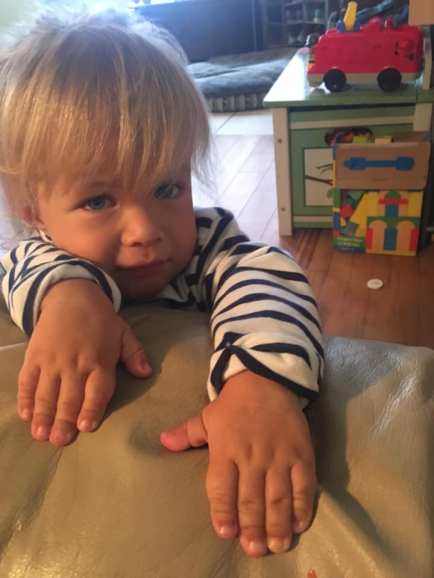
Ferris Backmeyer, 2-1/2, has chronic kidney disease (CKD) and her family is searching for a live kidney donor. (Photo: Lindsey Backmeyer)

Ferris is 2-1/2 years of age. She has had problems gaining weight and keeping that weight on, so only recently has her family been given the OK by their medical team to begin looking for a live donor.

In the meantime, Ferris continues to spend 13 hours overnight doing PD at home.

What follows is Lindsey’s post from Facebook . . .

“I am reminded daily just how hard living with ckd (chronic kidney disease) is for my sweet girl. Like this fine morning where she woke up way earlier than usual and we get to hang out on the bed for 2.5 hours to finish up dialysis.

“Most days are started with fits of vomiting and low energy levels. I’ve come to learn that this doesn’t necessarily depict a good or bad day. In fact most of our days are filled with smiles, afternoon/evening energy and cheeky toddler behaviour. The relentless vomiting is very normal for a pediatric dialysis patient — I say this only because I don’t know the adult world nearly as well.

“As of our last trip to Vancouver I’ve been informed Ferris is almost done the assessment process making her one step closer to a life-saving kidney transplant. Somehow, four weeks has almost passed and we are preparing to head down again next weekend. I am fairly certain the bulk of assessment will be completed and this discussion of living/deceased donors will be brought up yet again.

“I was informed that my health history of gestational diabetes and kidney stones in pregnancy makes me unsuitable for organ donation. The sobering realization that my girl’s chance at a better quality of life is completely out of my hands hit me harder than I had expected.

“A living kidney donor is Ferris’s best shot. Due to her age, she will likely need a couple of transplants over time. The first one is always the easiest to match and subsequent ones become harder due to the development of antibodies.

“Kidney’s from live donors are on the whole more successful and last longer than a kidney from a deceased donor. This means we want her first transplant to be the best kidney we can possibly find for her. The best kidney would be from a young healthy live donor.

“We are beyond ready, excited and terrified for transplant. I am hopeful we will see less vomiting, better energy levels, development in speech and language, oral eating and physical growth. These are the things other parents of transplanted toddlers have seen and I so badly want these things for Ferris.

“I can’t wait to say goodbye to 13 hours per day on dialysis. The freedom to stay out late, sleep wherever and have baths with her sisters will be nice, too.

“We are actively looking for a live kidney donor. It’s truly the most selfless act of life-saving kindness. Please share and help us find Ferris a kidney!”

——

If you are interested in more information about becoming a live kidney donor, here you go:

Living Kidney Donor Program

St. Paul’s Hospital

6A Providence Building

1081 Burrard Street

Vancouver, BC V6Z 1Y6

Tel: 604-806-9027

Toll free: 1-877-922-9822

Fax: 604-806-9873

Email: donornurse@providencehealth.bc.ca


The latest on Ferris’s situation. . . . Alberta headed to ‘opt out’ donor system

Ferris Backmeyer is a young Kamloops girl in need of a kidney transplant. I wrote about her right here on Oct. 7. . . . It is great to see at least one other outlet pick up on the story. If you click on the link right here you will find a story on Ferris that was written by Karen Edwards of infonews.ca.


About pediatric kidney transplants, flu shots, curried turkey casserole . . .

I wrote earlier this week about Ferris Backmeyer, and you may be wondering how in the world someone who is only 2-1/2 years of age is able to undergo a kidney transplant.

Ferris, who lives in Kamloops with her mother, father and two sisters, has kidney disease. She has been doing peritoneal dialysis at home for 18 months now.

Her mother, Lindsey, recently revealed on Facebook that they have been given the OK to

Ferris
Ferris Backmeyer, 2-1/2 years old, needs a kidney transplant. (Photo: Lindsey Backmeyer/Facebook)

look for a living kidney donor for Ferris.

“We have been told the donor process can take just as long as the transplant workup for Ferris,” Lindsey wrote, “so starting the search now is recommended.”

Obviously, Ferris isn’t going to get a kidney from a three-year-old living donor. So let’s look at a few things . . .

First, from the Kidney Foundation of Canada (kidney.ca):

“A living kidney donation comes most often from a family member such as a parent, child, brother or sister. A donor can also be a spouse, friend or co-worker. Or it can be a stranger. A genetic link between donor and recipient, although beneficial, is not always required. This is largely due to improved anti-rejection medications.

“A good living donor candidate is someone who is healthy, well-informed and makes a voluntary decision to donate one of their kidneys. Living donors must be over 18 and usually less than 70 years of age. They must be in good general health . . .”

So if you are older than 18, you are eligible to be a kidney donor.

While it is preferred that donors be under the age of 70, there are stories of donors who have been older. Health, both physical and mental, plays a huge role in donor eligibility, no matter the age.

When it comes to children, it would seem that having a live donor is the best option.

A 1982 report published in The Journal of Pediatrics reached this conclusion:

“We conclude that because of donor availability, capacity for good donor-recipient matching, and minimization of time on dialysis, transplantation of adult kidneys into pediatric patients is preferable to awaiting the relatively uncommon pediatric cadaver donor. We further conclude that the procedure is warranted.”

Despite the passage of time, it doesn’t seem that there has been any change to that conclusion.

Meanwhile, there is this from webmd.com:

“The reason most hospitals suggest an age minimum of 18 for kidney donors isn’t because a young kidney is too small. Studies have shown that a kidney from a six-year-old is all right to transplant into an adult.

“Instead, the main reason is that people under 18 are minors and can’t legally give their ‘informed consent’ proving that they agree to the procedure. Also, some genetic kidney diseases won’t have started to cause symptoms yet in young children and teenagers, so it’s hard to know if their kidneys may be affected by disease. . . .

“Kidneys from younger donors seem to work better over the long term. But people who get older kidneys are just as likely to be alive five years after a transplant as those who receive younger kidneys. Plus, the chances of complications from the procedure, and of organ rejection — when someone’s immune system attacks their new kidney — are the same with kidneys from all age groups.

“The takeaway from these studies is that kidneys from older donors can work, but younger people in need of a kidney may want to consider being matched with younger donors.”

There also is this, from stanfordchildrens.org: “A child older than age two can generally receive an adult kidney. There is usually enough space in the child’s belly for the new kidney to fit.”


Yes, it is that time of the year, again.

I am married to a woman who had a kidney transplant on Sept. 23, 2013. That doesn’t mean she has been cured of kidney disease; there isn’t a cure.

Having had a transplant, she must take anti-rejection medications in order to keep her system from rejecting the foreign object that now lives in the lower right side of her abdomen. Some of those medications — she takes them every 12 hours — are immunosuppressants, so her immune system is compromised.

So, yes, I get an annual flu shot. In fact, I got poked on Friday.

You have no idea how many people who are walking around out there have suppressed immune systems or are unable to get a flu shot for medical reasons.

Here is Nicole Basta of the U of Minnesota, the senior author of a study on “herd immunity,” in a story by Lisa Rapaport of Reuters:

“The more people who are vaccinated in a community, the lower the risk that influenza will be able to spread even if the vaccine does not perfectly protect against the disease.

“Influenza spreads by creating chains of transmission whereby one infected person infects additional people and those individuals infect others with whom they come in contact.”

Rapaport’s story is right here.

Flushot


Kamloops family given OK to search for kidney donor for daughter . . . Ferris Backmeyer, at 2-1/2, in need of transplant

Faceoff2
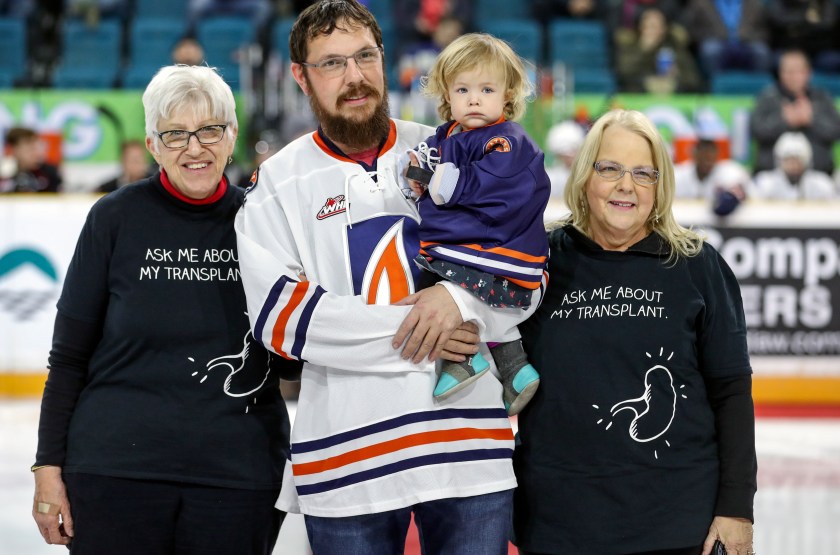
Ferris Backmeyer joined her father, Pat, along with Dorothy Drinnan (left) and Margaret Thompson for the ceremonial faceoff at a Kamloops Blazers game on Feb. 1. (Photo: Allen Douglas/Kamloops This Week)

If you were in attendance on Feb. 1 as the Kamloops Blazers played host to the Prince George Cougars, you may have seen Ferris Backmeyer at centre ice.

Ferris took part in the ceremonial face-off prior to what was the second annual RE/MAX Presents: WHL Suits Up with Don Cherry to Promote Organ Donation game.

Ferris and her father, Patrick, were at centre ice, along with Dorothy Drinnan and Margaret Thompson, two women who have grown to be close friends since both have had kidney transplants.

Ferris and her family are hopeful that she soon will join that club, too.

Yes, Ferris, who is 2-1/2 years of age, needs a kidney, and her mother, Lindsey, has turned to Facebook to announce that the search for a donor officially is underway. In other words, potential donors now are able to contact the Living Kidney Donor Program at St. Paul’s Hospital in Vancouver

Ferris
Ferris Backmeyer, at 2-1/2 years of age, is in need of a kidney transplant. (Photo: Lindsey Backmeyer/Facebook)

First, though, you should get to know Ferris, who made quite an impression when she and her father joined us a while back for a gathering of the Kamloops Kidney Support Group.

Michael Potestio of Kamloops This Week wrote about Ferris in April 2018.

“A few weeks after she was born,” Potestio wrote, “Ferris, now 14 months old, was informally diagnosed with Mainzer-Saldino syndrome, a disorder characterized by kidney disease, vision loss and misshapen bones.

“The disease is caused by gene mutations and is so rare there are only about 20 known cases, according to the U.S. National Library of Medicine.
“After she was born, Ferris wasn’t gaining weight and subsequent blood work showed abnormalities with her kidneys and liver.”

At that time, Lindsey told Potestio:

“The scariest part in the first few weeks was we didn’t know what was going on. And she was admitted to (B.C.) Children’s Hospital back when she was three weeks old and nobody really knew what was going on.

“It’s a bit disconcerting when the medical professionals can’t give you a diagnosis for your kid.”

Genetic testing later confirmed the diagnosis, and it wasn’t long before Ferris’s kidneys failed.

The Backmeyers, who also have two older daughters, have spent a lot of time at BCCH in Vancouver with Ferris, especially in the early days of kidney failure as medical staff got her started on dialysis. She has been doing peritoneal dialysis (PD) and it took a lot of testing to see just how much of the dialysis fluid her body comfortably could hold. Ferris now has been doing PD at home for 18 months.

In PD, the patient is hooked up to a cycler every night — yes, seven nights a week — and fluids are used to absorb and drain toxins from the body via a catheter that is implanted in the peritoneal cavity. The patient carries fluid all day in that cavity, then repeats the draining process nightly.

Ferris has struggled to gain weight, which has complicated her situation. She needs to get to 10 kilograms before a transplant can take place.

But now it seems that she is making progress in that area.

Lindsey recently posted this on Facebook:

“We just got back from B.C. Children’s Hospital from one of our biggest trips ever and it was the first time I didn’t have (husband) Pat with me the whole time and first solo trip back with a 2 year old that doesn’t nap!

“She let them do all the things and the only tears we saw were with labs. She had the patience of a saint and literally seemed to be handling things better than I was. Hours of different consultations, 2 sets of labs, a bunch of X-rays, a dentist appointment and a hearing test!

“The initial screening for kidney transplant has officially begun!

“Little miss remains on the lowest side for weight and height that they will transplant, and growth has slowed again considerably. Praying for more growth!

“As for the donor part of things, we have been given the go-ahead to have any interested donors contact the St. Paul’s living donor program at 604-806-9027, citing Ferris as the intended donor.

“Her blood type is ‘B’ but they encourage all interested donors to contact St. Paul’s directly. They then mail out a package.

“Ferris’s side of the process is completely separate from the donor side and the donor side is 100 per cent up to the donor. We have been told the donor process can take just as long as the transplant workup for Ferris, so starting the search now is recommended.

“I am sharing this publicly because I want to get the word out. She deserves to live a healthy life and we are sooo ready to move on to the next phase. Social media has proven to be successful and altruistic donors is totally a thing! So let’s do it!! Let’s find Ferris a kidney!!”

Understand that you don’t have to be a match in order to help Ferris get a kidney. If you aren’t a match, the Living Donor Paired Exchange program will be used to match you with another donor/recipient pair in a similar situation.

The age and size of a donor isn’t a big deal, either. What is important is the health of the donor and his/her kidneys.

There is more information available right here at Providence Health Care’s website.

If you are interested in more contact information, here you go:

Living Kidney Donor Program

St. Paul’s Hospital

6A Providence Building

1081 Burrard Street

Vancouver, BC V6Z 1Y6

Tel: 604-806-9027

Toll free: 1-877-922-9822

Fax: 604-806-9873

Email: donornurse@providencehealth.bc.ca