RE/MAX, WHL partner again to help Kidney Foundation. . . . Raised more than $460,000 in two seasons

RE/MAX of Western Canada and the WHL are once again getting behind WHL Suits Up with Don Cherry to Promote Organ Donation, the annual promotion that benefits the whlKidney Foundation of Canada and its provincial  branches.

If you aren’t familiar with this promotion, it involves the WHL’s 17 Canadian-based teams, each of whom uses one game each season to help promote organ donation and transplantation.

I don’t have dates for all teams but the B.C. Division games will go like this: Prince George Cougars, Jan. 31; Vancouver Giants, Feb. 8; Kamloops Blazers, March 6; Victoria Royals, March 13; and Kelowna Rockets, March 14.

During the 2017-18 season, the promotion in WHL cities raised more than $265,500, making it the largest public awareness and fundraising campaign in the history of the Kidney Foundation. Last season, the final total raised was $196,600.

In two seasons then, RE/MAX of Western Canada and the WHL have helped raise more than $460,000.


The 10th annual Kidney Walk Kamloops is scheduled for Sunday, Sept. 22, at McDonald Park on the North Shore.

Registration will open at 10 a.m., with the walk to start at 11. And we will walk in the KWlogo2rain if the forecast holds true.

If you would like to join us, you are able to walk all or part of the approximately 2.5-km pathway between McDonald Park and McArthur Island. Or you don’t have to walk at all; you might want to just sit and enjoy the company and festivities, then have breakfast. The Brock Central Lions Club will be on hand to provide breakfast — pancakes, sausages and coffee — by donation.

The Kidney Walk helps the Kidney Foundation raise awareness about kidney disease and raises funds for important programs and services to help kidney patients in this community and others across BC and the Yukon.

My wife, Dorothy, will be celebrating the sixth anniversary of her kidney transplant by taking part in her sixth straight Kidney Walk. In her six walks, she has raised more than $15,000. If you would like to support her — she reached the $3,000 mark on Thursday — you may do so right here.


A note from the Kidney E-News letter of the BC and Yukon Branch of the Kidney Foundation of Canada:

“The BC & Yukon Branch and the Children’s Organ Transplant Society (COTS) were excited to have 43 youth from across BC attend Camp Latona on Gambier Island in August.

“The kids got to enjoy the camp experience with other young people at various stages in their kidney disease/organ transplant journeys. The weather was fantastic and some of highlights included tubing, campfires, extraordinary food, swimming and, of course, making new friends! 

“A huge thank you to all of the gracious donors who made it possible for the kids to attend a cost-free, worry-free camp. We appreciate you!”


Scattershooting . . . on a Wednesday after another evening with Ken Burns’ superb Country Music series . . .

Scattershooting
When you spend most of a rainy Sunday and a Monday evening watching the NFL on TV, you realize that you really have forgotten how bad a lot of commercials are. I’m pointing a finger at you, Subway.


On the subject of the NFL, do we write off the New Orleans Saints and Pittsburgh Steelers without quarterbacks Drew Brees (thumb) and Ben Roethlisberger (elbow), respectively? . . . And what of the New York Jets without Sam Darnold (mononucleosis) and Trevor Siemian (ankle), and the Jacksonville Jaguars without Nick Foles (shoulder)? . . . Then there’s the Carolina Panthers, who have Cam Newton (foot), and we won’t even get into Oliver Luck who walked away from the Indianapolis Colts and football before the season began.

——

Mike Reilly of the B.C. Lions is the only one of the nine quarterbacks who were starters to begin the CFL season not to have been injured to this point. Might the NFL be headed for the same kind of season in terms of injuries to quarterbacks?


Two questions from Dwight Perry of the Seattle Times: “1. Has there ever been a more fitting NFL team to tank than one called the Dolphins? . . . 2. Is White Sox rookie pitcher Dylan Cease destined to become the team’s stopper?”


The Lethbridge Hurricanes, one of the WHL’s four community-owned teams, held their AGM on Monday night and reported a profit of $282,168 for the 2018-19 season. . . . Meanwhile, if you’re wondering how much a WHL championship is worth to a community-owned team playing in a smallish arena, well, the Prince Albert Raiders told their shareholders on Tuesday night that they made $633,314 last season. That comes a year after the Swift Current Broncos reported a profit of $561,500 in 2017-18, their championship season.

——

You cannot over-estimate the job done in Lethbridge by general manager Peter Anholt and Terry Huisman, the GM of business operations. Remember that this is a franchise that WHL commish Ron Robison recommended be sold to private interests. “It’s not to say that this community organization can’t get things turned around,” Robison said in May 2015. “But we think, when you look at the franchise moving forward, that private interests would be in the best interest of the club.” . . . Not enough shareholders listened, Anholt rode in on his white horse, and the rest, as they say, is history. . . . It’s just too bad that the WHL’s board of governors didn’t see fit to put the 2020 Memorial Cup tournament in Lethbridge instead of Kelowna because the Hurricanes and their fans deserve it.


Have been out and about a bit over the past couple of days. Have decided that I will vote for any candidate who promises to ban all of those gawdawful election signs.


PotatoHead


By now, chances are that you have seen that TV commercial featuring the A&W guy at Mosaic Stadium in Regina. It seems that the commercial, which is all about the Beyond Meat Burger, has caused some controversy on the flatlands. . . . There is more right here from 3DownNation, while Adrienne Ivey, a Saskatchewan rancher, has her say right here. . . . And now the Roughriders, like QB Cody Fajardo evading pass-rushers, are scrambling to distance themselves from all of it. The Regina Leader-Post has more on that right here.


Baseball, as we all know, is a game of numbers and statistics, moreso than any of the other major sports. But every once in a while something comes along that defies belief. . . . For example: Manager Bruce Bochy of the San Francisco Giants has managed in the bigs from 1995-2019. On the morning of Sept. 10, his lifetime record was 1995-2019.


Sheesh, it must be boring to be a fan of the New England Patriots. Two weeks in and they’re 2-0, having outscored the opposition, 86-3. And in their next game, on Sunday, they get to beat up on the — wait for it! — visiting New York Jets.


Ready to go Kidney Walking in Kamloops. . . . Pearlman, Valdez talk about transplant. . . . Mother wants to make late son proud, donates kidney

Almost all is in readiness for Kamloops’ 10th annual Kidney Walk.

We will gather on Sunday at McDonald Park on the North Shore, with registration at 10 a.m., and the walk to begin at 11.

Edna Humphreys is the executive director of the Kamloops branch of the Kidney KWlogo2Foundation. I can tell you from experience that without her leadership and organizational skills, the Kidney Walk would experience some difficult times.

(It’s also worth noting that if it’s a renal-related activity in Kamloops, you can bet that Humphreys is in the forefront. Among other things, she is a co-founder of the Kamloops Kidney Support Group, and also is the lead organizer of a Christmas luncheon for dialysis patients and transplant recipients. With music by old friend Jesse Jones. Yessss!)

Anyway . . . Humphreys recently took time out from her busy schedule to talk with Todd Sullivan of Kamloops This Week about the 2019 Kidney Walk.

That story is right here.


One of my favourite renal-related stories involves a woman named Catherine Pearlman, who walked into a Los Angeles-area Starbucks on Dec. 30, saw a poster on a bulletin board, and decided that very moment to become a kidney donor. . . . The result was that Eli Valdez, a complete stranger, received one of her kidneys. . . . They told their story to today.com, and it’s all right here.

If you missed it earlier, Pearlman wrote about her experience for the Los Angeles Times, and that piece is right here.

Catherine’s husband, Jeff Pearlman, is a writer and published author. He wrote on his blog about what all of this meant to him. Here’s how he started it:

“It’s 10:15 am, and as I write this my wife Catherine is in surgery here at UCLA’s Ronald Reagan Medical Center — donating one of her kidneys to a complete stranger.

“You read that correctly, but I recommend reading it again. My wife Catherine is in surgery donating one of her kidneys to a complete stranger.”

The complete piece is right here.

BTW, if you are a sporting fan and haven’t read Jeff’s book, Football for a Buck, you’re cheating yourself. It’s all about the USFL — remember that league? — and is loaded with especially juicy anecdotes, including some involving, yes, Donald Trump.


Laura Gillum’s son, Dean, was 23 months old when he drowned in the family’s backyard pool in the Pittsburgh area in 2015. His heart, lover and kidneys were donated.

“My son was amazing,” she told Lisa Washington of KDKA-TV. “At 23 months old, he saved three people’s lives. Not many people can say that, and even though he’s gone, I try every day to do something to make him proud of me.”

On March 7, Lisa donated a kidney to Brian Cox, a complete stranger. They met early in April.

“I just can’t comprehend why someone wouldn’t want to donate their kidney, so hopefully getting the message out, more people will want to do it and that they’ll want to educate themselves to find out just what everything entails,” Gillum said.

Washington’s complete story is right here.


Mondays With Murray: The Dawning of the Age of Cable TV

Today we take you back to 1981 when Jim Murray’s column was focused on a brand new TV channel, ESPN, and the man who made it happen, Chet Simmons.

  Sports broadcasting and cable pioneer Chester R. (Chet) Simmons served as president of ESPN when it launched in 1979. As a founding father of sports television, Simmons started in 1957 with Sports Programs, Inc., which soon evolved into ABC Sports, where he was instrumental in the development of Wide World of Sports. He became president of NBC Sports and later of ESPN, and was founding commissioner of the USFL.

   Thank you, ESPN, for always being in the JMMF corner.

  ENJOY!

—————

THURSDAY, JUNE 4, 1981, SPORTS

Copyright 1981/THE TIMES MIRROR COMPANY

JIM MURRAY

The Dawning of the Age of Cable TV

  In the early 1920s, a new medium, radio, and a new monopoly, network broadcasting, burst on an unprepared public and the satraps of the industry were quickly locked in bitter ideological conflict.

  On one side were forces headed by Gen. David Sarnoff, ruler of a conglomerate, Radio Corporation of America. He held that the greatest good the new medium could perform mondaysmurray2was to move goods. In other words, it should be a giant advertising agency whose entertainment specialties, like the old medicine shows, should be used primarily to sell snake oil, to unclog the pipelines of American’s manufactured goods.

  On the other side were the forces of free enterprise, which thought the entertainment should be sold directly to the public at the marketplace, just as stage, screen, sports and penny arcades were. Put your nickel in the slot and see the show. Pay-radio, not advertising — subsidized radio.

**********

  Gen. Sarnoff prevailed. He usually did. Pay-radio never came into being. Instead, toothpaste companies controlled the medium. They hired the comics, paid the orchestras, leased the wires. Razor blade companies brought you the World Series. Beer bottlers put on the Wednesday night fights. Pro football broadcasts carried sales pitches for shaving lather.

  When television came in, the old argument reopened. Executives such as Gene McDonald, president of Zenith Radio and Television, argued for selling products direct to home owners. His reasoning: Why should a World Series, which could gross $40 million a day if everybody who watched paid a dollar, sell radio rights for $175,000 and TV rights for $65,000 (as it did then in 1949)?

  McDonald and pay-TV advocates were blocked at every turn, largely by an aggressive mob of 12,000 movie exhibitors whose business was doomed anyway. They collected signatures and stopped pay-TV in its tracks. It was like the buggy-whip manufacturers collecting signatures to prevent the manufacturer of carburetors, but for a while the illusion of “free” TV prevailed. There is no such thing as free TV, actually. You paid for Jack Benny and the World Series, anyway.

**********

  But all this is ancient history, Pay-TV is alive and well and proliferating. Only this week the industry, which once held its convention “in a clothes closet in Las Vegas,” drew 12,000 conventioneers and 350 exhibitors to its three-day annual gathering in Los Angeles, attesting to its growth and vitality. The business’ enemies thought two decades ago they had patted it in the face with a shovel.

  It’s called Cable TV today, but it’s the same business. Gen. Sarnoff would be aghast. It managed to escape the political buzz-saws of “fee” TV in the nick of time because it happened to be needed. When there proved to be massive pockets of population unreachable by an ordinary TV signal because they were behind mountains or other interrupters, entrepreneurs built community antennas and charged the subscribers for piping the pictures into their living rooms. Not even Gen. Sarnoff could say, “You can’t do that!” Nobody could collect signatures to take away television altogether from your home screen. So, pay TV had its foot in the door.

  I had breakfast the other day with a TV executive who has a foot in both doors. Chet Simmons, when I first knew him, was in charge of sports programming for NBC in the days when competition for network sports preeminence made the Dodgers-Giants look like two sisters dancing.

  It’s well to remember that the American Football League succeeded where earlier expansion leagues had failed, simply because NBC needed it. No other single factor contributed so much to its success. NBC could not tolerate putting on Sunday afternoon zoo shows while CBS was showing the real Lions and Rams and keeping score.

  Chet Simmons runs an operation called The Total Sports Network, ESPN (for “Entertainment Network”) with headquarters in Bristol, Conn., of all places. It’s an audacious enterprise bankrolled by Getty Oil. It welcomes advertising, but it distributes its product by cable system, a bit of Roman riding that Gen. Sarnoff never thought of.

  “We are advertising-supported, we generate revenue the same way the three networks do,” Simmons said. “We are in affiliate agreements with cable systems. But we are in one business and one business only, we are a program source for the cable industry, that’s all we do.”

  Where does a 24-hour all-sports network find product? Would you believe televising the NFL draft? Twenty guys sitting around a room for 8-1/2 hours sorting out photographs of kids with 20-inch necks whose classes had graduated from A&M (usually without them). That’s entertainment?!

  “Believe it,” says Simmons, convincingly. “To our viewers, it’s news, it’s entertainment, it’s suspense.” Lyrics by Irving Berlin.

  What do you show at 4 o’clock in the morning, Chet, barroom fights? Reruns of the Cincinnati Bengals picking a linebacker? No. Chet said reruns of an event first programmed live the evening before are as avidly watched by sports fans as Saturday afternoon cowboy movies are by kids. They will watch the same film over and over. Especially if the good guys win.

  Where otherwise do you get product? Well, Simmons notes, the major networks leave an astonishing amount of prime sports footage just laying around. Not Notre Dame-Michigan, the World Series or the Super Bowl, perhaps. But they do leave the college World Series of Baseball and the NCAA golf tournaments.

  Even the famous Notre Dame-Brigham Young basketball playoff of last year was up for grabs. ESPN grabbed it. ESPN has the advantage, too, that it is all sports. It does not have to go pettifogging off after comparative trivialities such as elections, assassinations, wars, revolutions, drownings, floods, and other dilemmatic happenings of the non-world out there. If it doesn’t happen between the foul lines, so far as ESPN is concerned it’s a non-story.

  Network-station sportscasts usually have a breathless announcer trying to cram in 24 scores, a shouted interview with a third baseman on the way to a shower, and a look at a three-horse spill at Aqueduct, all sounding like Donald Duck interviewing Mel Tellis — film at 11. Rush-hour train-calling at Grand Central is more entertaining — and informative.

  How fair is the box office?

  “In May of 1979, we had a million and a half subscribers,” reports Simmons. “In May of 1981, we have 10 million.”

  How close is cable TV to bidding competitively against the networks for a World Series, a Super Bowl, the Olympic Games?

  “We are a long way from making money,” Simmons said “But, when it was estimated that it would take $400 million to wire the Borough of Queens for pay-TV, 20 applicants bid for the privilege of spending $400 million. So you know what the return is they were looking at. The networks are now looking into cable TV themselves. What does that tell you?”

  It tells me it’s a good thing Gen. Sarnoff isn’t around to hear it.

Reprinted with the permission of the Los Angeles Times

Jim Murray Memorial Foundation, P.O. Box 60753, Pasadena, CA 91116

———

What is the Jim Murray Memorial Foundation? 

  The Jim Murray Memorial Foundation is a 501(c)(3) nonprofit organization, established in 1999 to perpetuate the Jim Murray legacy, and his love for and dedication to his extraordinary career in journalism. Since 1999, JMMF has granted 104 $5,000 scholarships to outstanding journalism students. Success of the Jim Murray Memorial Foundation’s efforts depends heavily on the contributions from generous individuals, organizations, corporations, and volunteers who align themselves with the mission and values of the JMMF.

Like us on Facebook, and visit the JMMF website, www.jimmurrayfoundation.org.

——

A dozen years ago, Linda McCoy-Murray compiled a book of Jim Murray’s columns on female athletes (1961-1998). While the book is idle waiting for an interested publisher, the JMMF thinks this is an appropriate year to get the book on the shelves, i.e., Jim Murray’s 100th birthday, 1919-2019.  

Our mission is to empower women of all ages to succeed and prosper — in and out of sports — while entertaining the reader with Jim Murray’s wit and hyperbole.  An excellent teaching tool for Women’s Studies.

Proceeds from book sales will benefit the Jim Murray Memorial Foundation, a 501(c)(3) not-for-profit organization providing sports journalism scholarships at universities across the country.

More hepatitis C-infected kidneys being transplanted. . . . Disease able to be treated following surgery. . . . Kidney Walk set for Kamloops on Sept. 22

Kidneysign


A study published Thursday in the Journal of the American Society of Nephrology reports that American transplant centres are using three times more hepatitis C-infected kidneys for transplant rather than dispose of them.

There has long been a fear that a transplant receiving a kidney with hepatitis C would become ill. According to this report, medical advancements in treating hepatitis C mean that those recipients won’t become ill.

Jen Christensen of CNN writes:

“Hepatitis C is a viral infection that causes liver inflammation, sometimes leading to serious damage. Prior to 2018, most of the infected organs went to patients who already had hepatitis C. Since 2018, most of these infected kidneys, about 75 per cent, went to patients who did not have the virus.

“Patients who received infected kidneys had nearly the same function as those who received uninfected kidneys, the study said.”

Dr. Vishnu Potluri, the study’s lead author and a nephrology fellow at the U of Pennsylvania, told Christensen:

“The key thing about hepatitis C is that millions of Americans have this infection and most don’t know that they have it, it’s mild and takes many years for it to progress.”

Christensen continued: “Until a few years ago, there weren’t really good options to treat hepatitis C. Now, there are drugs with high cure rates, Potluri said. The transplant community realized that you could transplant a kidney from someone with hepatitis C and start treating them right away, Potluri said, and the early trials found the infection could be cured after the transplant.”

Hopefully, this study will signal a change for the system in the U.S., where nearly 40 per cent of hepatitis C-infected kidneys donated between January 2018 and March 2019 were discarded.

Christensen’s story is right here.


KWlogo2

Don’t forget that Kamloops’ 2019 Kidney Walk is set for Sunday, Sept. 22, at McDonald Park. You are able to register starting at 10 a.m., with the walk to begin at 11.

The Brock Central Lions Club will be on hand to provide breakfast — pancakes, sausages and coffee — by donation.

A few numbers for you: Kidney Walkers in B.C. and Yukon have walked 26 million kilometres over the past 12 years. That is more than 67 return trips to the moon. . . . They have raised more than $2.5 million in support of kidney patients. . . . The Kidney Walk helps the Kidney Foundation raise awareness about kidney disease and raises funds for important programs and services to help kidney patients in this community and others across BC and the Yukon. . . .

As of mid-August, in the region served by Kamloops’ Royal Inland Hospital, there were 1,378 patients with chronic kidney disease being monitored by nephrologists. Of those, 140 had undergone transplants, and 114 were on dialysis. . . . As of Aug. 27, there were 68 people in our area on the pre-transplant list. . . . In 2018, there were 339 kidney transplants performed in B.C., a one-year record.

My wife, Dorothy, will be celebrating the sixth anniversary of her kidney transplant by taking part in her sixth straight Kidney Walk. In her six walks, she has raised more than $15,000. If you would like to support her, you may do so right here.

Kidney donor: If you want to have a good community, you have to give to that community

So . . . how was your day?

As good as it might have been, there isn’t any way it was as great as was mine.

Now that I have your attention, let me tell you about it.

I was present at an event on Wednesday morning at which a woman said: “If you want to have a good community, you have to give to that community.”

She was three weeks from having donated a kidney to a stranger.

——

The Kamloops Kidney Support Group gathers on the second Wednesday and second Saturday of each month. We are there to provide support and share experiences with others who are or have been impacted by kidney disease.

On Wednesday, we were 15 people strong. One attendee has been doing peritoneal dialysis (PD) for a few months as he awaits a transplant. Another is preparing to start PD dialysis as he, too, waits for a transplant. There were others on hand who are dealing with kidney disease in one stage or another, one of whom does hemo-dialysis three times a week. There also were two people there, including my wife, Dorothy, who have had transplants.

Understand that these gatherings are completely informal. We meet in the Barside Lounge and Grill inside Chances Casino, have coffee, maybe some breakfast, and talk about our kidney-related experiences.

This time, as we were getting comfortable, a stranger strolled to our table and pulled up a chair. As we do in these instances, we went around the table, introducing ourselves and telling our stories.

When it got to the new person, I am sure the others were like me, expecting to hear from someone who recently had been diagnosed with kidney disease.

Instead, she started with: “I donated a kidney . . . three weeks ago today.” Her voice touched by emotion, she proceeded to tell us that she had given a kidney to a complete stranger.

After making the decision to be a living donor, she had begun the process by sitting down at her computer and Googling “BC Transplant living donor.” That led to her giving a kidney to a stranger — he isn’t a stranger any more — at Vancouver General Hospital.

“He’s a single father of two,” she said, “and I’m touched by that.”

One of the attendees asked: “How are you doing?”

“I’m doing well,” she replied. “A little discomfort . . . but I had a knee replaced last year and this was a breeze compared to that.”

When asked why she had decided to be a living donor, she responded: “I feel like I’m the luckiest person . . . it wasn’t a religion thing or anything.

“If you want to have a good community, you have to give to that community.”

Think about that for a moment or two.

And now she wants to be an advocate for organ donation and transplantation.

She wants to have a good community, so she will give to that community.

Yes, there are good people among us. Sometimes you don’t even have to go looking for them; they come to you.

It was a great day, indeed.


Scattershooting on a Tuesday evening while wondering what happened to summer . . .

Scattershooting


A note from old friend Jack Finarelli, aka The Sports Curmudgeon: “High school football is a very big deal in the State of Texas. The Prosper, Texas, school district is about 40 miles north of Dallas. Prosper HS sold the naming rights for its new football stadium to Children’s Health — a pediatric health care provider in Dallas. The deal runs for 10 years and the school district will collect $250K per year, making the total value here $2.5M. Children’s Health also will provide medical personnel on the sidelines for the games. The Prosper HS district built the stadium for a total cost of $53M; the stadium has a capacity of 12,000 seats.”


Bigfoot


After my note here the other day about the Victoria HarbourCats leading baseball’s West Coast League in attendance, a reader sent along a note pointing out that the Okotoks Dawgs of the Western Major Baseball League drew “102,368 fans to 26 games for an average of 3,937.” . . . That’s impressive and it’s worth noting that Okotoks, which is 18 km south of Calgary, had a population of 29,002 according to the 2018 census.


Headline at Fark.com: Detroit Tigers manager Ron Gardenhire says he understands if he’s Gardenfired.


ParallelParking


I have never been able to understand why the CFL game that had the Winnipeg Blue Bombers in Regina to play the Saskatchewan Roughriders on Sunday is referred to as the Labour Day Classic when it no longer is played on Labour Day. Just sayin’ . . .


Sign.jpg

I took this photo near our home east of Kamloops. A note to the land owner: Its not correct and I hope your not paying for it.


An item from a recent post by Patti Dawn Swansson, the River City Renegade:

“Speaking of indifference, can anyone at Sportsnet explain why they basically ignore the CFL? I realize that Rouge Football is a TSN property, but sports news is sports news is sports news. Call up the CFL on the Sportsnet website and you’ll find three videos: One from July, one from February and one from December 2018. That’s disgraceful.”

She has a point, and the complete post is right here.


Flipped on the TV on Tuesday morning and found the New York Yankees and Boston Red Sox playing on five Sportsnet channels. Didn’t recall seeing a day game on the schedule when I checked the previous night. Turned out it was Monday night’s game being replayed. On five channels. Seriously! Is this what happens when the seasons for darts and poker have ended?


Dwight Perry of the Seattle Times reports that “former NHL forward Darren McCarty says marijuana ‘saved his life.’ Which probably just clinched him the first Lady Bong Trophy.”


A report released in B.C. the other day pointed out that we’re being gouged to the tune of 13 cents a litre when we gas up. In Burnaby, gas stations will drop the price in the evening, then raise it the following day. I filled up on Saturday evening for $1.36.9; by Sunday morning, the price was $1.54.9. . . . Now I’m wondering if the 13-cent gouge is based on evening or day-time prices?


Outfielder Christian Yelich of the Milwaukee Brewers had his season come to an end on Tuesday, thanks to a fractured right kneecap. He was injured when he fouled a ball of the knee. . . . With the playoffs less than a month away and the Brewers charging hard for a wild-card spot, that’s crushing news for the Brewers and awful news for any baseball fan. . . . Jayson Stark of The Athletic pointed out that Yelich, in the past calendar year, had 91 extra-base hits, 52 of them home runs, with 120 RBI and 121 runs, to go with a slash line of .338/.445/.700/1.145. Amazing!


Five organs donated after death of SeaWolves’ catcher. . . . Numata saluted with honour walk as family says goodbye

Chace Numata, a 27-year-old catcher with the Double-A Erie SeaWolves, was said by teammates to be the club’s “heart and soul.”

Numata, a native of Pearl City, Hawaii, died in an Erie, Penn., hospital on Sept. 2 after having been involved in a skateboarding accident two days earlier.

“He’s a giver,” Erie outfielder Cam Gibson told the Detroit Free Press on Sept. 1. Gibson and Numata shared an apartment. “He’ll never ask for anything, but he’ll give. Even the small stuff. Me and him will go to Taco Bell at midnight and he forces himself in to pay for it. It’s little stuff like that. He refuses to take from people.

“He’s always dancing, always joking and making light of everything. He’s a bright light in everybody’s life. I can’t tell you the times he’s had heart-to-heart talks with me this year talking to me about what my future holds. Regardless if I’m doing well or doing bad, he’s always there. Numi is the heart and soul of this team. He has more heart and more soul than anybody in this entire organization.”

According to the University of Pittsburgh Medical Centre (UPMC), Numata’s heart, liver, pancreas and both kidneys were involved in transplants. On Tuesday, CORE (Center for Organ Recovery and Education) and UPMC shared a video in which Numata was the subject of an honour walk.

According to a report from fox2detroit.com, “UPMC says he was taken from his hospital room down the corridor to the operating room. With his favorite song, KC & The Sunshine Band’s ‘Give it Up’, playing in the background, members of his family along with Erie SeaWolves president Greg Coleman pushed him through the hospital.

“At the end of his walk, his parents kissed him goodbye one last time.”

Tony Paul of the Detroit News has more on this story right here.

If you have never seen an honour walk, the video of the one honouring Numata is in the tweet below. Yes, it’s emotional.


Cree rapper opens up about kidney situation. . . . Victoria preschool owner donating to stranger

Karmen Omeasoo is known in the music world as Hellnback. He is a Cree rapper who made quite a name for himself as an Indigenous performer. When he was 19, he learned that he had Type 2 diabetes; now he’s nearing 40 and about to go on dialsyis. . . . “My kidney function right now is at seven per cent,” he told Lenard Monkman of CBC News. “Seven per cent out of 100.” . . . Omeasoo is referring to his GFR (glomerular filtration rate). As a point of reference, my wife’s GFR was 11 when she began dialysis; six years after transplant, it’s in the mid-60s. . . . Monkman’s piece on Omeasoo is right here, and it is terrific. It is worth reading as Omeasoo details the symptoms and what he has been through to this point.


Three cheers to Kim Thorsen, the owner of Ross Bay Preschool in Victoria. She is preparing to donate a kidney, and she knows that it will go to a complete stranger. According to a story by CHEK-TV in Victoria: “Altruistic donors are incredibly rare. Of the 335 kidney transplants in B.C. last year, 100 were from living donors. But only four of those donations went to total strangers.” . . . More from this story: “As a living donor, Thorsen would go to the top of the transplant list in the rare event she needed a transplant. And even though she had no doubts before, Kim recently learned her kidney will most likely go to a child.” . . . “I’d be okay helping anyone,” Thorsen said, “but knowing it might help a child is amazing.” . . .

If you are contemplating being a kidney donor, it is important for you to understand that should you have issues with your remaining kidney at any time post-surgery, you would go to the top of the list. That is something is stressed in the preparatory period leading up to surgery.

CHEK-TV’s full story is right here.


Dorothy Drinnan had a kidney transplant on Sept. 23, 2013. Now she is preparing to take part in her sixth straight Kidney Walk. We will walk in Kamloops on Sept. 22 at McDonald Park, with registration at 10 a.m., and the walk at 11. . . . If you would like to be part of Dorothy’s team by supporting her with a donation, you are able to do so right here. She has been Kamloops’ No. 1 individual fundraiser each of the past five years.


Kidney disease hasn’t slowed own our girl Maggie. . . . Take a moment for PKD Awareness Day

Allow me to introduce you to our good friend Margaret (Maggie) Thompson.

She and my wife, Dorothy, have forged quite a friendship, one that began because they have something in common — both have had kidney transplants.

Dorothy had one six years ago; Maggie underwent one more than eight years ago.

A few years ago, they got together, along with Edna Humphreys, and started the Kamloops Kidney Support Group in an attempt to help others who are dealing, directly or indirectly, with kidney disease. To say the KKSG has been a success would be something of an understatement.

Dorothy and Maggie both did peritoneal dialysis before being cleared for transplant, and both are representative of how having kidney disease doesn’t have to slow one down.

Having said that, though, Maggie is in a league of her own.

Maggie2
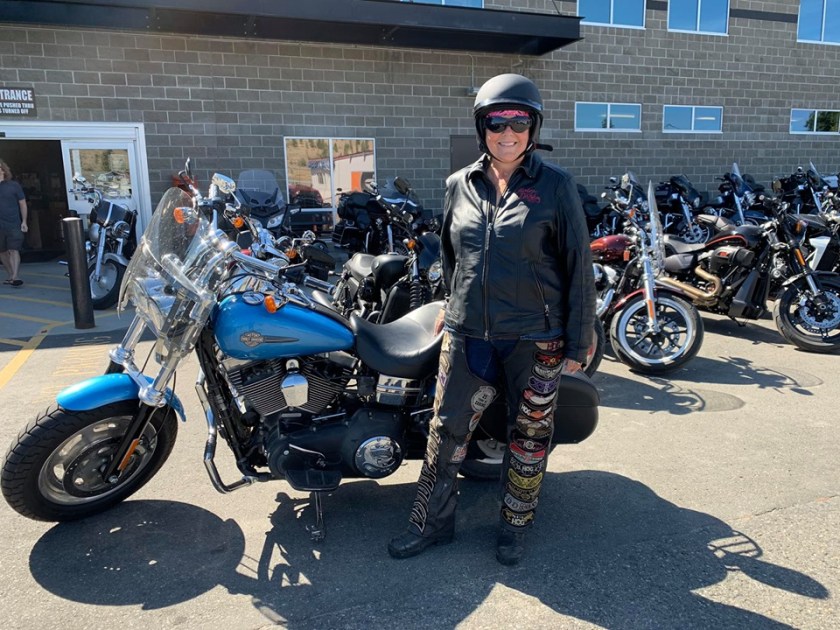
Maggie Thompson, with the Blue Bomb before parting with it last week. (Facebook photo)

In brief, here is a definition of peritoneal dialysis from kidneyfund.org: “Peritoneal dialysis (PD) is a treatment that uses the lining of your abdomen (belly area), called your peritoneum, and a cleaning solution called dialysate to clean your blood. Dialysate absorbs waste and fluid from your blood, using your peritoneum as a filter.”

A catheter is surgically implanted into our peritoneum that will allow you to do fluid exchanges. You learn how to do PD manually four times a day before being given a cycler that allows you to do it while sleeping at night. And the only way it limits your ability to travel is if you allow it to, something Maggie wouldn’t do.

A Harley-Davidson rider and owner, Maggie took a lengthy trip with friends into the U.S. a few years back. She drew up a travel schedule and arranged with Baxter, the company that provides PD supplies, to make fluid drops at various stops. Friends constructed a trailer that she towed behind her Harley; it contained other needed supplies.

As the friends travelled, then, they would stop to allow Maggie to do her exchanges.

Since having her transplant in July of 2011, Maggie hasn’t slowed down at all. She moved to Edmonton early in 2018, but makes regular visits to Kamloops, where she had lived for 30 years. Earlier this summer, she took two grandsons to the Calgary Stampede — yes, she also has a car — and then on a tour around Vancouver Island that included a stop in Tofino.

Maggie
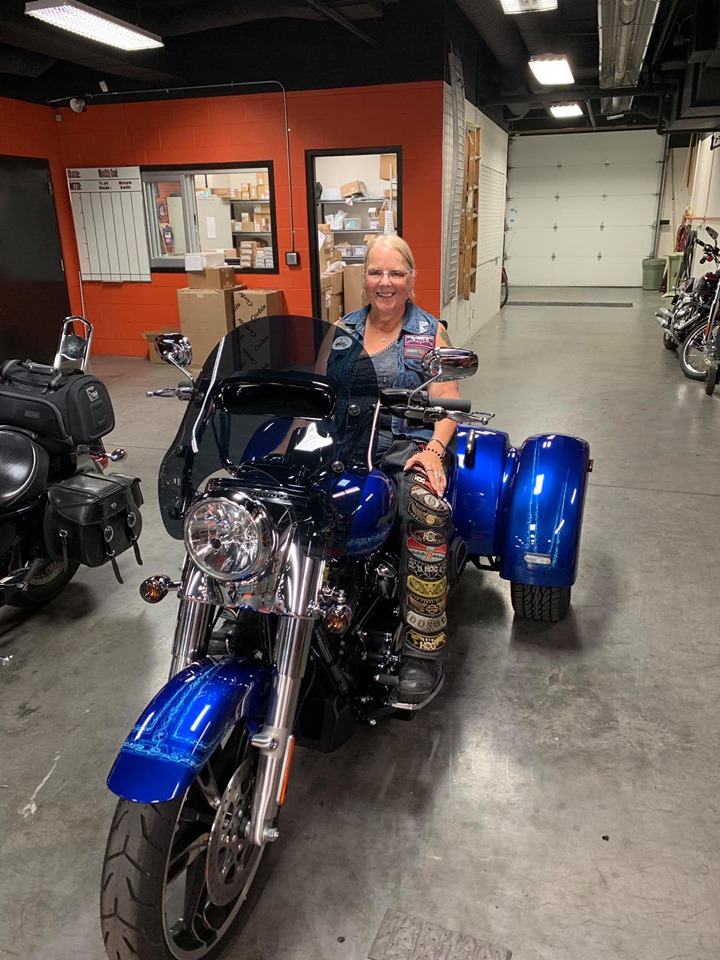
Maggie Thompson, with her new ride, Sassy Sapphire. (Facebook photo)

Late last week, Maggie rode her Harley — she called it the Blue Bomb — to Kamloops, where she visited the local dealership and traded it in on a Freewheeler Trike that she has dubbed Sassy Sapphire.

After a few days with us, Maggie climbed aboard Sassy Sapphire on Tuesday morning and headed home to Edmonton. She arrived early last evening having been on the road for almost 12 hours.

No, kidney disease hasn’t slowed down Maggie Thompson in the least.


It is National Polycystic Kidney Disease (PKD) Awareness Day in various parts of the world today (Wednesday, Sept. 4).

According to a news release:

“Since 2014, Health Canada has recognized September 4 as National Polycystic Kidney Disease (PKD) Awareness Day – a special day devoted to raising awareness of this life-threatening, genetic disease.

“Polycystic kidney disease (PKD) is a chronic, genetic disease causing uncontrolled growth of fluid-filled cysts in the kidneys, often leading to kidney failure. With 66,000 Canadians and millions worldwide living with PKD today, chances are high that you know someone with the disease.

“The more who know about PKD, the more resources we can dedicate to finding treatments and a cure. PKD Awareness Day is our opportunity to step up our efforts and gives us a platform to widely spread the word, share stories and encourage others to learn more. On PKD Awareness Day, let’s come together as a united front to spread the word about this disease further than we ever have before!

“Since its creation in 1993, the PKD Foundation of Canada has raised more than $1 million towards research, support and help for families living with PKD. From the first research grant awarded in 1999, the PKD Foundation of Canada has set up chapters and support groups across the country, built an expansive and passionate volunteer network, and connected with PKD groups around the world to support our most notable fundraising event – the Walk to END PKD.

“Today, the PKD Foundation of Canada is the only national organization solely dedicated to fighting PKD through research, education, advocacy, support and awareness.”

In Kamloops, locals involved in the PKD Foundation will appear before City Council on Sept. 10 in an attempt to spread awareness.


Here in Kamloops, preparations are well underway for the annual Kidney Walk, which is scheduled for Sept. 22 at McDonald Park. . . . If you would like to take part, we register at 10 a.m., with the walk to follow at 11. Some of us will walk a couple of kilometres, but there isn’t a defined distance. In fact, you don’t need to walk at all. Just come and join us for the breakfast — pancakes, bacon and coffee, by donation — with the Brock Central Lions Club doing the cooking. . . .

My wife, Dorothy, will be celebrating the sixth anniversary of her kidney transplant by taking part in her sixth straight Kidney Walk. In her six walks, she has raised more than $15,000. If you would like to support her, you may do so right here.