Welcome to a site where we sometimes provide food for thought, and often provide information about the Western Canada Professional Hockey Scouts Foundation.
I feel it is only right and proper to put an end to any and all speculation that may exist on social media and elsewhere–thanks to those kind enough to put my name forward, but I wish to categorically deny any interest in coaching the Maple Leafs.
When Roy MacGregor writes, I read. Such was the case with the superb essayist’s piece on the Don Cherry situation. As we have come to expect from MacGregor, it is terrific. . . . At one point, he writes that Cherry was fired “for a last straw no one could fit into the overstuffed barn that holds all the previous last straws.” . . . It doesn’t get any better, and it’s right here.
WHO WON THE GAME TONIGHT!? And I’m being serious. Twitter says WHL, online says Russia.
ICYMI, here’s how the annual junior hugfest between CHL teams and a touring Russian side ended last Thursday in Prince Albert. The Russians won the game, but had to go to a shootout to get it done. That outcome left the series — the Russians play two games against teams from the QMJHL, OHL and WHL — all even. . . . Guess what? . . . Yes, they went to another shootout. The WHL won that one on a goal by F Nolan Foote of the Kelowna Rockets to win the series. . . . Seriously!
——
BTW, the CHL’s broadcast partner, Rogers Sportsnet, put that final game on one of its channels, something called 360. When that game began, Sportsnet was showing an NHL game — New York Rangers at Tampa Bay Lightning — on four other channels. ICYMI, the Lightning opened up a 4-0 first-period lead en route to a 9-3 victory.
——
19 games – 10 OHL, just 5 QMJHL, & 4 WHL. But come Memorial Cup, Sportsnet staff will once again be "experts" on junior hockey.
The CHL (the Q & W especially) simply needs to do better in their national TV contract. Sportsnet doesn't care about the CHL, they have the NHL. https://t.co/kdIQcMGJNS
Tyler Yaremchuk was part of the TSN1260 broadcast crew in Edmonton on Friday when the Alberta Golden Bears skated to a 4-2 victory over the visiting Regina Cougars. . . . After the game, he tweeted: “50 straight wins for the Bears over Regina.” . . . Think about that for a moment or two . . . 50 in a row! Yikes!!! Now that’s a streak. . . . Dustin Nielson, the play-by-play voice on that broadcast team, tells me that the Golden Bears last lost to the Cougars in 2009. “Also haven’t lost at home to them since 1996,” he added. . . . Connor Hood, writing on the U of A’s website, pointed out that the streak “dates back to March 13, 2009, and includes 43 conference games, two playoff games and five non-conference games.” . . . On Saturday night, the Golden Bears ran that streak to 51 games with a 9-0 victory.
I'm so old I remember when #BlackFriday sales didn't last all month.
Running back Saquon Barkley of the New York Giants had one yard rushing on 13 carries in a recent loss to the New York Jets. . . . Dwight Perry of the Seattle Times broke that down a bit more: “To put that in perspective, that’s 2.9 per attempt — inches, not yards. Or . . . at that rate, just 117 more carries and he’d have a first down!”
It's going to happen! Minnesota calls up goalie Kaapo Kahkonen. Wild play Rangers on Monday. It'll be Kaapo Kakko versus Kaapo Kahkonen.
By now, you may have seen video of Houston Rockets guard Austin Rivers working the referees in the hopes they would give his father, Los Angeles Clippers head coach Doc Rivers, a technical foul on Nov. 13. Officials did just that, and then they ejected him. . . . Later, on Twitter, Austin wrote: “Welp . . . Thanksgiving is going to be weird . . .”
Hey, Kamloops, I got gas in Burnaby on Saturday night for $1.24.9. That’s only five cents more than I paid in our town on Friday night.
——
On the way to the Lower Mainland on Saturday morning, I collapsed a hundred times, if not more. Actually, we ran into snow, sleet, ice pellets and rain, lots of rain. . . . So what’s with all the drivers who can’t be bothered to turn on their headlights to that their taillights are on?
Donald Trump could end up with a library with his name on it. That would be like a gym with Keith Richards' name on it.
Imagine the odds you could have gotten on October 1 that Don Cherry AND Mike Babcock would be fired within a week of each other and before the end of November? Astronomical.
Mike Babcock now has been fired by two hockey teams — the Toronto Maple Leafs and the WHL’s Moose Jaw Warriors. The big difference is that the Warriors didn’t owe him about $23 million when they did the deed. . . .
Jack Todd has been writing about Don Cherry for a long time. So you knew that something was coming after Rogers Sportsnet fired Cherry. Todd’s column is right here.
Cranbrook’s Western Financial Place now is the official home of the Cranbrook Bucks, a BCHL team that will begin play next season. Their sign was installed just the other day. The Bucks put their sign directly into the frame that once held a sign indicating the facility was home to the WHL’s Kootenay Ice, a franchise that now calls Winnipeg home. (Photo: Darren Cottingham)
Patti Dawn Swansson, aka The River City Renegade, hits the nail on the head right here: “Really annoying people: The 7-Eleven Guy and Matthew McConaughey. I think a perfect commercial would be the 7-Eleven Guy spilling a strawberry Slurpee on the posh seats of McConaughey’s fancy-schmancy Lincoln.” . . . There’s more right here.
JUST NOTES: Would someone at ESPN please tell Randy Moss that he is speaking into a microphone so he doesn’t need to yell at us. Thank you. . . . Gotta think the World Curling Federation will be making a rule change in the not-too-distant future after a ruling caused Norway’s men to forfeit a game to England during the European championships in Helsingborg, Sweden on Sunday. It seems Norway subbed in a curler who didn’t use the broom of the player he was replacing. Yes, that’s against the rules. There’s more right here. . . .
Going by the part of the WHL website that lists disciplinary actions, Adam Foote, the Kelowna Rockets’ head coach, hasn’t yet been fined for not doing a post-game media interview after a 5-2 loss to the Blazers in Kamloops on Nov. 11. The WHL has a rule that states a coach must be available to media 15 minutes after a game. Conspiracy theorists, have at it. . . . The NHL announced on Tuesday that the season-ending award it gives to its top GM will be named after the late Jim Gregory. There isn’t an award named for Sam Pollock, Glen Sather or Bill Torrey, each of whom put together dominant teams. Of course, the NHL doesn’t have any individual awards named in honour of Wayne Gretzky or Mario Lemieux, either. . . . Hey, TSN, I realize that Toronto is the centre of your universe. I get that. So when the Maple Leafs fire Mike Babcock, your world stops. Yes, I get that, too. But you’ve got five channels so why cut off PTI before the episode is over just to show what’s available elsewhere? Why not show the viewer — me — some respect?
If you have been impacted by kidney disease, you will have some understanding of what is involved in living with something for which there isn’t a cure.
My wife, Dorothy, has kidney disease, and underwent a transplant on Sept. 23, 2013. Prior to that, she did peritoneal dialysis (PD) for almost four years. That involved being hooked up to a cycler and doing a fluid exchange for seven or eight hours every night — seven nights a week, 52 weeks a year.
This week, Lindsey Backmeyer of Kamloops, whose daughter, Ferris, is in need of a kidney transplant, took to Facebook to provide some insight into their situation.
Ferris Backmeyer, 2-1/2, has chronic kidney disease (CKD) and her family is searching for a live kidney donor. (Photo: Lindsey Backmeyer)
Ferris is 2-1/2 years of age. She has had problems gaining weight and keeping that weight on, so only recently has her family been given the OK by their medical team to begin looking for a live donor.
In the meantime, Ferris continues to spend 13 hours overnight doing PD at home.
What follows is Lindsey’s post from Facebook . . .
“I am reminded daily just how hard living with ckd (chronic kidney disease) is for my sweet girl. Like this fine morning where she woke up way earlier than usual and we get to hang out on the bed for 2.5 hours to finish up dialysis.
“Most days are started with fits of vomiting and low energy levels. I’ve come to learn that this doesn’t necessarily depict a good or bad day. In fact most of our days are filled with smiles, afternoon/evening energy and cheeky toddler behaviour. The relentless vomiting is very normal for a pediatric dialysis patient — I say this only because I don’t know the adult world nearly as well.
“As of our last trip to Vancouver I’ve been informed Ferris is almost done the assessment process making her one step closer to a life-saving kidney transplant. Somehow, four weeks has almost passed and we are preparing to head down again next weekend. I am fairly certain the bulk of assessment will be completed and this discussion of living/deceased donors will be brought up yet again.
“I was informed that my health history of gestational diabetes and kidney stones in pregnancy makes me unsuitable for organ donation. The sobering realization that my girl’s chance at a better quality of life is completely out of my hands hit me harder than I had expected.
“A living kidney donor is Ferris’s best shot. Due to her age, she will likely need a couple of transplants over time. The first one is always the easiest to match and subsequent ones become harder due to the development of antibodies.
“Kidney’s from live donors are on the whole more successful and last longer than a kidney from a deceased donor. This means we want her first transplant to be the best kidney we can possibly find for her. The best kidney would be from a young healthy live donor.
“We are beyond ready, excited and terrified for transplant. I am hopeful we will see less vomiting, better energy levels, development in speech and language, oral eating and physical growth. These are the things other parents of transplanted toddlers have seen and I so badly want these things for Ferris.
“I can’t wait to say goodbye to 13 hours per day on dialysis. The freedom to stay out late, sleep wherever and have baths with her sisters will be nice, too.
“We are actively looking for a live kidney donor. It’s truly the most selfless act of life-saving kindness. Please share and help us find Ferris a kidney!”
——
If you are interested in more information about becoming a live kidney donor, here you go:
DYK? As of Nov 1, 2019, there are 5,130 British Columbians alive because of an organ transplant. Visit our website for monthly updates on health information statistics. pic.twitter.com/i3R58UWvra
More numbers from BC Transplant: There are 1,487,323 donors registered in the province’s organ donor registry; there were 406 transplants performed in 2019, to Nov. 1; and there still were 755 patients awaiting transplants. . . . Visit the website at transplant.bc.ca for more information and lots more numbers.
Sean Delaney of Edmonton is the associate director of organ listing and allocation at Canadian Blood Services. Delaney, 48, also has undergone a kidney transplant; in fact, he had one more than 20 years ago when he got one from his brother. . . . Delaney’s story, as told by Moira Wyton of Postmedia, is right here, and it’s an interesting one. . . . “Delaney works to streamline organ donation across the country,” Wyton writes, “and create new ways to help people receive the organs they need to live and thrive.
This has included the creation of a national registry to administer new programs such as the Kidney Paired Donation Program, which has facilitated more than 700 transplants since its founding in 2009.” . . . Through all of this, he now finds himself back on the transplant list because his kidney is in failure, and he is doing peritoneal dialysis.
IN THE NEWS! 📰📣 Sean Delaney is an advocate for organ transplant recipients just like him. https://t.co/HXr0hk5lAa
— Kidney Foundation, BC & Yukon Branch (@KidneyBCY) November 15, 2019
GIVING TUESDAY 📖Meet Mauro: “No one knows what a [kidney] patient goes through until they are in their shoes. The only reason I did it [dialysis] was because I have a wife I adore and a daughter who has grown into a beautiful young lady.” https://t.co/eAW31gVqLL#HIDDENScarsCKDpic.twitter.com/7nLfZsvvcm
— Kidney Foundation, BC & Yukon Branch (@KidneyBCY) November 19, 2019
Check out this story from Cleveland where doctors at a clinic have used a robot to perform a kidney transplant . . .
IN THE NEWS! 📰📣 Cleveland Clinic doctors perform world’s first kidney transplant using single-incision robot. The single-port kidney transplant enables all surgical instruments and the donor kidney to be placed through one small abdominal incision.https://t.co/mIpRWryMwH
— Kidney Foundation, BC & Yukon Branch (@KidneyBCY) November 18, 2019
Will somebody please hold Merlin Olsen down for a few days? Tie him up if you have to.
It might be a good idea to give every defensive lineman in the area rabies shots. Quarantine the Ram camp.
Conrad Dobler is in town!
You all remember Conrad Dobler? The guy with the Fu Manchu moustache and the antisocial instincts of a treed gorilla. Put an iron flowerpot on his head and a sabre in one hand and you got Conan the Barbarian. A one-man Mongol horde. Genghis Khan would hide.
Conrad didn’t play football, he waged it. You couldn’t describe what he did as play. Not unless you figure the Indians played Custer.
Dobler turned a line of scrimmage into a killing ground. He went about the game with the maniacal, suicidal fervor of one of those people who think you go right to heaven if you die in battle.
Football is a brutal, violent game, but Dobler put another dimension to it. Strong men would go white at the lips, and veins would stand out in their necks when they spoke of Conrad Dobler. And those were just his teammates.
People on other teams would have to be restrained from getting a gun and insisting no judge in the world would call it anything but justifiable homicide. Dobler wasn’t just hated, he was abhorred.
He loved it.
He tells his side of the story in a new book, “They Call Me Dirty” (Putnam), that he was in town to publicize this week.
Dobler didn’t have a career, he had an apocalypse. Some guys put on their game face the morning of the game. Dobler was born with his. Some guys wear a mask to protect their face. Dobler wore his to protect the league.
First of all, there was the leg whip. This was a little refinement of the art of football mayhem that can only be likened to bombing unarmed cities or stoning baby carriages.
It calls for a lineman, if fooled or knocked out of his block, to whirl his body around with his legs out-thrust in such a way that they come blasting across the opposing lineman’s knees — or eyes or teeth — and do more or less permanent damage to his ability to make the tackle, or breathe normally for the rest of the game, for all of that.
Dobler also had this little technique of jamming his fingertips or his knuckles into an opponent’s Adam’s apple, a little maneuver the Gestapo used to use to make you talk. Dobler’s victims sometimes weren’t able to talk for days. Even Mean Joe Greene used to say, “What’s the matter with you, Dobler?”
Conrad Dobler was almost the Eddie Stanky of football. He wasn’t very big, he wasn’t very strong, he wasn’t very fast — all he could do was beat you. He always felt he had to get the first punch in. And the second and the third.
Still, he was part of what was, certifiably, the best offensive line in the history of pro football. The St. Louis Cardinals of the ’70s, the cement blocks of football, with Dobler, Dan Dierdorf and Thomas Banks anchoring them, set the National Football League record by giving up only eight sacks one season, and one of those was a field-goal attempt that went sour on a bad snap from center. To give you an idea how impressive that was, the Raiders’ quarterback was sacked nine times last Sunday alone.
Dobler’s assault was psychological as well as physical. “I used to find some reason to get mad at that guy across from me. He had freckles. He didn’t have freckles. He talked too much. He didn’t talk enough.
“Then, I had to get him so mad at me, he’d forget to play football. He’d just want to kill me. He’d forget to get the quarterback.
“I remember, once, I had Kenny Houston so mad at me on a sweep, he went right for me and let the ballcarrier go. He upended me. But the ballcarrier went in for a touchdown. He’d say, `Ha, Dobler! I got you that time!’ And I’d say, `You think so, donkey? Look in the end zone!’ “
Dobler used to get Olsen, the Rams’ all-world defensive tackle, so mad that they would turn their game into Dempsey-Firpo. Years later, on one of his TV shows, Olsen had a scene that showed a tombstone in the old West. On it was the inscription: “Here lies Conrad Dobler. Gone but not forgiven.”
Eventually, this notoriety boomeranged. Dobler had achieved such a reputation for kicking and biting — “Ever stop to wonder what fingers were doing inside my face mask?” — that the league not only outlawed the leg whip and the throat gouge, but Dobler became the marked man of football.
“There’d be a play where another lineman would have part of another player’s shirt in his hand — and they would call the holding on me!” Dobler says.
He was like the Mafia don who lives his life in the lenses of the FBI photographing his every move. He couldn’t function. “When you start stalling your team’s touchdown drives with phantom penalties, you’ve had it.”
Still, Dobler figures he elevated one of the obscure positions in football into a semi-glamour role. “I needed an edge and I found it,” he says. “I played 10 years and on the best offensive line ever in football.”
If he has any regrets, it’s that he never played in a Super Bowl — and that his outlaw reputation overshadowed his considerable talents as a player.
“I want people to know I was the very best,” he says. “I want them to know I was a player of ability. I made teams good. And when I left them, they became losers again.”
Sure, Conrad. Whatever you say. Now, can I have my hand back? And please put me down!
——
Reprinted with the permission of the Los Angeles Times
Jim Murray Memorial Foundation, P.O. Box 60753, Pasadena, CA 91116
———
What is the Jim Murray Memorial Foundation?
The Jim Murray Memorial Foundation is a 501(c)(3) nonprofit organization, established in 1999 to perpetuate the Jim Murray legacy, and his love for and dedication to his extraordinary career in journalism. Since 1999, JMMF has granted 104 $5,000 scholarships to outstanding journalism students. Success of the Jim Murray Memorial Foundation’s efforts depends heavily on the contributions from generous individuals, organizations, corporations, and volunteers who align themselves with the mission and values of the JMMF.
A dozen years ago, Linda McCoy-Murray compiled a book of Jim Murray’s columns on female athletes (1961-1998). While the book is idle waiting for an interested publisher, the JMMF thinks this is an appropriate year to get the book on the shelves, i.e., Jim Murray’s 100th birthday, 1919-2019.
Our mission is to empower women of all ages to succeed and prosper — in and out of sports — while entertaining the reader with Jim Murray’s wit and hyperbole. An excellent teaching tool for Women’s Studies.
Proceeds from book sales will benefit the Jim Murray Memorial Foundation, a 501(c)(3) not-for-profit organization providing sports journalism scholarships at universities across the country.
Toby Boulet, whose son, Logan, was killed in the crash of the Humboldt Broncos’ bus, has spoken out about the bill before the Alberta legislature that will permit organ donation unless a person has opted out of the process. . . . Boulet told Bob Weber of The Canadian Press that “there’s way more that needs to be added to the bill.” . . . Logan Boulet’s organs were harvested after his death and six people benefited from them. That turned into a huge story and thousands of people subsequently registered for organ donation, a phenomenon now recognized as the Logan Boulet Effect. . . . Toby and his wife, Bernadine, now speak frequently on organ donation. . . . According to Weber, Toby told him that the bill’s biggest failing is that it can’t address attitudes. “It’s pretty hard, in my opinion, to tell Albertans to do anything,” Boulet told Weber. “Albertans do the right thing. But if you tell them what to do, they don’t do the right thing. If you tell someone you’re going to have presumed consent in a law, that’s not going to go over very well.” . . . Boulet also pointed out that there will be a need to have “surgical teams that are dedicated and ready to go at a moment’s notice. We only have that in Calgary and Edmonton.” . . . Weber’s complete story is right here.
——
On Tuesday, Prince Edward Island moved closer to a system of presumed consent for organ donation, something that is expected to become law in Nova Scotia sometime in 2020. . . . In P.E.I., legislators on Tuesday passed a motion under which a committee “will reconsider the province’s rules concerning organ donation,” reported Kevin Yarr of CBC News. . . . His story is right here.
His name is Kirk Johnson, but he is better known as Jelly Roll Johnson, a top-of-the-line harmonica player. According to Jessica Bliss of the Nashville Tennessean: “He played harmonica on more than 50 gold and platinum albums, including three Grammy-winners by Randy Travis. He appeared on the Late Show, the Tonight Show, the CMA Awards show.” . . . One other thing — he dealt with PKD (polycystic kidney disease) for all of that time, knowing that it had killed his father and at least three other relatives had it. No, he didn’t miss any gigs and he often played at Nashville’s Bluebird Cafe while undergoing dialysis. . . . Eventually, he went through a liver and kidney transplant. . . . His story, as written by Bliss, is right here and it’s well worth a read.
Johnson pays tribute to his donor family through his life passion – playing the harmonica. "I think about the donor and his or her family every day," he said. "I'm grateful, and at the same time I realize they've had a tragedy." https://t.co/NPxEkH5pWL
— Kidney Foundation, BC & Yukon Branch (@KidneyBCY) November 14, 2019
——
Ian Furness, a sportscaster with Sports Radio KJR in Seattle, knows of what he tweets. His son, Kiefer, a high school student and an athlete, has been diagnosed with Type 1 Diabetes.
— Kidney Foundation, BC & Yukon Branch (@KidneyBCY) November 13, 2019
The next KFOC webinar, Nov 19 at 3 PM ET, deals with self-management of chronic kidney disease (CKD). Hear from a researcher and a kidney patient on how to balance CKD with the demands of daily life while maintaining emotional well-being. Register at: https://t.co/Nx7WAhwNu0pic.twitter.com/Uz0Ajz462p
— Kidney Foundation, BC & Yukon Branch (@KidneyBCY) November 9, 2019
IN THE NEWS! 📰📣 Heather Zirk: More families should be talking about organ and tissue donation. Heather Zirk, whose husband Harry donated tissue to an organ recipient many years ago, talks about what the transplant system does for families.https://t.co/ZoPQgq9l71
— Kidney Foundation, BC & Yukon Branch (@KidneyBCY) November 14, 2019
Sorry for all the hockey content in this episode of Scattershooting, but, hey, stuff happens. And, no, don’t be looking for any Don Cherry content here. I don’t know about you, but I am Cherryed out. . . .
The best thing about Australian rules football was every score resulted in a guy in a hat acting like Isaac just after he’d mixed a perfect mojito on the Love Boat. pic.twitter.com/VotY8so7ut
ICYMI, Don Nachbaur, a former WHL player and head coach, is back in the coaching game. He had Andrej Podkonicky, also a former WHL player, now are co-head coaches of HKM Zvolen, a Slovakian team in the Extraliga. . . . Podkonicky and Michal Kobezda had been coaching the club; Kobezda remains as an assistant coach. . . . Nachbaur, who spent seven seasons as head coach of the Spokane Chiefs after also working with the Tri-City Americans and Seattle Thunderbirds, was an assistant with the NHL’s Los Angeles Kings for 2017-18, but was dismissed 13 games into last season when head coach John Stevens was fired. . . . Podkonicky played two seasons (1996-98) with the Portland Winterhawks.
If you’re a WHL fan, you should know that the 2019-20 WHL Guide is available for download at whl.ca. . . . Just go to the tab slugged The WHL and click on WHL Guide and Record Book.
When the Vancouver Canucks entertained the Nashville Predators on Tuesday night, there was at least one celebrity in the stands. . . . Yes, Bill Murray had his 50/50 numbers; no, he didn’t seem to win. He also appeared to be wearing a Chicago Blackhawks sweater, which wasn’t a surprise as he is from Evanston, Ill.
Yes, Monday night’s NFL game between the visiting Seattle Seahawks and San Francisco 49ers — who, by the way, don’t play in San Francisco — was messy and sloppy and all of those things. But, hey, was it exciting, or what? . . . If you weren’t aware, the 49ers visit the Seahawks on Dec. 29. Happy New Year a few days early!
Will have comments from Blazers’ HC Shaun Clouston in today’s game story. Rockets’ HC Adam Foote declined interview request. Rockets’ rep emerged from coaches’ room and said sorry, but not today. #Kamloops#WHL
In his story after the host Kamloops Blazers beat the Kelowna Rockets, 5-2, on Monday, Marty Hastings of Kamloops This Week included this: “Rockets’ head coach Adam Foote refused a post-game interview request from KTW.”
Included in the WHL Guide is this, under Media Access to Players and other Team Personnel: “A member of the coaching staff of each team must be available to the media for interviews within 15 minutes following the game.”
Hmm, gotta wonder if the WHL will stick a hand into Foote’s wallet for this indiscretion?
——
That loss on Monday was the Rockets’ fourth straight. The Rockets, the host team for the 2020 Memorial Cup tournament, have allowed 25 goals in those four losses. That also was Kelowna’s 10th loss in 19 games this season. As well, veteran F Kyle Topping, 20, has had surgery to repair a broken ankle suffered during a 1-0 victory over the Royals in Victoria on Oct. 30, so he won’t play for a long time.
We now are left to wait and see how much of the winery the Rockets will sell in an attempt to bolster their roster for the tournament.
The Swift Current Broncos and Regina Pats sold their farms in order to make title runs in 2017-18 when both played in the Memorial Cup tournament, the Broncos as WHL champions and the Pats as the host team.
They since have fallen on hard times. Last season, they combined for 24 victories in 136 games and neither team made the playoffs. This season, they have totalled five victories — yes, five — in 33 games and, again, aren’t likely to appear in the playoffs.
The Rockets’ management, it would seem, has some big decisions ahead of it.
——-
When the WHL’s board of governors awarded the 2020 Memorial Cup tournament to Kelowna, it also heard presentations from the Kamloops Blazers and Lethbridge Hurricanes. The Blazers are 13-6-0 and riding high atop the B.C. Division; the Hurricanes are 13-5-3 and second in the Central Division, one point out of first.
——
Kelowna's Pavel Novak given a 5 minute major and GM for checking from behind on Kamloops forward Kyrell Sopotyk today. Sopotyk needed help to get off the ice. pic.twitter.com/N9qkhe3aAK
This was ugly . . . big-time nasty . . . and it drew an eight-game suspension from the WHL early Wednesday evening.
(I would have started at 20 games, but then I was in the building the night that Brad Hornung was injured, so I’m a little sensitive about hits like this.)
That’s F Pavel Novak of the visiting Kelowna Rockets drilling Kamloops Blazers F Kyrell Sopotyk from behind during a Monday afternoon game. Sopotyk (shoulder) is expected to sit for up to two months.
The Blazers will open a six-game East Division trek against the Brandon Wheat Kings on Dec. 6 and Sopotyk, who is from Aberdeen, Sask., won’t make the trip.
That means he has been robbed of the opportunity to play in front of family and friends in his home province — Aberdeen is a few slapshots northeast of Saskatoon. He’s 18 so, due to the way the WHL works its schedule, will have to wait until the 2021-22 season for the next opportunity, in his 20-year-old season.
When the Blazers wrap up their East Division trip on Dec. 14, against the Prince Albert Raiders, Sopotyk will have missed 14 games.
Meant to say TIED for longest suspension in 5 years. There have been a number of 8 gamers in the last few years.
I can’t remember anything like what is about to happen in the CFL’s West Division final in Regina on Sunday. I mean, the Saskatchewan Roughriders acquired quarterback Zach Collaros for the 2018 season, then signed him over the off-season thinking he would be their guy. But he got mugged three plays into this season and, once recovered from the concussion, was traded to the Toronto Argonauts. Meanwhile, the Winnipeg Blue Bombers lost their starter, Matt Nichols, and dealt for Collaros. On Sunday, then, Collaros will lead the Bombers into Regina with a berth in the Grey Cup on the line. . . . Wait, there’s more. . . . Cody Fajardo, who took over the Roughriders when Collaros was hurt, went on to have a fabulous season. But now there’s this problem with an oblique muscle, meaning Fajardo may not be able play on Sunday, which would give Isaac Harker his second career CFL start. . . . A year ago, you may recall, the Roughriders and Bombers played a West Division semifinal in Winnipeg. Collaros was concussed and wasn’t able to start for the Roughriders, who, after days of intrigue, trotted out Brandon Bridge. . . . The Blue Bombers won that one, 23-18.
In case you missed it, and I did, Team WHL played a touring Russian side in Saskatoon on Wednesday night. It was Game 5 of the annual CIBC-sponsored funfest. While the first four games — two each versus the QMJHL and OHL — got great exposure from the CHL’s broadcast partner, Rogers Sportsnet, last night’s game started on something called OLN and then was joined in progress on some Sportsnet channels. . . . I wanted to watch, but I couldn’t find OLN and, no, I don’t stream. . . . But, hey, it was the Toronto Maple Leafs at New York Islanders on five channels on my setup, with the Ottawa Senators at New Jersey Devils on another. Oh, and two channels had on something called Gotta See It, leading eventually into the Dallas Stars at Calgary Flames. . . . And by the time the WHL/Russian game was joined in progress, I had moved on to a couple of PVR’d episodes of Hogan’s Heroes. (Was a men’s wear store part of Stalag 13? If not, how is it that Hogan and Co. always seem to be wearing such well-fitting clothes?) . . . Anyway, I seem to recall a dearth of CHL playoff games on Sportsnet last spring and there was no sign of the outdoor game last month between the Calgary Hitmen and host Regina Pats. . . . Seriously, CHL, if this is the best your broadcast partner is able to do for you, it might be time to move on.
——
BTW, I went to Google hoping to find out something about OLN. This is from Wikipedia: “OLN is a Canadian English-language Category A specialty channel. OLN primarily broadcasts factual-based adventure-related programming and reality television series primarily aimed at male audiences.”
You have to love the big story in Major League Baseball these days about the Houston Astros and cheating. Only in baseball is their ‘honest’ cheating — having a runner on second base stealing an opponent’s signs — and ‘dishonest’ cheating — doing it with a camera from centre field and banging a garbage can in a tunnel to let the hitter know that he’s about to see an off-speed pitch. . . . And we won’t even get into the fact that the Astros are investigating themselves on this one.
Gotta run. Time to dig into Ken Dryden’s latest work . . . Scotty: A Hockey Life Like No Other. You’re right. I couldn’t wait until Christmas.
Last week it was announced that the George family had sold the Indianapolis Motor Speedway, home of the Indianapolis 500, Brickyard 400 and the Indy Car Grand Prix. The 2.5-mile oval in Speedway, Indiana, that has been in the Hulman-George family since 1945 now is owned by Roger Penske.
In honor of Veteran’s Day (Penske is a big supporter of veterans) and Penske’s purchase of the IMS, we bring you Jim Murray’s column from April 19, 1993.
Enjoy!
——
APRIL 19, 1993, SPORTS
Copyright 1993/THE TIMES MIRROR COMPANY
JIM MURRAY
You Want a Good Driver? Check With Roger Penske
It used to be said, if you wanted a baseball player, you checked with Branch Rickey. He could spot a 20-game winner from the window of a moving train, so the legend went.
If you wanted a football player, you went with Knute Rockne. He could get George Gipp out of a pool hall.
Needing a fighter, you would go to Cus d’Amato and tell him whether you wanted a Patterson or a Mike Tyson.
A Louis B. Mayer could find star quality in a guy parking cars at the studio lot.
But if you want a race car driver — and ones named Unser or Andretti aren’t available — check with Roger Penske.
Penske can spot a racing champion driving a cab. Or a truck. Look at the record: He found Mark Donohue, who was a graduate of Brown University, no less, and looked more like a refugee from an Ivy League faculty than a speed merchant. Penske won Indianapolis with him.
Then, he sort of found Tom Sneva driving a school bus in Spokane, Wash. He was principal of a high school, for cryin’ out loud. Penske won Indianapolis with him.
He found Rick Mears on a motorcycle in Colorado. Penske won four Indianapolises with him.
None of those guys really fit the mold of the hard-bitten leadfoots of the roaring road. I mean, they didn’t remind you of A.J. Foyt till they hit Victory Lane. Neither did Danny Sullivan when he won for Roger at Indy. Danny had been a Manhattan playboy.
So, when Penske signed a young Canadian chauffeur named Paul Tracy to replace the retiring Mears last year, a lot of people might have wondered what he saw in him. Except it would be like asking Rockne what in the world he saw in the Four Horsemen. Or what made Doc Kearns think Dempsey could fight.
Paul did not fit your basic profile of an Indy prospect. He wore glasses for nearsightedness. He was so pale he could haunt a house. You could see through him. If he chewed gum, you could see it.
But he had been driving cars since he was 6. His father would drop him off at a Go-Kart track with a box lunch and a can of gasoline and leave him there all day. He spent more time on wheels than entire teamster locals in eastern Canada.
When he was 15, he was competing in world championship Kart races. As he got older he was around cars so much he almost needed a periodic oil change himself.
Canadian kids are supposed to head for the ice as soon as they’re old enough to lace on skates. Paul Tracy preferred a garage to a rink, wheels to skates. He wanted to be an Unser, not a Gretzky.
He won a Can-Am race when he was only 16, the youngest ever. He was winning races before his voice changed. He was driving cars when other kids hadn’t gotten off tricycles. He could drive better than he could walk.
But there was nothing to suggest this was a future Foyt. Until Penske caught his act.
Penske didn’t want to sit him on the pole at Indy right away. What he basically wanted, at first, was a kid with patience, common sense and an ability to stand boredom. All of these are in short supply along pit row, where the greatest collection of people in a hurry in the world can be found.
Penske wanted to put his young discovery through a crucible of testing. This is a long, monotonous grind where you road-test cars, not by the hour but by the day. It’s a lonely boring way to spend a day. Or a week. Even a bus driver’s job is more fun than that of a racer, who has to tool a race car for interminable hours on an oval. He drives 500 miles and doesn’t go anywhere. He never sees another car.
Tracy did it, day after dull day. And the day came when Penske finally decided he had paid his dues and put him in a race car.
It’s too early to tell if he’s going to carry the Penske flag into further victories, but he got his first victory in an Indy car race on Sunday in the 19th Long Beach Toyota Grand Prix by more than 12 seconds over a former Indy winner, Bobby Rahal, and the current world Formula One champion driver, Nigel Mansell.
Tracy was like a guy let out of the laboratory. He had company on the track. He even scrubbed wheels with Danny Sullivan. He had the thrill of several flat tires in traffic, and went through the crowded streets of Long Beach, instead of the wimpy surfaces of a test track.
If you’ve ever looked at the family sedan gas gauge as it wavered perilously close to “E” and sucked it up and hoped it wouldn’t go on fumes as you were going through a rough stretch of road or neighborhood, you can sympathize with Driver Tracy.
He had been exchanging leadership in the race with the great Mansell until he hit Lap 60 and pitted, surrendering the lead to the Briton. Tracy refuelled. He tailed the Mansell car until it needed to pit on Lap 73.
Tracy had enough fuel for about 40 laps. He had 45 left in the 105-lap race. He put Mansell behind him and got ready.
In that situation, you wait for the dreaded cough and sputter in the engine and the sudden loss of power and movement. It never came. Paul Tracy spun under his first Indy-car checkered flag.
In a race that had Unsers and Andrettis and Formula One champions and six former Indy 500 winners, it came as a great surprise to a lot of people.
But not to Roger Penske. He can pick a race driver out of a crowd shot at the Vatican at Easter. Winning with Paul Tracy is easy. He probably could have done it with Spencer.
——
Reprinted with the permission of the Los Angeles Times
Jim Murray Memorial Foundation, P.O. Box 60753, Pasadena, CA 91116
———
What is the Jim Murray Memorial Foundation?
The Jim Murray Memorial Foundation is a 501(c)(3) nonprofit organization, established in 1999 to perpetuate the Jim Murray legacy, and his love for and dedication to his extraordinary career in journalism. Since 1999, JMMF has granted 104 $5,000 scholarships to outstanding journalism students. Success of the Jim Murray Memorial Foundation’s efforts depends heavily on the contributions from generous individuals, organizations, corporations, and volunteers who align themselves with the mission and values of the JMMF.
A dozen years ago, Linda McCoy-Murray compiled a book of Jim Murray’s columns on female athletes (1961-1998). While the book is idle waiting for an interested publisher, the JMMF thinks this is an appropriate year to get the book on the shelves, i.e., Jim Murray’s 100th birthday, 1919-2019.
Our mission is to empower women of all ages to succeed and prosper — in and out of sports — while entertaining the reader with Jim Murray’s wit and hyperbole. An excellent teaching tool for Women’s Studies.
Proceeds from book sales will benefit the Jim Murray Memorial Foundation, a 501(c)(3) not-for-profit organization providing sports journalism scholarships at universities across the country.
The day Don Cherry decided he should speak to and for Canadians on any subject at all should have been the day that somebody told him he couldn't, because he was an ex-coach hired to comment on matters related to a telecast called Hockey Night in Canada.
I haven’t watched Coach’s Corner in a long time. I stopped when the show became more of a noisy rant-and-rave affair than one that provided some insight into the NHL or even hockey in general.
But it is hard to ignore what happened on Saturday night, what with social media losing its mind over it for a lot of Sunday.
The surprising thing to me — although perhaps I shouldn’t be surprised considering the times in which we live — is the number of people who maintain there was nothing wrong with what went on with Don Cherry and his acquiescent sidekick, Ron MacLean.
After all, MacLean has apologized, writing in a tweet that what Cherry said was “hurtful and prejudiced . . .”
Also, the brass at Rogers Sportsnet has apologized, using “discriminatory,” “offensive” and “divisive” to describe the commentary.
As well, Hockey Canada condemned what was said: “The hockey community does not stand for the comments made (Saturday) night. Hockey is Canada’s game because it brings our country together, be it around the television or in local arenas. Belonging and inclusivity are an integral part of our game.”
And the NHL also issued a statement of condemnation: “Hockey is at its best when it brings people together. The comments made (Saturday) night were offensive and contrary to the values we believe in.”
Let’s agree, then, that what was said was all of those things.
Let’s also agree that this is a case of someone staying — or being allowed to stay — too long at the dance.
If you want more on Cherry, check out this column right here from Bruce Arthur of the Toronto Star.
Or try this one right here by Stu Cowan of the Montreal Gazette.
BREAKING: Canadians outraged that Don Cherry is giving anybody advice on what to wear.
Whether it’s the economy, the influence of TV and/or Netflix and the PVR, or whatever, there are a lot of sports teams out there that aren’t attracting as many fans as they once did and nowhere near as many as they would like to have in their home buildings.
One thing that often is cited as a reason for staying home is the prices at the concession stands. That being the case, perhaps it’s time more teams and facility operators took a look at happenings in Atlanta.
Prior to the 2017 NFL season, the concession prices at Mercedes-Benz Stadium (MBS), the home of the Atlanta Falcons, were slashed by 50 per cent. The result was a 16 per cent increase in average spending per fan over the 2016 season.
On top of that, according to a news release, the concessions also received “an NFL voice of the fan rating of No. 1 across all food and beverage categories.”
In 2018, the fans “spent on average the same amount as they did in 2017 and fans again rated the Falcons No. 1 in all food and beverage categories for the second consecutive year . . .”
In March, prior to the start of Major League Soccer’s 2019 season for Atlanta United, MBS cut the prices of five “top items” by 50 cents each:
Hot Dog: $1.50 (was $2)
Pretzel Bites: $4.50 (was $5)
ATL Bud Burger: $7.50 (was $8)
Ice Cream Waffle Cone: $4.50 (was $5)
Chips and Salsa: $2.50 (was $3)
A menu from one of the concessions at Mercedes-Benz Stadium in Atlanta.
Jacob Bogage of The Washington Post has more on the Atlanta situation right here.
Wouldn’t it be interesting to see what would happen if just one NHL team, or even one WHL team, cut ticket prices in conjunction with a trimming of concession prices?
The Cosmopolitan of Las Vegas, a casino, “is suing San Jose Sharks forward Evander Kane, claiming he failed to pay back $500,000 in gambling markers from April,” writes Dwight Perry of the Seattle Times. “Possible penalties range from a huge fine and restitution to two minutes for charging.”
Bob Calvert never played for the Moose Jaw Warriors, but there was a time when he was on the WHL team’s board of directors. His son, Jeff, was a goaltender of note with the Warriors (1989-91) and Tacoma Rockets (1991-94). On Friday night, Jeff’s son, Atley, made his WHL debut against the visiting Winnipeg Ice. . . . In other words, Friday was a big night for the Calvert family.
Can we please stop taking 'deep dives' into things that aren't water? Or 'unpacking' anything that isn't luggage?
ANOTHER PET PEEVE: The Regina Pats were to have played the visiting Swift Current Broncos at the Brandt Centre on Friday night. However, a problem with the ice resulted in . . . Well, the Pats and Broncos, along with a few others, including some purporting to be members of the media, announced that the game had been cancelled. Actually, it had been postponed and will be rescheduled. . . . Please, people, there is a difference between cancelled and postponed.
Kevin Shaw is an avid follower of the Regina Pats, who has taken to tweeting stories from the team’s past. This included the story in the below tweet that involves the long-gone Spokane Flyers losing 9-4 to the host Pats on Nov. 8, 1981. One night earlier, the Flyers had been beaten 11-3 by the visiting Victoria Cougars. . . . Yes, Spokane played one night at home and 24 hours later in Regina. Oh, and the Flyers bus driver took a wrong turn somewhere that extended the trek to Regina by a couple of hours. . . . BTW, one night before losing to Victoria, the Flyers were to have played in Kamloops. However, that game wasn’t played because, as Dave Senick of the Regina Leader-Post wrote: “Their bus was about to be repossessed and there was no money for gasoline or meals. And, the team’s payroll has not been met for two weeks.” . . . Ahh, those were the days.
But that isn't the whole story…. The Flyers had played the previous night in Victoria! Yes, British Columbia. Check out the @leaderpost article to read about the game and the Flyers woes… it's definitely interesting. pic.twitter.com/0cSPeiH0lF
Gotta remind people of this one: When UMBC beat Valley Forge by 88 on Tuesday, it reminded me of what Billy Tubbs once said when I asked him what he said to an opposing coach after beating his team by 90: "I say, can you come back next year."
JUST NOTES: Watching the Vancouver Canucks and host Winnipeg Jets on Friday night. The visitors lose D Chris Tanev and D Tyler Myers on back-to-back shifts in the second period. What happened? Both players limped off after blocking shots (luckily for the Canucks, both soon were back in action). I have never understood the emphasis on blocking shots that goaltenders are equipped, trained and paid to stop. . . . The Winnipeg Blue Bombers at the Saskatchewan Roughriders in the CFL’s West Division final. Yeah, I’ll take that for a Sunday afternoon’s entertainment. But will it be cold and snowy? . . . Did the Edmonton Eskimos save head coach Jason Maas’s job with their victory over the Alouettes in Montreal on Sunday. . . . The NFL and video review aren’t a match made in heaven. . . . As a sporting spectacle is there anything better than a big-time NCAA football matchup like Saturday’s game featuring LSU and Alabama?
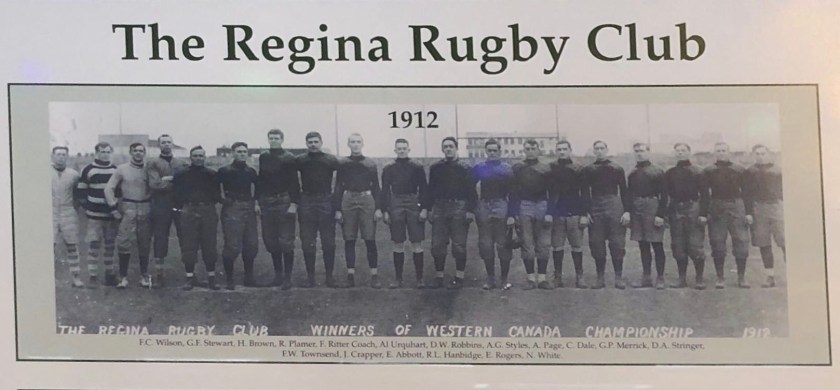
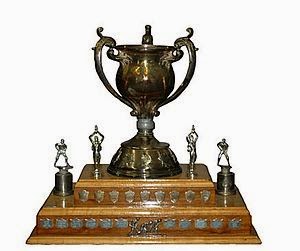
Edward Lyman (Hick) Abbott, fourth from right, was a star athlete whether it was with the Allan Cup-winning Regina Victories or the Regina Rugby Club.(Photo: Terry Massey, from Regina Rugby Club)
In more than 40 years as a journalist what follows may well be my favourite story. I loved researching it and I really enjoyed writing it. I post the story of Lyman (Hick) Abbott, a superb athlete, a sportsman and a hero, in time for every Remembrance Day.
I present this version of it in memory of J. Lyman Potts, who was named after Abbott and who would have turned 103 on Nov. 11. Potts, who died on Dec. 9, was a legend in the Canadian broadcasting and music industries.
It was Potts who took action when he realized in the mid-1990s that the Abbott Cup — originally funded by Potts’ father and named after Abbott — no longer was being given the respect it deserved. He wrote to old friend Tom Melville, a former Regina Leader-Post sports editor, and the two of them mounted a lengthy campaign that resulted in the Abbott Cup being retired to the Hockey Hall of Fame in Toronto.
Here, then, is the story of Lyman (Hick) Abbott . . .
——
Edward Lyman Abbott was, they all agreed, one of a kind.
He was a superb athlete and, just as important, he was a true sportsman. Everyone in southern Saskatchewan knew Abbott as Hick, which was shortened from Hickory, and he was loved by young and old alike.
LYMAN (HICK) ABBOTT
In the early part of the 20th century, Hick Abbott was the best athlete in Regina and maybe all of Western Canada. To this day, it may be Abbott who is the best athlete Regina has seen.
According to the Regina Leader:
“Previous to going to the war Abbott was one of the greatest hockey players that this Dominion every saw. He also was a stellar lacrosse, rugby and soccer player. He piloted Regina to a western championship in rugby in 1915 and what he did to bring the Allan Cup to Regina any of the old-time fans know.”
As we pause at the 11th hour of the 11th day of the 11th month, his story is but one of many worth remembering. This, then, is that story. Or, at least part of it.
————
The gentlemen of Regina’s sporting scene would gather at Joe Potts’ Rose Athletic Parlours on the east side of the 1700 block Rose Street. They would go there for a shave, maybe a trim and, most definitely, to talk about how their sporting world turned.
The Rose Athletic Parlours — the name was in honour of a Potts penpal, Philadelphia Athletics manager Connie Mack — was a seven-chair operation, with each barber having his own washbasin and mirror. There were two other huge mirrors — floor to ceiling — and a circular leather seat that surrounded a pole on which was beautiful leather backing. A long glass counter was home to a gold-coloured cash register and boxes of chocolate bars. Mahogany-veered cabinets behind the counter were full of tobacco products.
JOE POTTS
And there were photographs — they didn’t call them pictures then — everywhere. Photographs of prominent athletes. Many of them autographed.
The billiard room was separate and featured Boston tables, although there was one billiard table. Each table had its own mahogany cabinet in which players hung their hats and coats.
This is where doctors, dentists, lawyers and businessmen came. This is where they talked about the exploits of their favourite son.
Hick Abbott was of fair complexion. He had gray eyes that, in a blink, would steal a young girl’s heart. And that hair. Oh, that light brown hair that always had that naturally tousled look. Born in Orillia, Ont., in the Hovering parish, on May 1, 1891, Abbott, who was of the Methodist faith, moved to Regina for some reason long since lost. His father, James Henry Abbott, lived his last days in Toronto. In a file folder full of documents, notes, papers and photographs, there isn’t a mention of a mother. Perhaps Hick Abbott’s mother died and he moved to Regina to live with his sister, Robena Myrtle, who was a provincial government employee. A brother, Samuel Percival Abbott, lived near White Bear, Sask.
Hick Abbott played football (rugby football, it was frequently called then), hockey, baseball, lacrosse, soccer, basketball. He excelled at them all. He played in high school. He played for club teams. He played on playgrounds or in a gymnasium. It didn’t matter. He just wanted to play. He had to play.
But hockey was his game. He was a right winger who played for as many teams as he could.
He played for the Regina Bees Capital Hockey Club, which won the Valkenburg Cup as the province’s 1911-12 amateur champions.
But how was he to know that the highlight of his athletic career would come in the spring of 1914 when he helped the Regina Victorias to the 1914 Allan Cup title? The team photo refers to the Vics as World’s Amateur Champions 1914. There’s Abbott — bottom row, third from the right, next to Joe Potts, the Vics’ manager. The newspaper refers to Abbott as “the speedy and consistent right wing who is the sharpshooter of the team.”
But there was trouble in Europe where, before long, the First World War would be raging. Soon, newspapers were full of casualty reports. Regina’s sons were dying over there.
Naturally, Abbott heard the call, as did many of his teammates from that 1913-14 team, including goaltender Fred McCulloch, defencemen Charlie Otton and Austin Creswell, who was the team captain, and rover Freddy Wilson.
Abbott took officer training in Winnipeg, qualifying for the rank of lieutenant. He returned to Regina and enlisted with the 68th Battalion.
On the day Abbott enlisted — Sept. 23, 1915 — he was a 24-year-old student at law who lived in Regina at 2254 Rose St.
Seven months later, on April 28, he was on the S.S. Olympic as it sailed from Halifax. Abbott headed overseas as a platoon commander and officer in charge of records.
Abbott was a true warrior. Whether it was on the field of play or on the field of war, there wasn’t any quit in this man.
Upon his arrival in England, he quickly transferred to the 52nd Canadian Infantry Battalion, a trench unit. In the ensuing 26 months, shrapnel was the only thing that kept him from the front.
He was first injured on Oct. 7, 1916, while in action near Courcelette, about 30 miles northeast of Amiens, in what came to be known as the Battles of the Somme.
Four days later, Abbott was admitted to No. 14 General Hospital at Boulogne with a wound to his left shoulder. Two days later, he was in England, safely ensconced in a war hospital in Reading, a few miles west of London.
A doctor noted a “shrapnel bullet localized near wound.” That shrapnel was removed on Oct. 24; he was discharged from hospital on Nov. 13.
Abbott rushed back to the front and stayed until June 3, 1917, when he was granted 10 days leave, which he spent in Paris.
On July 26, 1917, following the Battle of Vimy Ridge, Abbott was awarded the Military Cross “for conspicuous gallantry and devotion to duty. He handled his men in the most able manner, and successfully led them through an intense hostile barrage. He set a fine example of courage and initiative.”
Three months later, on Oct. 27, he was awarded a Bar to his Military Cross.
The Bar, according to a letter Potts received from Abbott in early November, was “just for a little trench raiding affair.”
Abbott also mentioned that he now was wearing “a pair of plate glass spectacles on account of recent injuries to my eyes.”
The glasses were the result of his being wounded for a second time. He took a bullet — or a piece of shrapnel — in the right temple on Sept. 4, 1917, while raiding enemy trenches near Leuze, just over the border from France in the southwest part of Belgium.
A medical report indicates this was a “Severe G.S.W. (gunshot wound) near right eye.” Before he reached the hospital in Boulogne, the shrapnel//bullet was “removed with giant and small magnet.”
The Sept. 11 edition of The Leader reported, under the headline Popular Regina Young Man Is Among Wounded:
“As the casualty lists come in, more and more Regina soldiers are listed either as killed, wounded or gassed. In the list of yesterday appears the name of one of the best known and popular young men of the city, Lieut. Edward Lyman Abbott, as being wounded. This is the second time within 10 months that ‘Hick’ . . . has suffered injuries on the battlefield.”
The story continued:
“. . . he has written to friends in the city and appeared to be carrying on without much worry. Abbott was one of the finest athletes and best sportsmen in the city, standing at the head in every branch of sport he entered. He was particularly noted for his prowess at hockey, and football, two games in which he had no superior in the west.”
By Sept. 15, he had been “invalided, wounded and detached” to the Manitoba Regimental Depot and was being cared for in the 3rd London General Hospital in Wandsworth.
A doctor’s report noted: “Recommended for convalesence . . . to report back in three weeks.” Abbott was discharged on Sept. 24, 1917, and spent the next month at St. Mark’s College, leaving there on Oct. 25, 1917.
The next entry in his medical record is dated Sept. 14, 1918. It is short and to the point: K. in A.
Killed in Action.
It was, in the words of General Erich Ludendorff, the “black day of the German army.”
It was Aug. 8, 1918. It was the day on which the Battle of Amiens began. It was the battle in which Hick Abbott died.
After recovering from his head wound, Abbott returned to France on Dec. 24, 1917. A week later, he was back with his unit.
With Capt. G.M. Thomson heading for England, application was made for Abbott to be an acting captain with the 52nd Battalion. That was approved on March 16, 1918.
Abbott, then, was a captain when the Battle of Amiens, one of the war’s most decisive battles, began. The German’s spring offensive had been stopped only eight miles from Amiens. Now it was time to push them back. Later, after the Armistice had been signed on Nov. 11, 1918, it was generally acknowledged that this was where the tide had turned. In two weeks, 46 German divisions were defeated — 34,250 prisoners and 270 heavy guns were captured.
“It was,” said Ludenhoff, “the black day of the German army in the war . . . To continue would be a gamble. The war would have to be ended.”
On Aug. 14, with the battle almost won, Abbott — always the leader — was first out of a trench as he led a charge towards the enemy.
According to Earl Longworthy, an acquaintance of Abbott’s, he was killed by a sniper’s bullet to the head.
Longworthy was with Abbott’s battalion the day after his death and reported the platoon “worshipped the ground Abbott walked on and were in sorrowful spirits because of his death.”
A testimonial, author unknown, reads in part:
“Abbott was the type of Canadian, and the type of Britisher, that the Germans cannot understand; the type that fights with a silent fury and yet that does not hate; too much of a sportsman to fight unfairly, but more dangerous in attack than their finest products of hate-inspiration because of utter recklessness combined with a deadly skill and total inability to recognize defeat.”
By the time of his death on Aug. 14, 1918, Abbott’s father also was dead. Hick’s medals went to his sister, Robena, who was living in Regina at 2072 Angus St. A plaque and scroll went to his brother, Samuel, at White Bear.
Abbott’s will, dated July 1, 1916, indicated that there may have been another woman — besides his sister — in his life.
His will appointed his sister and R.D. MacMurchy, a Regina barrister, as executors. It read in part:
“I give and bequeath unto my sister Robena Myrtle Abbott all property, real and personal in my possession or due me at the time of my decease and in the advent of her prior decease all said property, real and personal to Miss Edith May Longworthy, 2035 Hamilton St., Regina, Canada.”
Word of Abbott’s death was reported in The Leader of Aug. 22, 1918:
“The death of the popular young Regina officer came as a great shock to his many friends in the city and to the hundreds who knew him through the province particularly as one of the finest athletes who ever appeared before the public in the province.”
Joe Potts was devastated by the news and wrote an appreciation that appeared in The Leader:
“The world of sport of Regina, and for that matter the entire province of Saskatchewan, is the poorer today by the loss of Hick Abbott.
“As long as Regina is, the name of Abbott will live. To the present generation his name stands supreme as a monument to the best that was in sport. To the future generation he has left an ideal for them to attain.
“The citizens of Saskatchewan have lost one of nature’s gentlemen, one who held dear the traditions of his land and one who ever had at heart one thing — the interest of his fellows.
“A hero among his fellows he was equally loved by the boys. No business was ever too pressing to prevent him claiming their comradeship. To the younger lads of Regina his life and glorious death will be an inspiration.
“In expressing these thoughts I am but giving voice to those of everyone in the city who knew him. As one who knew him intimately from the time he grew out of boyhood the loss is personally great.”
Potts had named his first-born son after Abbott — J. Lyman Potts was born on Nov. 11, 1916 — and would make certain that Hick wouldn’t be forgotten.
ABBOTT CUP
Late in 1918, Joe Potts started a fund-raising drive, the result of which would be the Abbott Memorial Cup, which for years would go annually to the champion of western Canadian junior hockey.
When the subscription drive started, the first name on the list was Lyman Potts ($10). The second name was that of Lieut. Austin Creswell, the captain of the 1914 Victorias.
E.A. Jolly, a prominent Regina druggist, sent in $5, along with a note:
“Captain Abbott was one of the highest types of Canadian citizens and his record on the ice and subsequently on the battlefield proved him a man of whom all of us should be proud. I remember the great games with Melville when Abbott worked so valiantly and well for victory, and I also remember what a great power Abbott was to the Victoria team when they won the Allan Cup on that great night in Winnipeg nearly five years ago.”
Dick Irvin, who would later prove to be one of the NHL’s great coaches, wrote from Belgium where he was a private “doing despatch work on a motorcycle . . . and seeing the sights of France and Belgium over the handle bars.”
Irvin was a 21-year-old centre on the Winnipeg Monarchs team that lost the 1914 Allan Cup final to the Vics.
“I am interested in what you say about the proposed Abbott Cup and you can put (me) down for a five spot,” Irvin wrote. “I think the idea splendid for junior hockey in the west and, as far as the memorial is concerned, you couldn’t have picked on a better name as Abbott was a . . . man all through.”
Hector Lang, the principal of Regina’s Central Collegiate during Abbott’s high school years who later moved to Medicine Hat and would be the Alberta trustee for the Abbott Cup, wrote that Abbott “at his studies, in his games, and on the field of battle, displayed always in the highest degree the character of the true sportsman. I remember, too, the other boys who studied and played with him — all good boys and true sports, and all of them better because of the influence of the big-hearted and fair-minded Hick Abbott.”
Sid Smith wrote from Gull Lake, Sask., expressing the hope that “this trophy will not be handled in such a way that it will fall into disregard, be forgotten as is often the case with such.”
Almost 80 years later, the Abbott Memorial Cup no longer could be considered a prominent trophy. Where it once went to the winner of a best-of-seven series, in its last years it was presented to the winner of one round-robin game between two western representatives during what was then the Royal Bank Cup — aka the national junior A championship.
“I know absolutely nothing about the Abbott Cup,” admitted one member of the Melfort Mustangs, Abbott Cup winners for 1996.
“It’s just an appetizer (for the Royal Bank Cup),” added another player.
It seems, alas, that Sid Smith’s worst fears were recognized.
——
Hick Abbott, who left Regina to fight for his country’s freedom, never returned to his adopted home town.
He is buried in Roye New British Cemetery, a few miles north of Paris.
Plot 1, Row B, Grave 13.
——
Hick Abbott was inducted into the Saskatchewan Sports Hall of Fame in 2014.
Ferris Backmeyer is a young Kamloops girl in need of a kidney transplant. I wrote about her right here on Oct. 7. . . . It is great to see at least one other outlet pick up on the story. If you click on the link right here you will find a story on Ferris that was written by Karen Edwards of infonews.ca.
IN THE NEWS! 📰📣 Kamloops toddler suffering from kidney failure now ready for transplant. A toddler suffering from kidney failure after being diagnosed with a rare syndrome has reached the minimum height and weight requirement for a kidney transplant.https://t.co/wBCoI9v7BY
— Kidney Foundation, BC & Yukon Branch (@KidneyBCY) November 7, 2019
IN THE NEWS! 📰📣 Alberta moves toward 'opt out' organ donation system. The Human Tissue and Organ Donation (Presumed Consent) Amendment Act passed first reading in the legislature Wednesday.https://t.co/TrSlZ1y3TO
— Kidney Foundation, BC & Yukon Branch (@KidneyBCY) November 8, 2019
Join us Nov 19, 3:00 pm-EST for a Webinar on Self-Management for patients with chronic kidney disease. From @kidneycanada, presented by Dr. Brenda Hemmelgarn, and featuring Dwight Sparkes (Patient). For more information and to register visit: https://t.co/7o15zQgyWq
“I’ve always wanted to donate a kidney because I know what the patients go through,” said Rudy, 56, who left a career in the corporate world to become a registered nurse.” https://t.co/KuTrmkrx34
IN THE NEWS! 📰📣 Former Sault man helped family when fire struck; now, woman wants to help him with organ donation. Richard Migwans awaiting kidney transplant; says ‘life is the biggest gift you can give.’https://t.co/XwNYlwiTXq
— Kidney Foundation, BC & Yukon Branch (@KidneyBCY) November 6, 2019
He said: ‘I went to change the music on the radio and I pressed the wrong button and accidentally tuned into an interview of a man speaking about his experience donating a kidney. That was the lightbulb moment, I just knew I was going to do it." https://t.co/kNmCvbMunF
🎬 We have a living kidney donor’s personal story in this episode of PLUGGED IN. Watch Sussanne recall how she was able to give her cousin the best gift ever – a kidney! Don’t forget to subscribe to our YouTube channel!https://t.co/e43Ukab2Fp
— Kidney Foundation, BC & Yukon Branch (@KidneyBCY) November 7, 2019



 one hand and you got Conan the Barbarian. A one-man Mongol horde. Genghis Khan would hide.




 TAKING NOTE