
RE/MAX, WHL partner again to help Kidney Foundation. . . . Raised more than $460,000 in two seasons

RE/MAX of Western Canada and the WHL are once again getting behind WHL Suits Up with Don Cherry to Promote Organ Donation, the annual promotion that benefits the whlKidney Foundation of Canada and its provincial  branches.

If you aren’t familiar with this promotion, it involves the WHL’s 17 Canadian-based teams, each of whom uses one game each season to help promote organ donation and transplantation.

I don’t have dates for all teams but the B.C. Division games will go like this: Prince George Cougars, Jan. 31; Vancouver Giants, Feb. 8; Kamloops Blazers, March 6; Victoria Royals, March 13; and Kelowna Rockets, March 14.

During the 2017-18 season, the promotion in WHL cities raised more than $265,500, making it the largest public awareness and fundraising campaign in the history of the Kidney Foundation. Last season, the final total raised was $196,600.

In two seasons then, RE/MAX of Western Canada and the WHL have helped raise more than $460,000.


The 10th annual Kidney Walk Kamloops is scheduled for Sunday, Sept. 22, at McDonald Park on the North Shore.

Registration will open at 10 a.m., with the walk to start at 11. And we will walk in the KWlogo2rain if the forecast holds true.

If you would like to join us, you are able to walk all or part of the approximately 2.5-km pathway between McDonald Park and McArthur Island. Or you don’t have to walk at all; you might want to just sit and enjoy the company and festivities, then have breakfast. The Brock Central Lions Club will be on hand to provide breakfast — pancakes, sausages and coffee — by donation.

The Kidney Walk helps the Kidney Foundation raise awareness about kidney disease and raises funds for important programs and services to help kidney patients in this community and others across BC and the Yukon.

My wife, Dorothy, will be celebrating the sixth anniversary of her kidney transplant by taking part in her sixth straight Kidney Walk. In her six walks, she has raised more than $15,000. If you would like to support her — she reached the $3,000 mark on Thursday — you may do so right here.


A note from the Kidney E-News letter of the BC and Yukon Branch of the Kidney Foundation of Canada:

“The BC & Yukon Branch and the Children’s Organ Transplant Society (COTS) were excited to have 43 youth from across BC attend Camp Latona on Gambier Island in August.

“The kids got to enjoy the camp experience with other young people at various stages in their kidney disease/organ transplant journeys. The weather was fantastic and some of highlights included tubing, campfires, extraordinary food, swimming and, of course, making new friends! 

“A huge thank you to all of the gracious donors who made it possible for the kids to attend a cost-free, worry-free camp. We appreciate you!”


Ready to go Kidney Walking in Kamloops. . . . Pearlman, Valdez talk about transplant. . . . Mother wants to make late son proud, donates kidney

Almost all is in readiness for Kamloops’ 10th annual Kidney Walk.

We will gather on Sunday at McDonald Park on the North Shore, with registration at 10 a.m., and the walk to begin at 11.

Edna Humphreys is the executive director of the Kamloops branch of the Kidney KWlogo2Foundation. I can tell you from experience that without her leadership and organizational skills, the Kidney Walk would experience some difficult times.
(It’s also worth noting that if it’s a renal-related activity in Kamloops, you can bet that Humphreys is in the forefront. Among other things, she is a co-founder of the Kamloops Kidney Support Group, and also is the lead organizer of a Christmas luncheon for dialysis patients and transplant recipients. With music by old friend Jesse Jones. Yessss!)

Anyway . . . Humphreys recently took time out from her busy schedule to talk with Todd Sullivan of Kamloops This Week about the 2019 Kidney Walk.

That story is right here.


One of my favourite renal-related stories involves a woman named Catherine Pearlman, who walked into a Los Angeles-area Starbucks on Dec. 30, saw a poster on a bulletin board, and decided that very moment to become a kidney donor. . . . The result was that Eli Valdez, a complete stranger, received one of her kidneys. . . . They told their story to today.com, and it’s all right here.

If you missed it earlier, Pearlman wrote about her experience for the Los Angeles Times, and that piece is right here.

Catherine’s husband, Jeff Pearlman, is a writer and published author. He wrote on his blog about what all of this meant to him. Here’s how he started it:

“It’s 10:15 am, and as I write this my wife Catherine is in surgery here at UCLA’s Ronald Reagan Medical Center — donating one of her kidneys to a complete stranger.

“You read that correctly, but I recommend reading it again. My wife Catherine is in surgery donating one of her kidneys to a complete stranger.”

The complete piece is right here.

BTW, if you are a sporting fan and haven’t read Jeff’s book, Football for a Buck, you’re cheating yourself. It’s all about the USFL — remember that league? — and is loaded with especially juicy anecdotes, including some involving, yes, Donald Trump.


Laura Gillum’s son, Dean, was 23 months old when he drowned in the family’s backyard pool in the Pittsburgh area in 2015. His heart, lover and kidneys were donated.

“My son was amazing,” she told Lisa Washington of KDKA-TV. “At 23 months old, he saved three people’s lives. Not many people can say that, and even though he’s gone, I try every day to do something to make him proud of me.”

On March 7, Lisa donated a kidney to Brian Cox, a complete stranger. They met early in April.

“I just can’t comprehend why someone wouldn’t want to donate their kidney, so hopefully getting the message out, more people will want to do it and that they’ll want to educate themselves to find out just what everything entails,” Gillum said.

Washington’s complete story is right here.


Kidney disease hasn’t slowed own our girl Maggie. . . . Take a moment for PKD Awareness Day

Allow me to introduce you to our good friend Margaret (Maggie) Thompson.

She and my wife, Dorothy, have forged quite a friendship, one that began because they have something in common — both have had kidney transplants.

Dorothy had one six years ago; Maggie underwent one more than eight years ago.

A few years ago, they got together, along with Edna Humphreys, and started the Kamloops Kidney Support Group in an attempt to help others who are dealing, directly or indirectly, with kidney disease. To say the KKSG has been a success would be something of an understatement.

Dorothy and Maggie both did peritoneal dialysis before being cleared for transplant, and both are representative of how having kidney disease doesn’t have to slow one down.

Having said that, though, Maggie is in a league of her own.

Maggie2
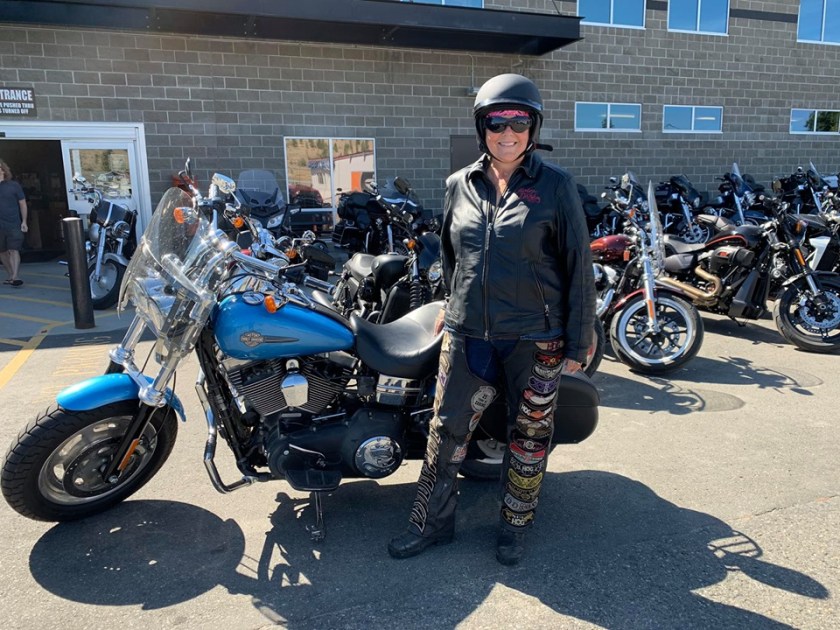
Maggie Thompson, with the Blue Bomb before parting with it last week. (Facebook photo)

In brief, here is a definition of peritoneal dialysis from kidneyfund.org: “Peritoneal dialysis (PD) is a treatment that uses the lining of your abdomen (belly area), called your peritoneum, and a cleaning solution called dialysate to clean your blood. Dialysate absorbs waste and fluid from your blood, using your peritoneum as a filter.”

A catheter is surgically implanted into our peritoneum that will allow you to do fluid exchanges. You learn how to do PD manually four times a day before being given a cycler that allows you to do it while sleeping at night. And the only way it limits your ability to travel is if you allow it to, something Maggie wouldn’t do.

A Harley-Davidson rider and owner, Maggie took a lengthy trip with friends into the U.S. a few years back. She drew up a travel schedule and arranged with Baxter, the company that provides PD supplies, to make fluid drops at various stops. Friends constructed a trailer that she towed behind her Harley; it contained other needed supplies.

As the friends travelled, then, they would stop to allow Maggie to do her exchanges.

Since having her transplant in July of 2011, Maggie hasn’t slowed down at all. She moved to Edmonton early in 2018, but makes regular visits to Kamloops, where she had lived for 30 years. Earlier this summer, she took two grandsons to the Calgary Stampede — yes, she also has a car — and then on a tour around Vancouver Island that included a stop in Tofino.

Maggie
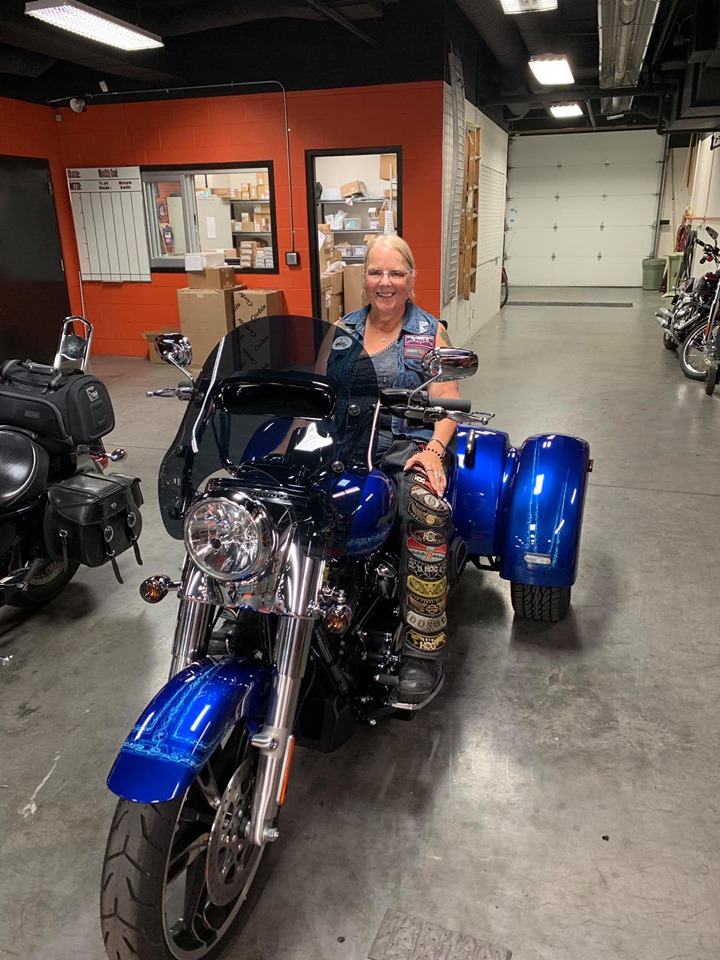
Maggie Thompson, with her new ride, Sassy Sapphire. (Facebook photo)

Late last week, Maggie rode her Harley — she called it the Blue Bomb — to Kamloops, where she visited the local dealership and traded it in on a Freewheeler Trike that she has dubbed Sassy Sapphire.

After a few days with us, Maggie climbed aboard Sassy Sapphire on Tuesday morning and headed home to Edmonton. She arrived early last evening having been on the road for almost 12 hours.

No, kidney disease hasn’t slowed down Maggie Thompson in the least.


It is National Polycystic Kidney Disease (PKD) Awareness Day in various parts of the world today (Wednesday, Sept. 4).

According to a news release:

“Since 2014, Health Canada has recognized September 4 as National Polycystic Kidney Disease (PKD) Awareness Day – a special day devoted to raising awareness of this life-threatening, genetic disease.

“Polycystic kidney disease (PKD) is a chronic, genetic disease causing uncontrolled growth of fluid-filled cysts in the kidneys, often leading to kidney failure. With 66,000 Canadians and millions worldwide living with PKD today, chances are high that you know someone with the disease.

“The more who know about PKD, the more resources we can dedicate to finding treatments and a cure. PKD Awareness Day is our opportunity to step up our efforts and gives us a platform to widely spread the word, share stories and encourage others to learn more. On PKD Awareness Day, let’s come together as a united front to spread the word about this disease further than we ever have before!

“Since its creation in 1993, the PKD Foundation of Canada has raised more than $1 million towards research, support and help for families living with PKD. From the first research grant awarded in 1999, the PKD Foundation of Canada has set up chapters and support groups across the country, built an expansive and passionate volunteer network, and connected with PKD groups around the world to support our most notable fundraising event – the Walk to END PKD.

“Today, the PKD Foundation of Canada is the only national organization solely dedicated to fighting PKD through research, education, advocacy, support and awareness.”

In Kamloops, locals involved in the PKD Foundation will appear before City Council on Sept. 10 in an attempt to spread awareness.


Here in Kamloops, preparations are well underway for the annual Kidney Walk, which is scheduled for Sept. 22 at McDonald Park. . . . If you would like to take part, we register at 10 a.m., with the walk to follow at 11. Some of us will walk a couple of kilometres, but there isn’t a defined distance. In fact, you don’t need to walk at all. Just come and join us for the breakfast — pancakes, bacon and coffee, by donation — with the Brock Central Lions Club doing the cooking. . . .

My wife, Dorothy, will be celebrating the sixth anniversary of her kidney transplant by taking part in her sixth straight Kidney Walk. In her six walks, she has raised more than $15,000. If you would like to support her, you may do so right here.


Report: There are 3,500 donated kidneys discarded every month in U.S. . . . Survey published in JAMA shows system is badly broken

A reader sent me a link that led me to a story on USA TODAY’s website. I had to read the story a couple of times because I found it so shocking.

Here are the first two paragraphs:

“The United States discards about 3,500 donated kidneys a year, many of which could be used to save lives, new research shows.

“The study, published Monday in the journal JAMA Internal Medicine, focused on the rate at which donated kidneys were used in the U.S. and France between 2004 and 2014. In that time, the U.S. discarded about 17.9% of the kidneys it recovered, while France discarded about 9.1% of the kidneys it recovered. In all, the U.S. threw away almost 28,000 donated kidneys in that 10-year period.”

Let that sink in for a few minutes. People are dying because they need kidneys and yet donated kidneys are being trashed.

The study was published in JAMA — The Journal of the American Medical Association.

During the time under study, the U.S. recovered 156,089 kidneys from deceased donors and discarded 27,987 (17.9 per cent) of them. In France, 29,984 kidneys were recovered, with 2,732 (9.1 per cent) of them discarded.

According to figures supplied by the National Kidney Foundation, there are almost 100,000 Americans in need of kidney transplants. While 12 people on the waiting list die each day, about 10 kidneys are trashed each day.

Adrianna Rodriguez of USA TODAY wrote:

“The study showed that kidneys discarded in the U.S. were on average about 36 years old, whereas kidneys discarded in France were on average about 50 years old. That means  France had a higher kidney acceptance rate from older donors.

“The study found that the U.S. is more likely than France to throw away kidneys when the donor had hypertension, diabetes, had a heart attack or tested positive for Hepatitis C.”

That story also included this quote from Sumit Mohan, associate professor of medicine and epidemiology at Columbia U in New York City: “They should definitely be used and are definitely viable. Using kidneys from diabetic donors do remarkably well.”

Rodriguez points out that “the mortality rate for patients who go on dialysis is about 20 per cent annually, which works out to be a five-year survival rate.”

Mohan told Rodriguez: “It’s comparable to some of the worst cancers we see.”

Keep in mind that while some cancers are curable, there isn’t a cure for kidney disease. No, there isn’t.

Mohan added: “People aren’t asking ‘What’s the quality of my kidney?’ The question that everybody asks is, ‘When am I getting my kidney?’ ”

In short, the system in the U.S. is broken. The good news it that there is a move afoot to overhaul the country’s organ transplant regulations. The bad news is that we all know that won’t happen this week or next.

The USA TODAY story is right here and it really is worth a read.

The complete JAMA Internal Medicine study is right here, and it is absolutely devastating if you are an American and at all impacted by kidney disease.

Another reader sent me a link to an editorial in the New York Daily News. The editorial board there writes: “Beggars know they can’t be choosers. Even an imperfect kidney is better than life, and ultimately death, on dialysis. Fix the rules so more Americans can receive the gift of life.” . . . The complete editorial is right here.

All of this hits really close to home. My wife, Dorothy, had a kidney transplant on Sept. 23, 2013. Had we been living in the U.S., the kidney she received likely would have been rejected because it may have failed one of the afore-mentioned qualifiers.

At that point, she had been doing peritoneal dialysis for almost four years.


If you are in the area of Granville Island in Vancouver early in September, you may want to check out this play — Waiting Time — that will be part of the Fringe Theatre Festival.


Pearlman, Valdez talk about kidney transplant from experience. . . . BC Place lights up for PKD Awareness Day

Catherine Pearlman was in a Los Angeles-area coffee shop one day when she saw a flyer involving a man she had never met. That man, Eli Valdez, was in desperate need of a kidney transplant. . . . Pearlman ended up donating a kidney to Valdez. . . . If you have ever wondered about the thought process involved in giving a kidney or what it means to be on the receiving end — like, what does it mean to have someone else’s organ in your body? — give this right here a listen because it is absolutely awesome. . . . Valdez especially bares his soul over the 45-minute conversation. I can tell you from experience that my wife, Dorothy, who had a transplant on Sept. 23, 2013, had many of the same feelings as did Valdez.

If you aren’t familiar with this story, Catherine’s husband, Jeff, who is a writer of note, posted a piece on his website shortly after the transplant. That piece is right here.

A couple of weeks later, Catherine wrote a piece for the Los Angeles Times in which she described all that she and Eli had gone through. That piece is right here.


PKD Awareness Day takes place on an annual basis, always on Sept. 4. Millions of people worldwide, including more than 66,000 Canadians, live every day of their lives with PKD, or polycystic kidney disease. As the above tweet mentions, PKD “causes uncontrolled growth of cysts in the kidneys, often leading to kidney failure.” . . . According to the BC Renal Agency’s website, “autosomal dominant polycystic kidney disease is the most common inherited renal disorder, and is the fourth-leading cause of end-stage renal disease in Canada.”

Watch for PKD Awareness Day in your community.


Kidney Condo unveiled in Nanaimo. . . . Getting set to Walk in Kamloops. . . . Boulet award goes to Alberta man

There is big news out of Nanaimo where out-of-town kidney patients who are taking dialysis training now have a place to stay free of charge. They are calling it the Kidney Condo, and it is backed by the Vancouver Island Kidney Patients’ Association and the Kidney Foundation of British Columbia and Yukon. . . . Nicholas Pescod of the Nanaimo Bulletin has more right here.


Here in Kamloops, preparations are well underway for the annual Kidney Walk, which is KWlogo2scheduled for Sept. 22 at McDonald Park. . . . If you would like to take part, we register at 10 a.m., with the walk to follow at 11. Some of us will walk a couple of kilometres, but there isn’t a defined distance. In fact, you don’t need to walk at all. Just come and join us for the breakfast — pancakes, bacon and coffee, by donation — with the Brock Central Lions Club doing the cooking. . . .

My wife, Dorothy, will be celebrating the sixth anniversary of her kidney transplant by taking part in her sixth straight Kidney Walk. In her six walks, she has raised more than $15,000. If you would like to support her efforts with a donation, you may do so right here.


Dan McLaughlin of Riverview, N.B., needed a new kidney, so he put a sign on his car that indicated he was looking for a donor. Just over three weeks ago, he got the call and immediately headed for Halifax. . . . He had the transplant and, hey, how did it go? He told Shelley Steeves of Global News that when he woke up “colours were brighter, somehow it was easier to breathe, the air was fresher and a day later I walked almost a kilometre, which I couldn’t do before.” . . . There is more on McLaughlin’s story right here.


Morris Irvine underwent a lung transplant in 2011. On Sunday, the Albertan was the first recipient of an humanitarian award named in honour of the late Logan Boulet, who was killed in the bus crash involving the SJHL’s Humboldt Broncos. . . . There’s lots more right here.

Having transplant in Vancouver? Kidney suite might be for you. . . . KKSG gatherings set for September

If you or someone you know is a candidate for a kidney transplant and lives outside of Vancouver, you will learn in the lead-up that a stay of at least a couple of months in the big city will be necessary after surgery.

And with the cost of accommodations being what they are in the big smoke, well, you might have questions.

You should know, then, that there are kidney suites available in Vancouver . . .

The Kidney Foundation of Canada, BC & Yukon Branch offers seven kidney suites within Vancouver. These are for post-kidney-transplant recipients who have come to Vancouver from outside the Lower Mainland and need to stay in town for up to two months after surgery. These suites are fully furnished, and are located near major transit lines.

These suites are free for those who meet our financial criteria (low income) and just $35 per night for those who do not.

There is more right here.


If you happen to live in Kamloops and area, you may be wondering about the next gatherings of the Kamloops Kidney Support Group (KKSG). . . . We get together on the second Wednesday and second Saturday of every month. In September, that will be Sept. 11, 10 a.m., and Sept. 14, 9 a.m. . . . All coffee drinking and eating of eggs takes place at the Barside Lounge and Grill at Chances Casino, 1250 Halston Ave. . . . Believe me when I say that these gatherings are informal.


SOME ODDS AND ENDS . . .

One in 10 Canadians live with kidney disease or are at risk – most are unaware of this. . . .

You can lose up to 80 per cent of your kidney function before experiencing symptoms. . . .

As of mid-August, in the region served by Royal Inland Hospital in Kamloops, there were 1,378 patients with chronic kidney disease (CKD) being monitored by nephrologists. Of those, 140 have undergone transplants, and 114 are on dialysis. . . .

As of December 2018, there were 665 people in B.C. waiting for organ transplants, with 528 of those being kidney patients. In 2018, 335 kidney transplants were performed in B.C.


Some numbers from a piece by the editorial board of The New York Times from earlier this week:

About 20 Americans die each week waiting for organs. . . .

More than 100,000 people in the United States are currently waiting for organs, and only about 35,000 will receive them in 2019. . . .

That piece also included this:

“Far too few people are donating organs to begin with, and far too few of the organs that have been donated are making their way to patients in waiting. Experts say that misconceptions about donor eligibility requirements and, in some states, cumbersome registration processes are preventing nearly half of those who support organ donation from becoming registered donors. Outdated standards are causing transplant surgeons to reject some 75,000 usable organs every year, according to a Washington Post analysis. And an astounding lack of accountability and oversight in the nation’s creaking, monopolistic organ transplant system is allowing hundreds of thousands of potential organ donations to fall through the cracks.”

The complete piece is right here and it’s well worth your time if you are interesting in the American transplantation system.


Stroup family cries tears of joy after organs donated. . . . Daughter had registered two years ago as donor

Folks in Kamloops will gather at McDonald Park on Sept. 22 for the annual Kidney Walk. If you would like to participate, we register at 10 a.m., walk at 11, and have breakfast when it’s all done. The Brock Central Lions Club supplies the breakfast — pancakes, sausage and coffee — by donation.

We held a news conference on Monday at St. Andrews on the Square. If you are curious about how the media saw what we had to announce, here’s a look . . .

Chad Klassen of CFJC-TV filed a video report and wrote a story, both of which are right here.

——

John Luke Kieper of KamloopsBCNow was on hand, too, and he posted his story right here.

——

Dairai Mutandiro of Kamloops Matters joined us and wrote this piece right here.


Tara Stroup’s daughter, Madeline, was in a coma for seven days after being involved in a car crash in Abbotsford, B.C., on July 26. When the family decided to take Madeline off life support and donate her organs, they discovered that she had registered as a donor. . . . Tara spoke with Estefania Duran of CBC News about the decisions involved and the aftermath. That story is right here.


Introducing the Kamloops Kidney Support Group — we’re here for you. . . . 2019 Kamloops Walk to hold news conference

Early each month, I post a message to Twitter that goes something like this:

Nearly 49,000 Canadians are being treated for kidney failure. If you are one, the Kamloops Kidney Support Group will gather Saturday, Aug. 10, 9 a.m., and Wednesday, Aug. 14, 10 a.m., at Chances (Barside Lounge and Grill), 1250 Halston Ave. Join us for breakfast and conversation. #kamloops @KidneyBCY

——

I also post a similar message to Facebook and send a PSA (Public Service Announcement) to various media people and outlets in the Kamloops areas.

——

So . . . allow me to tell you a bit about the Kamloops Kidney Support Group (KKSG).

It was founded by three women — Edna Humphreys, who has a son who has had a kidney transplant, Dorothy Drinnan and Margaret Thompson, both of whom are enjoying life after kidney transplants. Margaret has since moved to Edmonton, however, so we carry on while she watches with interest from afar.

The KKSG doesn’t have any affiliations, medical or otherwise. We are a bunch of folks who come together twice a month, over coffee and/or breakfast, and talk about our renal-related experiences.

No one has kept track, but I would guess that we have had contact with upwards of 50 different people over the time that we have been around. People come and people go; some are regulars and others show up perhaps when they feel a need for some support or when they have a question or two.

We meet twice a month — on the second Wednesday and second Saturday — and had 17 people attend our last gathering.

Two regulars recently have started dialysis — one hemo and the other peritoneal — as they wait for the phone call that hopefully will come soon, telling them there is a match and that a transplant is in the works.

There are other people in our group who are dealing with one type of kidney issue or another, all under medical care. We have one couple who have joined us a couple of times as they seek all the information they can find, their son having been diagnosed with kidney disease.

Dorothy, who was born with one kidney, had her transplant on Sept. 23, 2013. Prior to that, she spent almost four years doing peritoneal dialysis. At that time, there wasn’t a support group or anyone she could chat with — outside the medical community — or ask questions of in a search for information.

You are asking: What kind of information?

It could be answering questions about the interview process one goes through at St. Paul’s Hospital or Vancouver General Hospital in the lead up to a potential transplant.

It could be pointing out that there isn’t a cure for kidney disease — just because someone undergoes a transplant and gets a new (used) kidney doesn’t mean he/she is cured. Yes, it’s true. While there are cures for various kinds of cancer and other diseases, there isn’t a cure for kidney disease.

The trick is to learn how to live with it. Those of us involved with the KKSG hope that we are able to help people do just that.

If you have been impacted by kidney disease, feel free to check us out.

If you live in a community other than Kamloops and wonder if such a group really is worthwhile, I highly recommend it. If you would like more information, get in touch with us.

If you are in the Kamloops area, we will be at the Barside Lounge and Grill in Chances on Saturday, 9 a.m., and Wednesday, 10 a.m.


2019 KAMLOOPS KIDNEY WALK

NEWS CONFERENCE

WHAT: Organizers of the 2019 Kamloops Kidney Walk have scheduled a news conference.

WHEN: Monday, Aug. 19, 2 p.m.

WHERE: St. Andrews on the Square, 159 Seymour St.

WHO: Organizers will outline plans. . . . Two honourees will be introduced. . . . Organizers will introduce and thank the largest single donor in the event’s 10-year history.

We look forward to seeing you there.

FMI: Edna Humphreys, 250-376-6361 (ednahumphreys@shaw.ca); Dorothy Drinnan, 250-573-2988 (ddrinnan52@gmail.com).


Langley grandfather needs kidney. . . . B.C. ranks No. 1 in living kidney donations. . . . Hey, there’s an app for that, too

Jerry Franks would love to play with his grandson, Donovan, but oftentimes just doesn’t have the energy. Why not? Because Jerry, a 64-year-old from Langley, B.C., needs a kidney transplant; in fact, he has been on dialysis for three years now — three times a week.

“His daughter Danielle has been reaching out on social media ‘and every way I know how,’ ” writes Bob Groeneveld in the Langley Advance Times, “and his son Rob has a plea for kidney donors to help ‘My best friend, my Dad’ emblazened on his business truck – along with the phone number to call to be a donor: 604-806-9027.”

Groeneveld has a whole lot more on Jerry’s story right here.


According to its Twitter account, CORE “is a non-profit dedicated to promoting donation, education and research of organ and tissue transplantation.” . . . CORE is an acronym for Centre for Organ Recovery and Education.” It is headquartered in Pittsburgh, to this tweet obviously is directed to our American friends. . . .


If you are going to be in Vancouver’s West End on Saturday, Aug. 10, some folks will have hot dogs and Chilliwack corn for you.