Welcome to a site where we sometimes provide food for thought, and often provide information about the Western Canada Professional Hockey Scouts Foundation.
These are the kind of stories we like to read. . . . Tom Mitrovski of Toronto is 72 now. There was a time when he never thought he would see 50.
He underwent a kidney transplant on Nov. 27, 1979, thinking then that he had five to 10 years left. . . . Tom Hayes of Global News has the story right here.
IN THE NEWS! 📰📣Toronto kidney recipient celebrates 40-year anniversary. When 72-year-old Tom Mitrovski’s kidneys failed, he thought he had five-to-10 years to live. That’s what he was told 40 years ago.https://t.co/Kj6fzIjFXk
Doctors at the Cleveland Clinic have successfully performed a laparoscopic liver transplant, the second time such an operation has been done in the U.S. . . . Chris Cantergiani of WKYC has more right here, and there is a lot of interesting stuff in the story.
Earlier this year, doctors at the Cleveland Clinic performed the first robotic single-port kidney transplant, doing it all through one small abdominal incision. There’s more on that story right here.
IN THE NEWS! 📰📣Sarah Hyland posts Instagram photo she ‘hated’ for her ‘invisible illness warriors’. Hyland, who is engaged to The Bachelorette alum Wells Adams, was born with kidney dysplasia, which means the kidneys don’t develop as they should.https://t.co/JwOmhnfUUh
Do you have any interest in shaping a workforce strategy for the delivery of sustainable, high quality care in hemodialysis services? @BCRenalAgency is looking for patients to be part of a Dialysis Workforce Strategy Working Group.Visit https://t.co/geHLm9ylVg to RSVP by Nov 28. https://t.co/Uz6ZaBmzJZ
IN THE NEWS! 📰📣 Man loses 150 pounds to get a kidney transplant. Jason Smith will tell you his life was saved twice with two surgeries. One helped him lose 150 pounds, and the other got him a new kidney.https://t.co/aK7epHGO34
Patrick, Jefferson and Terry from Kelowna, BC, “are feeling great and very grateful for organ donation” after all receiving kidney transplants earlier this year. Thanks Patrick, for the fantastic photo! pic.twitter.com/PHw23ja5jO
FREE WEBINAR 🗣 On December 10 at 8 pm EST, The PKD Foundation is presenting an educational webinar called "Treating Polycystic Kidney Disease: Could Diet Be The Key?" Visit their site for more info. https://t.co/NCueMH2Cgc#PKD#kidneydiseasehttps://t.co/lzCgAHwbY9
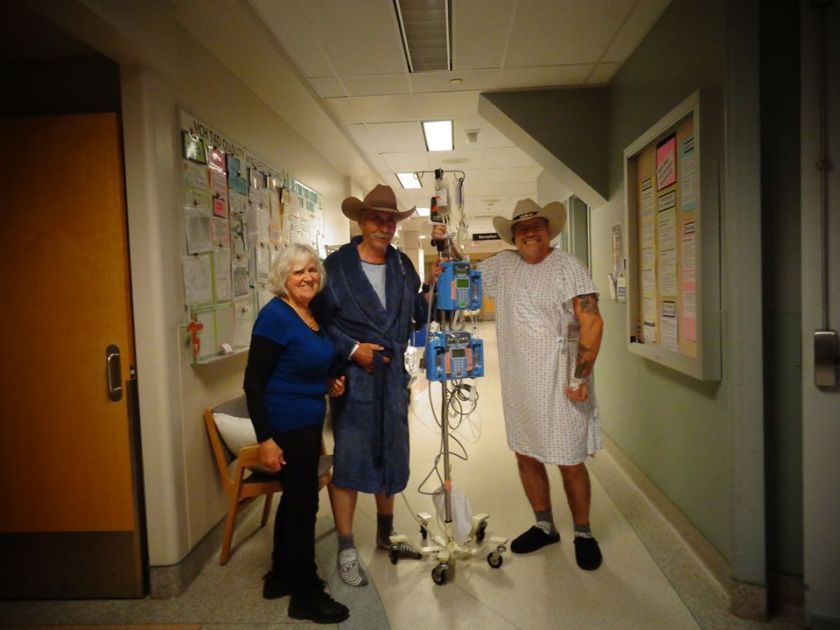
Two years ago, Hugh McLennan (second from left) and Louis (Big Rig) McIvor were roaming the halls at Vancouver General Hospital, along with Hugh’s wife, Billie. The big question: Where in the big city did they tie up their horses? (Photo: Hugh McLennan/Facebook)
Happy anniversary to Hugh McLennan, who has been living for two years with a transplanted kidney, courtesy of his good friend Louis (Big Rig) McIvor.
Here’s what Hugh wrote on his Facebook page on Saturday:
“Two years ago (Friday) this guy gave me one of his kidneys! We’re both doing fine and we’d encourage you to look into being an organ donor and if you know someone on dialysis look into getting tested as a living donor.”
Now that is really sound advice.
Hugh and his wife, Billie, own and operate a ranch near Pinantan Lake, just outside of Kamloops.
Best wishes to Melissa Wells of Kamloops, who underwent a kidney transplant on Nov. 9.
Melissa has a kidney disease — Type 3 Membranoproliferative glomerulonephritis (MPGN) — that resulted in kidney failure. She spent more than six years waiting for a transplant, all the while doing dialysis.
In July, her husband, Marty, wrote:
“She’s been through countless failed surgeries, successful surgeries, and even had a direct line put into her heart just so she was able to get treatment to stay alive.”
Marty also added something that, with all that Dorothy has been through, I think of regularly. It has to do with the number of people walking around who live with kidney disease but don’t give any appearance of being ill.
“If you saw Melissa today she would seem totally normal,” Marty wrote in July. “She goes about her daily life — visiting family, hanging out with friends, going shopping. What you don’t see is her strength. She fights through constant headaches, nausea, fatigue, shooting pains through her arm, and overall pain of having major organ failure. The constant needling of her arm almost every day and the perpetual surgeries she has to deal with in Kamloops, Kelowna, and Vancouver are exhausting and expensive.”
The good news is that Melissa has a new kidney now. Here’s hoping that all goes well.
What happens when an organ or organs come available for transplant? How quickly does the window of opportunity close? When there is a death, how many organs might be available for transplant? What about tissue, corneas, etc.? . . . Shawn Logan of Postmedia has an excellent look at all of that and a whole lot more right here.
Journey of a donor: How a donated organ finds its way to its new home https://t.co/ZnwPlEkefo
Susan Bell and Dorothy Stewart of CBC News have produced a story that includes Colleen Atsynia, a single mother of five.
According to the story, she “was in her mid-40’s when kidney disease forced her to leave her job, her family and her northern Quebec community of Wemindji for dialysis treatment in Montreal.”
As Atsynia told the reporters: “When you first find out you need a transplant, to me it felt like, ‘OK, that’s it. I’m done. I’m just going to die.”
According to the story, Atsynia’s life changed when “someone she doesn’t know gave it all back to her by donating a kidney” in May 2018.
“I was extremely happy because I knew I was going to finally come home,” she said. “My kids were happy . . . they were really happy.”
IN THE NEWS! 📰📣A chance to live': Single mom of 5 shares profound impact of organ donation. https://t.co/bfYGO4sjbH
— Kidney Foundation, BC & Yukon Branch (@KidneyBCY) November 22, 2019
IN THE NEWS! 📰📣How This 27-Year-Old Ran a Marathon While Undergoing Dialysis Three Days a Week. When Nate Boutcher was 22, he found out his kidneys were failing. https://t.co/DijeLrWHyN#followup
— Kidney Foundation, BC & Yukon Branch (@KidneyBCY) November 21, 2019
— Kidney Foundation, BC & Yukon Branch (@KidneyBCY) November 22, 2019
This doesn’t have anything to do with transplants or kidney disease, but it is a great watch . . .
This young man is severely colorblind. They are studying colorblindness in class. The school principal brought in some glasses that allowed this youngster see color for the very first time.
DYK? As of Nov 1, 2019, there are 5,130 British Columbians alive because of an organ transplant. Visit our website for monthly updates on health information statistics. pic.twitter.com/i3R58UWvra
More numbers from BC Transplant: There are 1,487,323 donors registered in the province’s organ donor registry; there were 406 transplants performed in 2019, to Nov. 1; and there still were 755 patients awaiting transplants. . . . Visit the website at transplant.bc.ca for more information and lots more numbers.
Sean Delaney of Edmonton is the associate director of organ listing and allocation at Canadian Blood Services. Delaney, 48, also has undergone a kidney transplant; in fact, he had one more than 20 years ago when he got one from his brother. . . . Delaney’s story, as told by Moira Wyton of Postmedia, is right here, and it’s an interesting one. . . . “Delaney works to streamline organ donation across the country,” Wyton writes, “and create new ways to help people receive the organs they need to live and thrive.
This has included the creation of a national registry to administer new programs such as the Kidney Paired Donation Program, which has facilitated more than 700 transplants since its founding in 2009.” . . . Through all of this, he now finds himself back on the transplant list because his kidney is in failure, and he is doing peritoneal dialysis.
IN THE NEWS! 📰📣 Sean Delaney is an advocate for organ transplant recipients just like him. https://t.co/HXr0hk5lAa
— Kidney Foundation, BC & Yukon Branch (@KidneyBCY) November 15, 2019
GIVING TUESDAY 📖Meet Mauro: “No one knows what a [kidney] patient goes through until they are in their shoes. The only reason I did it [dialysis] was because I have a wife I adore and a daughter who has grown into a beautiful young lady.” https://t.co/eAW31gVqLL#HIDDENScarsCKDpic.twitter.com/7nLfZsvvcm
— Kidney Foundation, BC & Yukon Branch (@KidneyBCY) November 19, 2019
Check out this story from Cleveland where doctors at a clinic have used a robot to perform a kidney transplant . . .
IN THE NEWS! 📰📣 Cleveland Clinic doctors perform world’s first kidney transplant using single-incision robot. The single-port kidney transplant enables all surgical instruments and the donor kidney to be placed through one small abdominal incision.https://t.co/mIpRWryMwH
— Kidney Foundation, BC & Yukon Branch (@KidneyBCY) November 18, 2019
I don’t make a habit of watching the annual Tournament of Roses Parade from Pasadena, Calif. But I plan on watching the 131st annual event on New Year’s Day.
Why?
To honour Regina Tanner and all of the other generous folks who have donated kidneys. (Hello, Susan Duncan and Cheryl Vosburgh and Louis (Big Rig) McIvor and so many others.)
Regina, who is from Fresno, Calif., will be in the Parade, walking with the Donate Life Rose Parade float. Regina gave up a kidney in 2016 so that her husband, Cary, could get one via transplant. The two of them ended up part of a paired kidney donation chain that featured 18 people.
That piece also includes some interesting facts and statistics regarding organ donation and transplantation.
IN THE NEWS! 📰📣 Against All Odds: Penticton resident looks back at receiving three kidneys in 32 years. Folstad received his first kidney at the Vancouver General Hospital in 1986 after being diagnosed with kidney disease at age 19. https://t.co/ZdW4cuFqJ9
IN THE NEWS! 📰📣 Penticton man donates kidney after reading article on Castanet. Medicine Hat resident John Boksteyn received a kidney transplant from a Penticton man after being on dialysis for three and a half years.https://t.co/umOHFF50vc
IN THE NEWS! 📰📣 She saved her sister with a kidney donation. 40 years on, they're still celebrating. Sisters Lorna Telherio and Donna Watters were born 14 years apart, but when it came to being a match for a kidney donation, they are just like twins.https://t.co/IAczv0f320
The special bond between living donor and transplant recipient is one of a kind. Our BC Transplant shirts say it all! Head to our website at https://t.co/50FT6gw8uO to find the perfect fit for you. pic.twitter.com/CcZtYXi7dZ
Two of our happy liver transplant recipients Jamie and Steve, representing the BC Transplant booth at Broadmead Community Day in Victoria. pic.twitter.com/F0Zd9PI7Ix
When Jennifer’s mother passed away on Christmas Eve a few years ago, her family didn't think twice about honouring their mother’s decision to donate her organs; they knew this decision would have made her very proud. She is part of #50YearsofTransplant. https://t.co/zWsXLe1g4dpic.twitter.com/74ifOdGgWf
"Me being a celebrity and a star, I felt like I was invincible, and I never thought that anything like this would happen to me. But it did." https://t.co/EsWHbxTEgt
RE/MAX of Western Canada and the WHL are once again getting behind WHL Suits Up with Don Cherry to Promote Organ Donation, the annual promotion that benefits the Kidney Foundation of Canada and its provincialbranches.
If you aren’t familiar with this promotion, it involves the WHL’s 17 Canadian-based teams, each of whom uses one game each season to help promote organ donation and transplantation.
I don’t have dates for all teams but the B.C. Division games will go like this: Prince George Cougars, Jan. 31; Vancouver Giants, Feb. 8; Kamloops Blazers, March 6; Victoria Royals, March 13; and Kelowna Rockets, March 14.
During the 2017-18 season, the promotion in WHL cities raised more than $265,500, making it the largest public awareness and fundraising campaign in the history of the Kidney Foundation. Last season, the final total raised was $196,600.
In two seasons then, RE/MAX of Western Canada and the WHL have helped raise more than $460,000.
The 10th annual Kidney Walk Kamloops is scheduled for Sunday, Sept. 22, at McDonald Park on the North Shore.
Registration will open at 10 a.m., with the walk to start at 11. And we will walk in the rain if the forecast holds true.
If you would like to join us, you are able to walk all or part of the approximately 2.5-km pathway between McDonald Park and McArthur Island. Or you don’t have to walk at all; you might want to just sit and enjoy the company and festivities, then have breakfast. The Brock Central Lions Club will be on hand to provide breakfast — pancakes, sausages and coffee — by donation.
The Kidney Walk helps the Kidney Foundation raise awareness about kidney disease and raises funds for important programs and services to help kidney patients in this community and others across BC and the Yukon.
My wife, Dorothy, will be celebrating the sixth anniversary of her kidney transplant by taking part in her sixth straight Kidney Walk. In her six walks, she has raised more than $15,000. If you would like to support her — she reached the $3,000 mark on Thursday — you may do so right here.
A note from the Kidney E-News letter of the BC and Yukon Branch of the Kidney Foundation of Canada:
“The BC & Yukon Branch and the Children’s Organ Transplant Society (COTS) were excited to have 43 youth from across BC attend Camp Latona on Gambier Island in August.
“The kids got to enjoy the camp experience with other young people at various stages in their kidney disease/organ transplant journeys. The weather was fantastic and some of highlights included tubing, campfires, extraordinary food, swimming and, of course, making new friends!
“A huge thank you to all of the gracious donors who made it possible for the kids to attend a cost-free, worry-free camp. We appreciate you!”
DID YOU KNOW? Patients and caregivers can add their voice to the BC PharmaCare drug review process. Occasionally, medications of interest to kidney patients are under review and open to input. There is such an opportunity open until October 16.https://t.co/Y9bTOk2HEgpic.twitter.com/j0aEsQvuqk
IN THE NEWS! 📰📣 Five-year-old with kidney disease surprises doctors. Outwardly Lincoln looks like any other child his age, but he is not like other children. The little boy is living with serious health problems which began before he was even born.https://t.co/EVnUq8s6ea
Almost all is in readiness for Kamloops’ 10th annual Kidney Walk.
We will gather on Sunday at McDonald Park on the North Shore, with registration at 10 a.m., and the walk to begin at 11.
Edna Humphreys is the executive director of the Kamloops branch of the Kidney Foundation. I can tell you from experience that without her leadership and organizational skills, the Kidney Walk would experience some difficult times.
(It’s also worth noting that if it’s a renal-related activity in Kamloops, you can bet that Humphreys is in the forefront. Among other things, she is a co-founder of the Kamloops Kidney Support Group, and also is the lead organizer of a Christmas luncheon for dialysis patients and transplant recipients. With music by old friend Jesse Jones. Yessss!)
Anyway . . . Humphreys recently took time out from her busy schedule to talk with Todd Sullivan of Kamloops This Week about the 2019 Kidney Walk.
One of my favourite renal-related stories involves a woman named Catherine Pearlman, who walked into a Los Angeles-area Starbucks on Dec. 30, saw a poster on a bulletin board, and decided that very moment to become a kidney donor. . . . The result was that Eli Valdez, a complete stranger, received one of her kidneys. . . . They told their story to today.com, and it’s all right here.
If you missed it earlier, Pearlman wrote about her experience for the Los Angeles Times, and that piece is right here.
Catherine’s husband, Jeff Pearlman, is a writer and published author. He wrote on his blog about what all of this meant to him. Here’s how he started it:
“It’s 10:15 am, and as I write this my wife Catherine is in surgery here at UCLA’s Ronald Reagan Medical Center — donating one of her kidneys to a complete stranger.
“You read that correctly, but I recommend reading it again. My wife Catherine is in surgery donating one of her kidneys to a complete stranger.”
BTW, if you are a sporting fan and haven’t read Jeff’s book, Football for a Buck, you’re cheating yourself. It’s all about the USFL — remember that league? — and is loaded with especially juicy anecdotes, including some involving, yes, Donald Trump.
Laura Gillum’s son, Dean, was 23 months old when he drowned in the family’s backyard pool in the Pittsburgh area in 2015. His heart, lover and kidneys were donated.
“My son was amazing,” she told Lisa Washington of KDKA-TV. “At 23 months old, he saved three people’s lives. Not many people can say that, and even though he’s gone, I try every day to do something to make him proud of me.”
On March 7, Lisa donated a kidney to Brian Cox, a complete stranger. They met early in April.
“I just can’t comprehend why someone wouldn’t want to donate their kidney, so hopefully getting the message out, more people will want to do it and that they’ll want to educate themselves to find out just what everything entails,” Gillum said.
IN THE NEWS! 📰📣 BC Children’s Hospital was a life-saver for Vancouver Island family. At BC Children’s Hospital, Jeremy had surgery to remove his right kidney along with the tumour, which was a Wilms tumour— a type of childhood kidney cancer.https://t.co/OLe0OY5d5G
Here are the @WTGF_Games in numbers. 1500 athletes from 6 to 84 yrs old. 52 athletes and 6 donor/donor family athletes on Team Canada. 53 countries represented. 800+ volunteers. 16 sporting events. Canada came 4th overall in the medal count with 23 gold, 21 silver and 20 bronze. pic.twitter.com/wYszYU8zw5
“I’ve had more healthy years now than sick,” she said. “That would obviously never be possible if a family hadn’t decided to donate.” https://t.co/5VVDY4UPdy
As good as it might have been, there isn’t any way it was as great as was mine.
Now that I have your attention, let me tell you about it.
I was present at an event on Wednesday morning at which a woman said: “If you want to have a good community, you have to give to that community.”
She was three weeks from having donated a kidney to a stranger.
——
The Kamloops Kidney Support Group gathers on the second Wednesday and second Saturday of each month. We are there to provide support and share experiences with others who are or have been impacted by kidney disease.
On Wednesday, we were 15 people strong. One attendee has been doing peritoneal dialysis (PD) for a few months as he awaits a transplant. Another is preparing to start PD dialysis as he, too, waits for a transplant. There were others on hand who are dealing with kidney disease in one stage or another, one of whom does hemo-dialysis three times a week. There also were two people there, including my wife, Dorothy, who have had transplants.
Understand that these gatherings are completely informal. We meet in the Barside Lounge and Grill inside Chances Casino, have coffee, maybe some breakfast, and talk about our kidney-related experiences.
This time, as we were getting comfortable, a stranger strolled to our table and pulled up a chair. As we do in these instances, we went around the table, introducing ourselves and telling our stories.
When it got to the new person, I am sure the others were like me, expecting to hear from someone who recently had been diagnosed with kidney disease.
Instead, she started with: “I donated a kidney . . . three weeks ago today.” Her voice touched by emotion, she proceeded to tell us that she had given a kidney to a complete stranger.
After making the decision to be a living donor, she had begun the process by sitting down at her computer and Googling “BC Transplant living donor.” That led to her giving a kidney to a stranger — he isn’t a stranger any more — at Vancouver General Hospital.
“He’s a single father of two,” she said, “and I’m touched by that.”
One of the attendees asked: “How are you doing?”
“I’m doing well,” she replied. “A little discomfort . . . but I had a knee replaced last year and this was a breeze compared to that.”
When asked why she had decided to be a living donor, she responded: “I feel like I’m the luckiest person . . . it wasn’t a religion thing or anything.
“If you want to have a good community, you have to give to that community.”
Think about that for a moment or two.
And now she wants to be an advocate for organ donation and transplantation.
She wants to have a good community, so she will give to that community.
Yes, there are good people among us. Sometimes you don’t even have to go looking for them; they come to you.
IN THE NEWS! 📰📣 ‘All My Children’ Alum Cameron Mathison Reveals Cancer Battle: ‘Feeling Very Grateful And Optimistic’. “About a month ago, I had an MRI for some gut issues I’ve been having, and during that MRI they found a tumour on my right kidney.”https://t.co/XdFaHHMSRM
On Sept. 10, 2001, a frail 6-month-old Kareena was dying of liver failure and needed a transplant within the next 48 hours. The unthinkable attacks on our country the next day nearly stopped her from receiving a second chance at life. #NeverForgethttps://t.co/1pWr1lgtS7
Catherine Pearlman was in a Los Angeles-area coffee shop one day when she saw a flyer involving a man she had never met. That man, Eli Valdez, was in desperate need of a kidney transplant. . . . Pearlman ended up donating a kidney to Valdez. . . . If you have ever wondered about the thought process involved in giving a kidney or what it means to be on the receiving end — like, what does it mean to have someone else’s organ in your body? — give this right here a listen because it is absolutely awesome. . . . Valdez especially bares his soul over the 45-minute conversation. I can tell you from experience that my wife, Dorothy, who had a transplant on Sept. 23, 2013, had many of the same feelings as did Valdez.
If you aren’t familiar with this story, Catherine’s husband, Jeff, who is a writer of note, posted a piece on his website shortly after the transplant. That piece is right here.
A couple of weeks later, Catherine wrote a piece for the Los Angeles Times in which she described all that she and Eli had gone through. That piece is right here.
BC Place will glow teal today in advance of #PKDAwarenessDay on Sept. 4th 💙 Over 66,000 Canadians live with polycystic kidney disease (PKD) which causes uncontrolled growth of cysts in the kidneys, often leading to kidney failure. Learn more at @endPKD or https://t.co/yhlFbVAAdLpic.twitter.com/1PaTelCtBW
PKD Awareness Day takes place on an annual basis, always on Sept. 4. Millions of people worldwide, including more than 66,000 Canadians, live every day of their lives with PKD, or polycystic kidney disease. As the above tweet mentions, PKD “causes uncontrolled growth of cysts in the kidneys, often leading to kidney failure.” . . . According to the BC Renal Agency’s website, “autosomal dominant polycystic kidney disease is the most common inherited renal disorder, and is the fourth-leading cause of end-stage renal disease in Canada.”
Watch for PKD Awareness Day in your community.
Volunteers are the backbone of @KidneyBCY. They help advance our mission and vision—to eliminate the burden of kidney disease and achieve excellent kidney health, optimal quality of life, and a cure for kidney disease. Want to help? Contact Janeen: jtronnes@kidney.bc.ca pic.twitter.com/k1qZugvcMd
Since Rob received a kidney from his dad 10 years ago, he’s travelled to over 20 countries around the world and stepped foot on every continent. He lives life to the fullest as none of this would have been possible for him before transplant. Rob is part of #50YearsofTransplant. pic.twitter.com/BGThlTDvDh
There is big news out of Nanaimo where out-of-town kidney patients who are taking dialysis training now have a place to stay free of charge. They are calling it the Kidney Condo, and it is backed by the Vancouver Island Kidney Patients’ Association and the Kidney Foundation of British Columbia and Yukon. . . . Nicholas Pescod of the Nanaimo Bulletin has more right here.
Here in Kamloops, preparations are well underway for the annual Kidney Walk, which is scheduled for Sept. 22 at McDonald Park. . . . If you would like to take part, we register at 10 a.m., with the walk to follow at 11. Some of us will walk a couple of kilometres, but there isn’t a defined distance. In fact, you don’t need to walk at all. Just come and join us for the breakfast — pancakes, bacon and coffee, by donation — with the Brock Central Lions Club doing the cooking. . . .
My wife, Dorothy, will be celebrating the sixth anniversary of her kidney transplant by taking part in her sixth straight Kidney Walk. In her six walks, she has raised more than $15,000. If you would like to support her efforts with a donation, you may do so right here.
Dan McLaughlin of Riverview, N.B., needed a new kidney, so he put a sign on his car that indicated he was looking for a donor. Just over three weeks ago, he got the call and immediately headed for Halifax. . . . He had the transplant and, hey, how did it go? He told Shelley Steeves of Global News that when he woke up “colours were brighter, somehow it was easier to breathe, the air was fresher and a day later I walked almost a kilometre, which I couldn’t do before.” . . . There is more on McLaughlin’s story right here.
Meet Saho, she is a pediatric heart transplant recipient from Japan attending the @WTGF_Games in NewCastle, UK. She is looking fabulous in our BC Transplant swag. We are so happy for all of the #transplantwarriors who are participating in the games and achieving their goals. pic.twitter.com/VIeutqlv5P
On the final day of the @WTGF_Games, we would like to congratulate all of these #transplantwarriors from Team BC. These individuals are representing transplant communities from all across the province, we are so happy for your successes and wish you safe travels back home! pic.twitter.com/8mUfi8hh4z
Morris Irvine underwent a lung transplant in 2011. On Sunday, the Albertan was the first recipient of an humanitarian award named in honour of the late Logan Boulet, who was killed in the bus crash involving the SJHL’s Humboldt Broncos. . . . There’s lots more right here.
If you have been impacted by kidney disease, please keep in mind that the Kamloops Kidney Support Group gathers this morning (Wednesday, Aug. 14), 10 o’clock, at the Barside Lounge and Grill inside Chances at 1250 Halston Ave. . . . Feel free to join us. . . .
If you are in the vicinity of downtown Kamloops on Monday (Aug. 19), organizers of the 2019 Kamloops Kidney Walk are holding a news conference, 2 p.m., at St. Andrews on the Square, 159 Seymour St. Join us as we announce particulars of this year’s Walk, and also introduce the event’s honourees.
What’s it like when the recipient of a kidney transplant meets the donor? Well, Chris, 21, a recipient, met his donor, Abraham, 19, on Good Morning America recently and, as you might expect, things got emotional. . . . Abraham, whose mother has started the process of becoming a donor, was asked what he would say to anyone considering it, and he responded: “I would say go for it. Reach out to a hospital and see if you’re eligible and if you are eligible, really consider it. I was in the hospital for two days. I was off painkillers in five days. I feel great.” . . .The whole story is right here.
A lexophile, thanks to a contest in The New York Times: England has no kidney bank, but it does have a Liverpool.
Kerry Eggers of the Portland Tribune has a story right here about Doug Little, now 68, who was a 6-foot-3 forward on the Oregon Ducks basketball team in the early 1970s. . . . Today, Little is on the list and hoping for a kidney transplant.
Pls share! Vaccines used in Canada are safe and effective, even for people who have severe egg allergies. Need more info? Read why #immunization is important: https://t.co/qnMX2O9oq9. The Vaccine Evaluation Center’s Julie Bettinger explains: pic.twitter.com/DfNhO5vS4x
The World Transplant Games open Saturday and run through Aug. 24 in NewcastleGateshead in the north-east area of England. . . . “The youngest participant,” reports Catherine Priestley, “is a six-year-old Argentinian girl who will compete in the ball throw, long jump and 50-metre sprint, with the oldest an 84-year-old French man taking part in the cycling, swimming and athletics.” . . . Priestley’s story is right here. . . . The Games’ website is right here. . . . It’s worth noting that the 2020 Canadian Transplant Games are scheduled for Winnipeg, Aug. 10-15.
There is an interesting project underway in Winnipeg with two doctors working to educate health care providers about how “to use a match equation than can pretty accurately predict a person’s risk of kidney failure, according to Michelle Gerwing of CTV News. . . . This all is aimed at early diagnosis of kidney disease. . . . As Dr. Navdeep Tangri, a nephrologist, explains: “If you have diabetes and kidney disease today there is a treatment out there that can delay dialysis by up to two decades and potentially prevent it all together, but all of that is non-applicable, we can’t start people on that treatment once their kidney function drops below 30-per cent.” . . . Gerwing’s story is right here.
Not all hero’s wear capes, a truly incredible man! Mr Rajamiyer Venkateswaran, has performed hundreds of heart transplants. “Yesterday I operated on a man who was basically dead. I finished at 7pm last night, went home and could say, I saved him.” ♥️♻️ https://t.co/wZExO8xs9U

 Kidney Foundation of Canada and its provincial
 rain if the forecast holds true.
 Foundation. I can tell you from experience that without her leadership and organizational skills, the Kidney Walk would experience some difficult times.
 scheduled for Sept. 22 at McDonald Park. . . . If you would like to take part, we register at 10 a.m., with the walk to follow at 11. Some of us will walk a couple of kilometres, but there isn’t a defined distance. In fact, you don’t need to walk at all. Just come and join us for the breakfast — pancakes, bacon and coffee, by donation — with the Brock Central Lions Club doing the cooking. . . .
  TAKING NOTE