Welcome to a site where we sometimes provide food for thought, and often provide information about the Western Canada Professional Hockey Scouts Foundation.
Chace Numata, a 27-year-old catcher with the Double-A Erie SeaWolves, was said by teammates to be the club’s “heart and soul.”
Numata, a native of Pearl City, Hawaii, died in an Erie, Penn., hospital on Sept. 2 after having been involved in a skateboarding accident two days earlier.
“He’s a giver,” Erie outfielder Cam Gibson told the Detroit Free Press on Sept. 1. Gibson and Numata shared an apartment. “He’ll never ask for anything, but he’ll give. Even the small stuff. Me and him will go to Taco Bell at midnight and he forces himself in to pay for it. It’s little stuff like that. He refuses to take from people.
“He’s always dancing, always joking and making light of everything. He’s a bright light in everybody’s life. I can’t tell you the times he’s had heart-to-heart talks with me this year talking to me about what my future holds. Regardless if I’m doing well or doing bad, he’s always there. Numi is the heart and soul of this team. He has more heart and more soul than anybody in this entire organization.”
According to the University of Pittsburgh Medical Centre (UPMC), Numata’s heart, liver, pancreas and both kidneys were involved in transplants. On Tuesday, CORE (Center for Organ Recovery and Education) and UPMC shared a video in which Numata was the subject of an honour walk.
According to a report from fox2detroit.com, “UPMC says he was taken from his hospital room down the corridor to the operating room. With his favorite song, KC & The Sunshine Band’s ‘Give it Up’, playing in the background, members of his family along with Erie SeaWolves president Greg Coleman pushed him through the hospital.
“At the end of his walk, his parents kissed him goodbye one last time.”
Tony Paul of the Detroit News has more on this story right here.
If you have never seen an honour walk, the video of the one honouring Numata is in the tweet below. Yes, it’s emotional.
Unbelievably powerful. Detroit Tigers minor leaguer Chace Numata saved five lives with his organs. He was given an honor walk through the hospital before his family kissed him goodbye. @UPMCnews@COREDonateLife
IN THE NEWS! 📰📣 Man loses 175 pounds to donate kidney to sister, keeps it off. His 13-year-old sister was on dialysis for years, he wanted to help her — and himself.https://t.co/DhEyW9Jn6b
Did you know we have a COTS family support group on Facebook? Here, we share our stories in hopes of fostering love, hope, and community. If you would like to be added, message us! pic.twitter.com/zMqsmDRwaI
— Children’s Organ Transplant Society of BC (@ChildrensOTS) September 5, 2019
@KidneyBCY's Inaugural South Asian Starry Night: A Benefit Connecting Communities happens October 18. We are looking for volunteers to help bring this ground-breaking night to life. If that sounds like you, contact Janeen at Janeen.Tronnes@kidney.cahttps://t.co/C3us32D5sPpic.twitter.com/Ew6pmcUeXx
Oct. 23 Transplant Education Session for BC adult kidney patients & potential living kidney donors: Join In person, by phone or computer! Hear from nurses, a transplant recipient, social worker & living kidney donor! Download Info Sheet: https://t.co/dJS5OrymXN@BC_Transplantpic.twitter.com/VeJcaHzEpb
IN THE NEWS! 📰📣 Winnipeg mother looking for kidney from living type-O donor. Amanda Vogiatzakis said she is facing at least a seven-year wait for a kidney transplant from a deceased donor because of her type-O blood.https://t.co/rWS4Q5qdBq
Karmen Omeasoo is known in the music world as Hellnback. He is a Cree rapper who made quite a name for himself as an Indigenous performer. When he was 19, he learned that he had Type 2 diabetes; now he’s nearing 40 and about to go on dialsyis. . . . “My kidney function right now is at seven per cent,” he told Lenard Monkman of CBC News. “Seven per cent out of 100.” . . . Omeasoo is referring to his GFR (glomerular filtration rate). As a point of reference, my wife’s GFR was 11 when she began dialysis; six years after transplant, it’s in the mid-60s. . . . Monkman’s piece on Omeasoo is right here, and it is terrific. It is worth reading as Omeasoo details the symptoms and what he has been through to this point.
Three cheers to Kim Thorsen, the owner of Ross Bay Preschool in Victoria. She is preparing to donate a kidney, and she knows that it will go to a complete stranger. According to a story by CHEK-TV in Victoria: “Altruistic donors are incredibly rare. Of the 335 kidney transplants in B.C. last year, 100 were from living donors. But only four of those donations went to total strangers.” . . . More from this story: “As a living donor, Thorsen would go to the top of the transplant list in the rare event she needed a transplant. And even though she had no doubts before, Kim recently learned her kidney will most likely go to a child.” . . . “I’d be okay helping anyone,” Thorsen said, “but knowing it might help a child is amazing.” . . .
If you are contemplating being a kidney donor, it is important for you to understand that should you have issues with your remaining kidney at any time post-surgery, you would go to the top of the list. That is something is stressed in the preparatory period leading up to surgery.
The latest episode of PLUGGED IN is here just in time for back to school. 🚸🏫 Our Kidney Kids were gracious enough to help us out over the summer – reporting, being quiz masters and giving us tips on how to keep our kidneys healthy. Watch today! 🎥https://t.co/pFF1Kex7lX
Dorothy Drinnan had a kidney transplant on Sept. 23, 2013. Now she is preparing to take part in her sixth straight Kidney Walk. We will walk in Kamloops on Sept. 22 at McDonald Park, with registration at 10 a.m., and the walk at 11. . . . If you would like to be part of Dorothy’s team by supporting her with a donation, you are able to do so right here. She has been Kamloops’ No. 1 individual fundraiser each of the past five years.
Allow me to introduce you to our good friend Margaret (Maggie) Thompson.
She and my wife, Dorothy, have forged quite a friendship, one that began because they have something in common — both have had kidney transplants.
Dorothy had one six years ago; Maggie underwent one more than eight years ago.
A few years ago, they got together, along with Edna Humphreys, and started the Kamloops Kidney Support Group in an attempt to help others who are dealing, directly or indirectly, with kidney disease. To say the KKSG has been a success would be something of an understatement.
Dorothy and Maggie both did peritoneal dialysis before being cleared for transplant, and both are representative of how having kidney disease doesn’t have to slow one down.
Having said that, though, Maggie is in a league of her own.
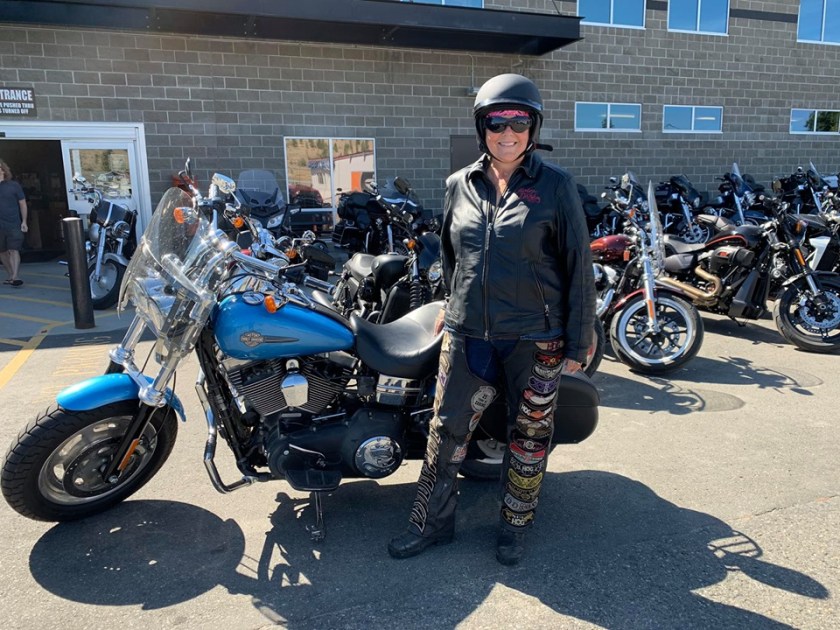
Maggie Thompson, with the Blue Bomb before parting with it last week. (Facebook photo)
In brief, here is a definition of peritoneal dialysis from kidneyfund.org: “Peritoneal dialysis (PD) is a treatment that uses the lining of your abdomen (belly area), called your peritoneum, and a cleaning solution called dialysate to clean your blood. Dialysate absorbs waste and fluid from your blood, using your peritoneum as a filter.”
A catheter is surgically implanted into our peritoneum that will allow you to do fluid exchanges. You learn how to do PD manually four times a day before being given a cycler that allows you to do it while sleeping at night. And the only way it limits your ability to travel is if you allow it to, something Maggie wouldn’t do.
A Harley-Davidson rider and owner, Maggie took a lengthy trip with friends into the U.S. a few years back. She drew up a travel schedule and arranged with Baxter, the company that provides PD supplies, to make fluid drops at various stops. Friends constructed a trailer that she towed behind her Harley; it contained other needed supplies.
As the friends travelled, then, they would stop to allow Maggie to do her exchanges.
Since having her transplant in July of 2011, Maggie hasn’t slowed down at all. She moved to Edmonton early in 2018, but makes regular visits to Kamloops, where she had lived for 30 years. Earlier this summer, she took two grandsons to the Calgary Stampede — yes, she also has a car — and then on a tour around Vancouver Island that included a stop in Tofino.
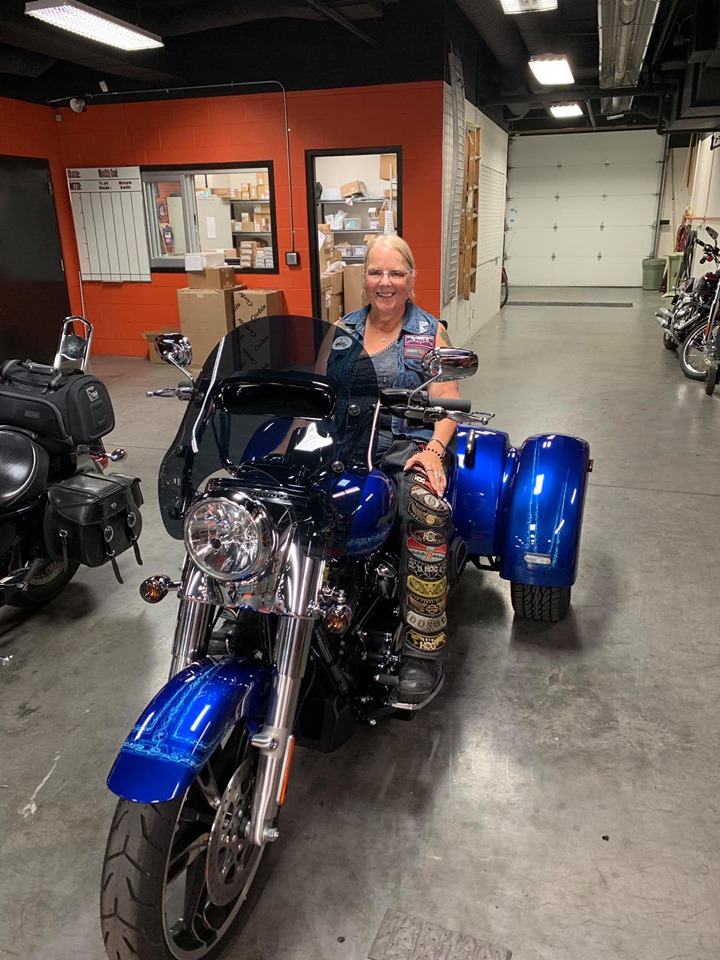
Maggie Thompson, with her new ride, Sassy Sapphire. (Facebook photo)
Late last week, Maggie rode her Harley — she called it the Blue Bomb — to Kamloops, where she visited the local dealership and traded it in on a Freewheeler Trike that she has dubbed Sassy Sapphire.
After a few days with us, Maggie climbed aboard Sassy Sapphire on Tuesday morning and headed home to Edmonton. She arrived early last evening having been on the road for almost 12 hours.
No, kidney disease hasn’t slowed down Maggie Thompson in the least.
It is National Polycystic Kidney Disease (PKD) Awareness Day in various parts of the world today (Wednesday, Sept. 4).
According to a news release:
“Since 2014, Health Canada has recognized September 4 as National Polycystic Kidney Disease (PKD) Awareness Day – a special day devoted to raising awareness of this life-threatening, genetic disease.
“Polycystic kidney disease (PKD) is a chronic, genetic disease causing uncontrolled growth of fluid-filled cysts in the kidneys, often leading to kidney failure. With 66,000 Canadians and millions worldwide living with PKD today, chances are high that you know someone with the disease.
“The more who know about PKD, the more resources we can dedicate to finding treatments and a cure. PKD Awareness Day is our opportunity to step up our efforts and gives us a platform to widely spread the word, share stories and encourage others to learn more. On PKD Awareness Day, let’s come together as a united front to spread the word about this disease further than we ever have before!
“Since its creation in 1993, the PKD Foundation of Canada has raised more than $1 million towards research, support and help for families living with PKD. From the first research grant awarded in 1999, the PKD Foundation of Canada has set up chapters and support groups across the country, built an expansive and passionate volunteer network, and connected with PKD groups around the world to support our most notable fundraising event – the Walk to END PKD.
“Today, the PKD Foundation of Canada is the only national organization solely dedicated to fighting PKD through research, education, advocacy, support and awareness.”
In Kamloops, locals involved in the PKD Foundation will appear before City Council on Sept. 10 in an attempt to spread awareness.
Here in Kamloops, preparations are well underway for the annual Kidney Walk, which is scheduled for Sept. 22 at McDonald Park. . . . If you would like to take part, we register at 10 a.m., with the walk to follow at 11. Some of us will walk a couple of kilometres, but there isn’t a defined distance. In fact, you don’t need to walk at all. Just come and join us for the breakfast — pancakes, bacon and coffee, by donation — with the Brock Central Lions Club doing the cooking. . . .
My wife, Dorothy, will be celebrating the sixth anniversary of her kidney transplant by taking part in her sixth straight Kidney Walk. In her six walks, she has raised more than $15,000. If you would like to support her, you may do so right here.
3-year-old Kaden Jones waited 202 days for a heart transplant and now is back on track to living a 'normal life like other kids' again. https://t.co/NAbLstkESq
A reader sent me a link that led me to a story on USA TODAY’s website. I had to read the story a couple of times because I found it so shocking.
Here are the first two paragraphs:
“The United States discards about 3,500 donated kidneys a year, many of which could be used to save lives, new research shows.
“The study, published Monday in the journal JAMA Internal Medicine, focused on the rate at which donated kidneys were used in the U.S. and France between 2004 and 2014. In that time, the U.S. discarded about 17.9% of the kidneys it recovered, while France discarded about 9.1% of the kidneys it recovered. In all, the U.S. threw away almost 28,000 donated kidneys in that 10-year period.”
Let that sink in for a few minutes. People are dying because they need kidneys and yet donated kidneys are being trashed.
The study was published in JAMA — The Journal of the American Medical Association.
During the time under study, the U.S. recovered 156,089 kidneys from deceased donors and discarded 27,987 (17.9 per cent) of them. In France, 29,984 kidneys were recovered, with 2,732 (9.1 per cent) of them discarded.
According to figures supplied by the National Kidney Foundation, there are almost 100,000 Americans in need of kidney transplants. While 12 people on the waiting list die each day, about 10 kidneys are trashed each day.
Adrianna Rodriguez of USA TODAY wrote:
“The study showed that kidneys discarded in the U.S. were on average about 36 years old, whereas kidneys discarded in France were on average about 50 years old. That means France had a higher kidney acceptance rate from older donors.
“The study found that the U.S. is more likely than France to throw away kidneys when the donor had hypertension, diabetes, had a heart attack or tested positive for Hepatitis C.”
That story also included this quote from Sumit Mohan, associate professor of medicine and epidemiology at Columbia U in New York City: “They should definitely be used and are definitely viable. Using kidneys from diabetic donors do remarkably well.”
Rodriguez points out that “the mortality rate for patients who go on dialysis is about 20 per cent annually, which works out to be a five-year survival rate.”
Mohan told Rodriguez: “It’s comparable to some of the worst cancers we see.”
Keep in mind that while some cancers are curable, there isn’t a cure for kidney disease. No, there isn’t.
Mohan added: “People aren’t asking ‘What’s the quality of my kidney?’ The question that everybody asks is, ‘When am I getting my kidney?’ ”
In short, the system in the U.S. is broken. The good news it that there is a move afoot to overhaul the country’s organ transplant regulations. The bad news is that we all know that won’t happen this week or next.
The USA TODAY story is right here and it really is worth a read.
The complete JAMA Internal Medicine study is right here, and it is absolutely devastating if you are an American and at all impacted by kidney disease.
Another reader sent me a link to an editorial in the New York Daily News. The editorial board there writes: “Beggars know they can’t be choosers. Even an imperfect kidney is better than life, and ultimately death, on dialysis. Fix the rules so more Americans can receive the gift of life.” . . . The complete editorial is right here.
All of this hits really close to home. My wife, Dorothy, had a kidney transplant on Sept. 23, 2013. Had we been living in the U.S., the kidney she received likely would have been rejected because it may have failed one of the afore-mentioned qualifiers.
At that point, she had been doing peritoneal dialysis for almost four years.
If you are in the area of Granville Island in Vancouver early in September, you may want to check out this play — Waiting Time — that will be part of the Fringe Theatre Festival.
We’re excited to help shout about a new Canadian play called Waiting Time at @VancouverFringe, spotlighting a story about transplant and organ donation. Opening night kicks off next Thursday, Sept 5! pic.twitter.com/7Hb5E7AOdb
Featured Kidney Kitchen Recipe. 🍳Weekends are for brunching. Do it right with this spinach ricotta frittata recipe that is high in protein and low in potassium and sodium.https://t.co/mMLoXLTBKSpic.twitter.com/Y0WzQYxDbQ
IN THE NEWS! 📰📣 'It’s hard on the whole family' Saskatoon baby awaits organ transplant. Baby Emmet is battling nephronophthisis, a rare genetic disease of the kidneys and liver. https://t.co/W6mAnwo1sn
Paul and Jane are #TransplantGrandparents. Thanks to a life-saving liver transplant in 2011, Paul got to walk his two daughters down the aisle on their wedding days and be present at his son’s. His is grateful for the extra time to watch his five little grandchildren grow up. pic.twitter.com/0dkB0dP081
Catherine Pearlman was in a Los Angeles-area coffee shop one day when she saw a flyer involving a man she had never met. That man, Eli Valdez, was in desperate need of a kidney transplant. . . . Pearlman ended up donating a kidney to Valdez. . . . If you have ever wondered about the thought process involved in giving a kidney or what it means to be on the receiving end — like, what does it mean to have someone else’s organ in your body? — give this right here a listen because it is absolutely awesome. . . . Valdez especially bares his soul over the 45-minute conversation. I can tell you from experience that my wife, Dorothy, who had a transplant on Sept. 23, 2013, had many of the same feelings as did Valdez.
If you aren’t familiar with this story, Catherine’s husband, Jeff, who is a writer of note, posted a piece on his website shortly after the transplant. That piece is right here.
A couple of weeks later, Catherine wrote a piece for the Los Angeles Times in which she described all that she and Eli had gone through. That piece is right here.
BC Place will glow teal today in advance of #PKDAwarenessDay on Sept. 4th 💙 Over 66,000 Canadians live with polycystic kidney disease (PKD) which causes uncontrolled growth of cysts in the kidneys, often leading to kidney failure. Learn more at @endPKD or https://t.co/yhlFbVAAdLpic.twitter.com/1PaTelCtBW
PKD Awareness Day takes place on an annual basis, always on Sept. 4. Millions of people worldwide, including more than 66,000 Canadians, live every day of their lives with PKD, or polycystic kidney disease. As the above tweet mentions, PKD “causes uncontrolled growth of cysts in the kidneys, often leading to kidney failure.” . . . According to the BC Renal Agency’s website, “autosomal dominant polycystic kidney disease is the most common inherited renal disorder, and is the fourth-leading cause of end-stage renal disease in Canada.”
Watch for PKD Awareness Day in your community.
Volunteers are the backbone of @KidneyBCY. They help advance our mission and vision—to eliminate the burden of kidney disease and achieve excellent kidney health, optimal quality of life, and a cure for kidney disease. Want to help? Contact Janeen: jtronnes@kidney.bc.ca pic.twitter.com/k1qZugvcMd
Since Rob received a kidney from his dad 10 years ago, he’s travelled to over 20 countries around the world and stepped foot on every continent. He lives life to the fullest as none of this would have been possible for him before transplant. Rob is part of #50YearsofTransplant. pic.twitter.com/BGThlTDvDh
If you or someone you know is a candidate for a kidney transplant and lives outside of Vancouver, you will learn in the lead-up that a stay of at least a couple of months in the big city will be necessary after surgery.
And with the cost of accommodations being what they are in the big smoke, well, you might have questions.
You should know, then, that there are kidney suites available in Vancouver . . .
The Kidney Foundation of Canada, BC & Yukon Branch offers seven kidney suites within Vancouver. These are for post-kidney-transplant recipients who have come to Vancouver from outside the Lower Mainland and need to stay in town for up to two months after surgery. These suites are fully furnished, and are located near major transit lines.
These suites are free for those who meet our financial criteria (low income) and just $35 per night for those who do not.
If you happen to live in Kamloops and area, you may be wondering about the next gatherings of the Kamloops Kidney Support Group (KKSG). . . . We get together on the second Wednesday and second Saturday of every month. In September, that will be Sept. 11, 10 a.m., and Sept. 14, 9 a.m. . . . All coffee drinking and eating of eggs takes place at the Barside Lounge and Grill at Chances Casino, 1250 Halston Ave. . . . Believe me when I say that these gatherings are informal.
SOME ODDS AND ENDS . . .
One in 10 Canadians live with kidney disease or are at risk – most are unaware of this. . . .
You can lose up to 80 per cent of your kidney function before experiencing symptoms. . . .
As of mid-August, in the region served by Royal Inland Hospital in Kamloops, there were 1,378 patients with chronic kidney disease (CKD) being monitored by nephrologists. Of those, 140 have undergone transplants, and 114 are on dialysis. . . .
As of December 2018, there were 665 people in B.C. waiting for organ transplants, with 528 of those being kidney patients. In 2018, 335 kidney transplants were performed in B.C.
Some numbers from a piece by the editorial board of The New York Times from earlier this week:
About 20 Americans die each week waiting for organs. . . .
More than 100,000 people in the United States are currently waiting for organs, and only about 35,000 will receive them in 2019. . . .
That piece also included this:
“Far too few people are donating organs to begin with, and far too few of the organs that have been donated are making their way to patients in waiting. Experts say that misconceptions about donor eligibility requirements and, in some states, cumbersome registration processes are preventing nearly half of those who support organ donation from becoming registered donors. Outdated standards are causing transplant surgeons to reject some 75,000 usable organs every year, according to a Washington Post analysis. And an astounding lack of accountability and oversight in the nation’s creaking, monopolistic organ transplant system is allowing hundreds of thousands of potential organ donations to fall through the cracks.”
The complete piece is right here and it’s well worth your time if you are interesting in the American transplantation system.
Here are our Team Canada bowlers at the World Transplant Games in Newcastle. Sending them lots of positive vibes from Vancouver! @WTGF_Gamespic.twitter.com/X3Vjx6vWpW
The RSVP deadline is approaching for kidney patients and family members to be part of a @Fraserhealth focus group. See original post for details. ⬇️ https://t.co/23p6SIM5z3
Anja and Christine are both dietitians with the Post Kidney Transplant Program at St. Paul’s Hospital. Between the two, there are approximately 1,000 kidney transplant recipients they follow. They are part of #50YearsofTransplant. https://t.co/MSZMTFcsHcpic.twitter.com/8RzNT4etds
It’s PLUGGED IN time! 🎥 Watch as we meet a Kidney March participant who found inspiration in the pool. Later David C. Jones and Sidney the Kidney get in the swing of things for a good cause, and Kate and Sue share 10 Tips for Kidney March participants!https://t.co/jUV9YBxE8g
Folks in Kamloops will gather at McDonald Park on Sept. 22 for the annual Kidney Walk. If you would like to participate, we register at 10 a.m., walk at 11, and have breakfast when it’s all done. The Brock Central Lions Club supplies the breakfast — pancakes, sausage and coffee — by donation.
We held a news conference on Monday at St. Andrews on the Square. If you are curious about how the media saw what we had to announce, here’s a look . . .
Chad Klassen of CFJC-TV filed a video report and wrote a story, both of which are right here.
——
John Luke Kieper of KamloopsBCNow was on hand, too, and he posted his story right here.
——
Dairai Mutandiro of Kamloops Matters joined us and wrote this piece right here.
Kristi with @TRFofBC had a heart transplant at 17 years old and this August will be her 19th anniversary with her heart. Her transplant meant that she had more time. Time to grow up, finish university, get married and celebrate 19 more birthdays. Happy heart-aversay to her! pic.twitter.com/qBJsfA8Bjd
Madeline Stroup died earlier this month after a car crash. Now, her family is calling on British Columbians to become organ donors after her organs saved the lives of five other British Columbians in need of transplants pic.twitter.com/wQlFtVEWRP
Tara Stroup’s daughter, Madeline, was in a coma for seven days after being involved in a car crash in Abbotsford, B.C., on July 26. When the family decided to take Madeline off life support and donate her organs, they discovered that she had registered as a donor. . . . Tara spoke with Estefania Duran of CBC News about the decisions involved and the aftermath. That story is right here.
IN THE NEWS! 📰📣 Girl who had kidneys removed competes in race weeks after walking for first time. Mia Mifsud, three, was the youngest competitor at the British Transplant Games.https://t.co/h8efJoXzgj
If you are in the vicinity of downtown Kamloops this afternoon (Monday, Aug. 19), feel free to join organizers of the 2019 Kamloops Kidney Walk for a news conference at St. Andrews on the Square, 159 Seymour St.
We will be announcing details of the 2019 Walk, introducing this year’s honourees, and accepting the largest single donation in the event’s 10-year history.
Just in case you missed them, here are stories about two people who live in Kamloops, both in need of a kidney transplant.
Vic Morin was profiled by Todd Sullivan of Kamloops This Week in March, and that story is right here.
Julie Dodds went public earlier this month through a post on Facebook, after which Eric Thompson of kamloopsmatters.com wrote a story that is right here.
DID YOU KNOW? We have dozens of informative brochures on our website available for download? Subjects range from Chronic Kidney Disease, nutrition, risk factors for kidney disease, treatment, organ donation, kidney disease and children, and more. Go to: https://t.co/kcZibGG0Pipic.twitter.com/6X8yL8mDgi
A major story involving adult lung transplants broke late last week in Vancouver where a machine has been developed that, according to a news release, “allows lungs to live outside the body for up to 12 hours after retrieval.” . . . The news release continues: “Lungs that might initially be rejected for transplant can be reassessed, repaired and reconditioned in a bubble-like machine.” . . . This is absolutely huge news for the 40 adults waiting for transplants in B.C. . . . The complete news release is right here.
If you have been impacted by kidney disease, please keep in mind that the Kamloops Kidney Support Group gathers this morning (Wednesday, Aug. 14), 10 o’clock, at the Barside Lounge and Grill inside Chances at 1250 Halston Ave. . . . Feel free to join us. . . .
If you are in the vicinity of downtown Kamloops on Monday (Aug. 19), organizers of the 2019 Kamloops Kidney Walk are holding a news conference, 2 p.m., at St. Andrews on the Square, 159 Seymour St. Join us as we announce particulars of this year’s Walk, and also introduce the event’s honourees.
What’s it like when the recipient of a kidney transplant meets the donor? Well, Chris, 21, a recipient, met his donor, Abraham, 19, on Good Morning America recently and, as you might expect, things got emotional. . . . Abraham, whose mother has started the process of becoming a donor, was asked what he would say to anyone considering it, and he responded: “I would say go for it. Reach out to a hospital and see if you’re eligible and if you are eligible, really consider it. I was in the hospital for two days. I was off painkillers in five days. I feel great.” . . .The whole story is right here.
A lexophile, thanks to a contest in The New York Times: England has no kidney bank, but it does have a Liverpool.
Kerry Eggers of the Portland Tribune has a story right here about Doug Little, now 68, who was a 6-foot-3 forward on the Oregon Ducks basketball team in the early 1970s. . . . Today, Little is on the list and hoping for a kidney transplant.
Pls share! Vaccines used in Canada are safe and effective, even for people who have severe egg allergies. Need more info? Read why #immunization is important: https://t.co/qnMX2O9oq9. The Vaccine Evaluation Center’s Julie Bettinger explains: pic.twitter.com/DfNhO5vS4x
The World Transplant Games open Saturday and run through Aug. 24 in NewcastleGateshead in the north-east area of England. . . . “The youngest participant,” reports Catherine Priestley, “is a six-year-old Argentinian girl who will compete in the ball throw, long jump and 50-metre sprint, with the oldest an 84-year-old French man taking part in the cycling, swimming and athletics.” . . . Priestley’s story is right here. . . . The Games’ website is right here. . . . It’s worth noting that the 2020 Canadian Transplant Games are scheduled for Winnipeg, Aug. 10-15.
There is an interesting project underway in Winnipeg with two doctors working to educate health care providers about how “to use a match equation than can pretty accurately predict a person’s risk of kidney failure, according to Michelle Gerwing of CTV News. . . . This all is aimed at early diagnosis of kidney disease. . . . As Dr. Navdeep Tangri, a nephrologist, explains: “If you have diabetes and kidney disease today there is a treatment out there that can delay dialysis by up to two decades and potentially prevent it all together, but all of that is non-applicable, we can’t start people on that treatment once their kidney function drops below 30-per cent.” . . . Gerwing’s story is right here.
Not all hero’s wear capes, a truly incredible man! Mr Rajamiyer Venkateswaran, has performed hundreds of heart transplants. “Yesterday I operated on a man who was basically dead. I finished at 7pm last night, went home and could say, I saved him.” ♥️♻️ https://t.co/wZExO8xs9U
It was a humbling experience to sit in my recliner on Friday evening and again on Saturday and hear from so many people via Twitter, email, text, Messenger, etc. As I sat and pecked away on my laptop all those evenings, it was easy to forget that there actually were folks out there who would be reading whatever it is that I was writing.
Thank you all so much for the kind words. They won’t be forgotten.
But considering the direction that I am taking this site, one note stood out from all the rest. Here is part of it . . .
“Best of luck with the new focus. It does hit a little close to home because three weeks ago my 78-year-old father went to the hospital at my urging to have a kidney stone checked.
“In the process, they found a tumour on one of his kidneys — fortunately, it’s early enough that he’ll be having surgery at the end of this month to have the tumour — and hopefully just a very small portion of the kidney — removed.
“It’s often not a stroke of luck to have a kidney stone, but in this case it was because, if not for that, the tumour wouldn’t have been found until it was too late.
“As the doctor told him, the kidney stone saved his life.”
And then there was the email from a WHL insider that included this:
“I am excited to continue to read your work as a kidney patient who is beginning kidney failure.”
Some food for thought from the Kidney Foundation of Canada/B.C. & Yukon Branch. . . .
One in 10 Canadians live with kidney disease or are at risk – most are unaware of this. . . .
You can lose up to 80 per cent of your kidney function before experiencing symptoms. . . .
As of December 2018, there were 665 people in B.C. waiting for (an organ) transplant, with 528 of those being kidney patients. In 2018, 335 kidney transplants were performed in B.C.
It stands to reason that diet is of utmost importance to folks who deal with kidney disease of one type or another. . . . With that in mind, you should be aware of the Kidney Community Kitchen, a creation of the Kidney Foundation of Canada. The tweet below highlights Classic Hamburgers and the recipe is available by following the link. . . . At the site, there also is an areas that allows you to browse recipes by meal type. Check it out.
Featured Kidney Community Kitchen Recipe 🍔 Because it’s a long weekend, you gotta have burgers! Keep them low in sodium, potassium and phosphorus with this simple recipe.https://t.co/ktN7LvGC7xpic.twitter.com/7e5TB0WRln
Here's your Friday Funny! Check out Amanda Nicastro, star of "I'm just Kidneying” from New York. She says her show makes it easier for loved ones to have that conversation about the organ donation process. Watch here: https://t.co/lMZDqT7h37
📹Watch the latest PLUGGED IN episode to learn about the process one couple when through in order for the wife to successfully donate her kidney to her husband. We also catch up with a mother/daughter pair who share their Top 10 Tips for Kidney Marchers.https://t.co/C02oeOwB4j
It was over a month ago when Stevie Wonder informed concert-goers in London, England, that he is scheduled to undergo a kidney transplant late in September. Yes, he said, a donor has been found.
Little is know about what got Stevie Wonder to the point where he needs a kidney transplant. He made the announcement in London to quell rumours about his health, but there don’t appear to have been any statements made since then.
Nina Shapiro, who writes about health-related issues, has more right here.
If you’re new here, Dorothy, my wife of more than 47 years, has had a kidney transplant and her immune system now is compromised. There are a lot of people walking around out there who are just like her, which is just one more reason why immunization is so important.
Pls share! At least 95% of the population needs to be immunized to develop herd immunity. Read why #immunization is important: https://t.co/Ffp8PfiTv2). Shannon’s son needs those around him to be vaccinated after surviving a heart transplant and cancer: pic.twitter.com/mrSfe0Fat3
— BCChildren'sHospital (@BCChildrensHosp) August 3, 2019
Pls share! Get caught up on your vaccinations as part of your back-to-school routine. Read why #immunization is important: https://t.co/JEYgqjBzwg. Dr. Manish Sadarangani talks about how vulnerable children can be affected: pic.twitter.com/imiLRy6SoY
— BCChildren'sHospital (@BCChildrensHosp) August 4, 2019

 TAKING NOTE