Mondays With Murray: Gibson’s Ability Is ‘Gift’; So Is Color of His Skin

Gibson

Bob Gibson, a former St. Louis Cardinals pitcher and a member of the Baseball Hall of Fame, died of pancreatic cancer on Friday in his hometown of Omaha, Neb. He was 84.

Gibson’s death came on the 52nd anniversary of perhaps his most overpowering performance, when he struck out a World Series record 17 batters in Game 1 of the 1968 World Series against Detroit.

Gibson’s career included 251 wins, including 56 shutouts. He won two Cy Young Awards and threw a no-hitter in 1971.

He was inducted into the Baseball Hall of Fame in Cooperstown in 1981.

——

FRIDAY, OCTOBER 4, 1968, SPORTS

Copyright 1968/THE TIMES MIRROR COMPANY

JIM MURRAY

Gibson Ability Is ‘Gift’; So Is Color of His Skin

  Bob Gibson doesn’t dislike white people, he just wonders where they were when he needed them.

  He is no more fun to face with a pencil than with a bat. He doesn’t consider reporters evil, just stupid. Not all of them, he points out in his remarkable book, “From Ghetto to Glory,” just most of them.

  His answers come back like his high, hard one. You don’t dare take a toe-hold on them. Bob resents any quotes that make him sound like Chapter 2 of Uncle Remus or a jive-talker from Lennox Ave.

  “I’m a Nebraskan,” he notes simply.

  Some Nebraskans didn’t care for the sensation, he also points out in his book, co-authored by Phil Pepe. The painter who walked off the job in the middle of spraying his house, for instance, but the unconscious irony of the colloquy of two other neighbors was not lost on Gibson. “There’s a Negro just moved in across the street,” one was told. “No,” was the contradiction, “that’s Bob Gibson.”

  There are those who think it remarkable Bob Gibson can throw that hard, handicapped as he is by the chip on his pitching shoulder. Others decide it is an advantage. “Some guys load the ball with spit,” notes another player. “Others load it with hate.”

  The trust of the matter is, Bob Gibson puts no pressure on Bob Gibson. He neither hates nor likes. He accepts the challenge, the records, the notoriety, with a shrug. He takes his ability to throw a baseball for granted. “I am not proud of that ability,” he says simply. “It was a gift.” It was from the same donor, he notes, who gave him the color of his skin.

  Gibson’s advantage lies not in his right arm but in his two feet. He RUNS the first few feet of the 60-1/2 from the mound to the plate as he pitches. By the time Bob Gibson lets go of the ball with his long arm and longer legs, it has only about 53 feet left to cover. Gib is so close to the batter when he releases the ball he can smell what he had for breakfast. He looks like he’s running in for a bunt on every pitch. It’s fortunate he’s abundantly reflexed, otherwise he’d have holes in him. Robert Clemente broke his leg with a line drive back to the mound last year. Where Gibson ends up after a pitch, he has to guard not only against the ball, but also the bat.

  If this World Series has done nothing else, it has laid to rest the ghost of John McGraw and other nasty-tempered martinets of the dugout, the “Stick-it-in-his-ear!” or “You-get-this-busher-out-or-get-on-the-bus-to-Spokane-next-year!” type of leader. The kind the press describes as “fiery.”

  The only thing fiery about Cardinals manager Red Schoendienst is his hair. Detroit’s Mayo Smith treats his ball club as if he were trying to sell them a new car, a sort of “Gee, fellows, be serious!” type of relationship.

  You won’t see either Red or Mayo running out to scream at the umps every other play, or jumping up and down on their caps. Mayo acts like the head abbot in a friary. Schoendienst wouldn’t raise his voice if he saw a tarantula crawling up your leg. If you came in late, you couldn’t tell by his expression whether he just won the pennant — or just lost it. 

  Neither manager would stoop to pasting clippings on the locker room door, or trying to convince his charges the other guys spent all their time poisoning Pablum or gassing canaries. They take the position baseball is no more emotional than accounting, that it’s just another white-collar job, a game, not a war. They leave fines to traffic judges, curfews to the shore patrol. They watch a game like titled Englishmen at a cricket match.

  They have no flair for self promotion. You can understand every word they say; they don’t criticize their players in print. They make Dr. Schweitzer look cantankerous, and Hubert Humphrey, pessimistic. They will be on camera so little, they can go on “What’s My Line” unguessed before an unmasked panel.

  Their teams are like they are, as efficient as morticians, as evenly matched as Lunt and Fontanne. If the old Cardinals were the “Gas House Gang,” this one is the “Guest House Gang.” With these two in command, the World Series is going to be so impersonal, they might be able to play it by mail. It’ll be as polite as a French duel, as restrained as a UN debate. Not even the insolence of a Lou Brock stealing second on a pickoff attempt can provoke retaliation. They should donate the proceeds to Moral Re-Armament or the American Friends Society. Now that it’s all tied up, they may show up for the third game with flowers in their hair or “Make love — not outs” signs on their uniforms, a 50-man object lesson in non-violence.

Reprinted with the permission of the Los Angeles Times

Jim Murray Memorial Foundation P.O. Box 661532, Arcadia, CA 91066

——

info@jimmurrayfoundation.org|

www.jimmurrayfoundation.org

Mondays With Murray: Does the Man Bleed?

On Sept. 28, 1976, Muhammad Ali met Norton in the ring at Yankee Stadium for their third fight.

Ali had taken the heavyweight title from George Foreman two years earlier in Zaire at the Rumble in the Jungle. Norton, the one major contender left, had beaten Ali in San Diego in 1973, but Ali had beaten him in the rematch later that year. The fight in Yankee Stadium was to settle it all and this time the heavyweight belt was on the table.

Jim Murray was in New York for the bout and what follows was his preview of the fight that appeared in the Los Angeles Times on the same day as the fight, which Ali won in a 15-round decision.

Enjoy!

——

September 28, 1976, SPORTS

Copyright 1976/THE TIMES MIRROR COMPANY

JIM MURRAY

Does the Man Bleed?

  NEW YORK — Anyone who has ever been to Stillman’s Gym, a Warner Bros. movie or the old St. Nick’s Arena on a Saturday night knows what a fighter looks like who has had more than 200 fights, amateur and professional, has been floored, won and lost his title, had his jaw broke and had to turn to wrestling to hustle a buck.

  First of all, there’s all that scar tissue, right? The nose looks like a pancake. mondaysmurray2There’s that nervous twitch. He walks on the balls of his feet as if the earth were a pitching ship on a storm-tossed sea.

  When he speaks, which he does in a laryngitic whisper, the voice sounds like someone being strangled or trying to talk with an arrow through his Adam’s apple.

   If someone starts to count to 10, he’ll get out of bed in a sound sleep and begin punching the air. If someone rings a bell, he’ll attack a lamp pole. Red Skelton can do him to a T. His brains are scrambled eggs, his eyes are slits, his lips permanently swollen. He tries to pay no attention to the flock of birds constantly flying over his head. He talks through his nose because that’s the only thing left with an opening.

  You often find him outside the Garden wearing dark glasses and selling a cup of pencils. He’s Mountain Rivera in “Requiem For a Heavyweight.” He’s Marlon Brando in “On The Waterfront” telling Rod Steiger, “I cudda been a contender,” only it come out “cuttehah” because he has a permanent cold in the hose from right hooks and hasn’t been able to pronounce an “n” in years.

  He may be shining somebody else’s shoes in a golf club in Georgia or at an airport in Texas. He’s broke. Some dame in high-heeled shoes some place has got his money. She only got what some mob guy in a gray hat and cigar didn’t take first.

  He is the victim of countless industrial accidents but the state unemployment doesn’t take care of him. Nobody takes care of him. A hundred guys were around lighting his cigars when the champagne was flowing and the parties went on till dawn. They cross the street now when they see him coming. When he dies, a stranger will find him. His last companion will be a bottle of muscatel.

  Let me now present to you a real-life pug who has been trading left hooks with the world for more than 18 years, 16 of them as a professional.

  For Muhammad Ali, formerly known as Cassius Marcellus Clay, the cruel world of fistiana, the shatterer of dreams, the maker of human flotsam has been Camelot.

  Look at the eyes. Not a mark on them. The nose. It’s downright pretty. No one knows if he bleeds. He never has.

  Listen to him talk. It’s hard not to. Nothing wrong with that Adam’s apple. It’s a melodious sing-song, half street patter, half Sugar Hill.

  He hasn’t got a pimple on him. His ears don’t look like uncooked biscuits. You could hang earrings on them.

  He’s made $38 million in the ring and he owns property in as many locations as the Santa Fe Railroad. He is the chief support of an entire religion. He is the highest-paid performer in the world. He gets up to a million dollars a minute, certainly a round. He doesn’t need an oil well. His left jab is his oil well.

  Eisenhower was president when Ali first laced on a pair of boxing gloves but when he goes to the White House now, he checks it over to see if he’ll like it. He barely finished high school but even the Supreme Court took cover when he came before it.

  He is the only man in the world who can mock integration and not evoke a chorus of indignation. They cheer whatever he says. No one wants to mess with him in open debate. Better to knock Motherhood than Muhammad Ali.

  So, why isn’t he in a rooming house in Pittsburgh and it’s raining outside and the blinking neon outside the window keeps him awake? Why isn’t he shuffling along Harlem looking for handouts?

  For more than 16 years, he’s fought the toughest guys on this planet, guys right out of the slammer for armed robbery, guys who busted cops with their own nightsticks, guys who came into the fight game on the bottom of freight trains or who learned to fight with their fists on rooftops so they wouldn’t get thrown off. Why aren’t his ears stopped up? Why isn’t his nose broken, his speech stammering, his gait shuffling?

  Why doesn’t he owe the government $20 million or so? How come his wives haven’t taken him to the cleaners? How come he doesn’t need a white cane like Sam Langford or a nose job or an ear transplant?

  Has the fight game gone soft? Isn’t there a Fritzie Zivic to detach your retina with a thumb gouge any more? Did the Marquis of Queensberry really take over? Why, the guy Ali is fighting for the title tonight is so pretty he’s a movie star between fights. Not Mike Mazurki guarding the gang’s hideout but right up there in gorgeous Technicolor kissing the leading lady. And that’s not all.

  No, Ali has bucked the system, the establishment, the odds, tradition and the law of the fight game by observing one principle: hard hitters get hard hitten. Ali can hit as hard as he wants but, more importantly, as often as he wants. Ali doesn’t get in fights, he gives a recital, a showing. It’s like paintings at an exhibition, Rembrandt showing his oils. Heifetz doing Bruch.

  There has never been a 220-pound athlete who can move around a ring with the swiftness and grace of Ali. Most of his fights are things of beauty like a Moiseyev ballet. He doesn’t beat his opponents, he capes them.

  There has never been another like him. Two hundred fights, 20 of them for the highest stakes in sports, the heavyweight title, and he could go on “What’s My Line?” tomorrow and be mistaken for a guy who spent the last 10 years in a monastery.

  Someday, somewhere there may be a guy who can set bells ringing in Muhammad Ali’s ears, who can put a haze over those eyes, who can thicken that tongue, still that banter, slow those legs, scar those lips or tear those eyelids.

  Ken Norton? From here, Ken Norton looks like just another fiddle to the artist. Ken Norton, like so many of the others, may find himself playing straight man to the star by Round 3. Or Round 1.

  The crowd does not go to see Ali win or lose. They go to see The Performance. Art. One of these nights it will be the artist’s last landscape. Too bad they can’t hang it in the Louvre.

Reprinted with the permission of the Los Angeles Times

Jim Murray Memorial Foundation P.O. Box 661532, Arcadia, CA 91066

——

info@jimmurrayfoundation.org|

www.jimmurrayfoundation.org

Mondays With Murray: Two columns on Tom Terrific . . . Enjoy!

Tom Seaver passed away on Aug. 31. He was 75. The cause of death was complications of Lewy body dementia and COVID-19, according to the Baseball Hall of Fame.

Here are two Jim Murray columns on the pitcher known as Tom Terrific.

——

WEDNESDAY, OCTOBER 17, 1973, SPORTS

Copyright 1973/THE TIMES MIRROR COMPANY

JIM MURRAY

Seaver Deserves Better

  NEW YORK — Usually when a pitcher is a veteran who has a series of 20-win seasons and has pitched his team into two World Series in four years, he is a mondaysmurray2grizzled old party who spits tobacco and you could scratch matches on his beard. He talks in four-letter words and comes from coon-hunting country and never reads anything that doesn’t have pictures in it and his favorite actor is John Wayne.

  But George Thomas Seaver looks as if he just stepped out of the pages of a Ralph Henry Barbour novel or is one of the Merriwell brothers.

  He looks as if he might go around helping old ladies across the street or rescuing babies from drowning. As if he had just two more knots to tie or fires to start rubbing sticks together to get his Eagle Scout badge. He is Mr. Cleancut; as wholesome as a Saturday Evening Post cover, or a Disney movie, the kind of guy who would put splints on broken cats, the sort of fellow who would help his mother with the dishes and bring home all A’s on his report card.

  You’d want your daughter to marry someone like Tom Seaver. You’d want your son to grow up like that. They call him “Tom Terrific.” He looks as if his name should be “Roger Trueheart” or “Peter Pluck.” He’s the kind of guy who might spend more time in museums than bar rooms. He’s concerned, was one of the few baseball uniforms to take a stand on the Vietnam war.

  His fastball makes baseball men drool and hitters slobber with rage. He could throw the proverbial strawberry through a battleship. His control is uncanny. Tommy Strikethree has as much control of his pitches as he has of himself.

  Without him, the Mets are a .380 club. He pitches nearly 300 flawless innings a year. He’s such a competitor, he would bite a lion or pull a bear out of a tree.

  You would think, if God were paying attention, Tommy Strikethree, by now, would be working on his fifth or sixth World Series win. I mean, guys who would be lifted by the fifth inning pitching against him have won that many.

  But George Thomas Seaver’s record in World Series is about what you would expect from a crooked-armed junk thrower with a hitch in his delivery and a bad habit of tipping his pitches.

  The Mets get him runs in clumps of one. They send about 28 men to bat the night he pitches.

  Take Tuesday night. In a gelid Shea Stadium amid an Arctic front moving through Queens, Seaver, sporting a 19-win year and an earned-run average you would need Palomar to read, struck out the side twice. He had the feared Reggie Jackson, a 117-runs-batted-in MVP candidate looking like a revolving door. He struck out 12, walked none and was — well — Terrific.

  His team gave him a one-inning attack. They didn’t really need bats for the other eight. Seaver was in there.

  Over on the other mound, Catfish Hunter who is not “Mr. Terrific” or Walter Wonderful and is more of a pitcher who nibbles around the outside and wears out the corners of the plate, had given up a homer, a double, assorted singles, a wild pitch, several walks and even threw in an error for good measure and wasn’t around for the seventh inning. But he got exactly what Tommy Strikethree got — a standoff. His World Series record is still 1.000. Seaver’s is still .500.

  I’m glad to see God has better things to do than see justice served in baseball games but, the point is, Tom Seaver joins some distinguished company. Walter Johnson was .500 for his six Series decisions.

  Tom Seaver is nine decisions behind Whitey Ford who won 10 World Series games but look at some of the company he’s chasing besides Ford. Shucks, Orval Overall won three and only lost one. Bill Hallahan (surely you remember Bill Hallahan? “Wild” Bill Hallahan?) won three. Ernest G. Shore was 3-1. Guys like Harry Brecheen and Lew Burdette and Mickey Lolich won three in ONE Series.

  Great pitchers like Christy Mathewson were .500 for World Series. But they did get five victories.

  Lefty Gomez never lost a World Series game. He was in some real cliff-hangers. He won one 18-4 in 1936. That’s more runs than the Mets get Tom Seaver a season.

  For Seaver, it’s like someone painting a masterpiece and having somebody use it for a doorstop or to hang in the garage at work. He’s their bad luck charm.

  It was a foregone conclusion the Mets would lose for Seaver. On a passed ball, at that. They’re not much of a ball team when you move off the mound. They have to hoard runs. Never have so many done so little for so few. The pitching staff consists of five guys with their fingers in the dike.

  But I have a feeling somewhere there’s a ghostly crew looking on and nodding safely — Walter Johnson and Christy Mathewson and a lot of other guys who pitched 300 innings or 400 victories and then got in World Series only to see journeymen win the car or the plaudits.

————

SUNDAY, AUGUST 31, 1975, SPORTS

Copyright 1975/THE TIMES MIRROR COMPANY

JIM MURRAY

The Other Seaver

  If they were caught in a hotel fire, lots of people would try to throw their jewels or stocks or money out the burning window. Tom Seaver would want to throw his right arm.

  As ex-teammate Tug McGraw once said, “Seaver is exploring the possibility of keeping his right arm at Ft. Knox over the winter.”

  He won’t sleep on it, open car doors with it, cut meat with it, drink beer with it. He won’t hang it out the car window, let it get sunburned. He treats his arm as if it had a life of its own. He won’t pat dogs with it, play tennis with it, cut wood with it or comb his hair with it.

  He treats it the way a captain treats a ship, a gunman his gun, or a cowboy his horse. He pampers it, worries about it. He trots it out only every fifth day.

——

  Most pitchers pitch every fourth day, but Seaver’s arm lets him know it needed an extra day’s rest, and Seaver never contradicts his arm.

  No Hope diamond, no Rembrandt, no British Guiana stamp ever recorded the tender loving care of Seaver’s right arm. He does everything but keep it under glass. He takes better care of it than a bank takes care of money — and for the same reason. It is probably the most expensive parcel of fleshy real estate in the game — $250,000 a front foot.

  It is a one-purpose appendage. It throws strikes. It has no other function. That is all Seaver asks of it.

  Any manager in the big leagues can tell you it is valuable only because it comes with Seaver attached. But Seaver is not persuaded. He lets the rest of Tom Seaver shift for itself. He will even open beer cans with his left arm, slice bread, let it hang out the window, comb hair, shave whiskers, and do all the things God intended an arm to do. It is an orphan. Cinderella. Tom makes it do all the work he wouldn’t dream of asking its brother to do.

——

  Tom sat in the dugout at the ballpark the other night and watched, fascinated, as two Dodgers pitchers, Mike Marshall and Andy Messersmith, practised double plays around first and second base. “Isn’t that swell?!” he said, not unsarcastically. “They’ve got the double play down pat. Shouldn’t they be working on getting guys to hit into them?” The lesson was clear: Seaver would never ask his arm to complete a double play. Start one, perhaps, but there were other arms to take it from there: arms that couldn’t sneak a fastball part Henry Aaron.

  “You can transplant organs — kidneys, hearts, livers,” Tom said, “but you can’t transplant shoulders and elbows. Or arms. You get one to a customer.” Even in casual conversation, Seaver tends to forget his poor, sit-by-the-fire left arm.

  There have probably been purer arms in the major leagues — although I don’t make that even money, by any means. But there’s never been one more consistent. Seaver can trust his arm. And vice versa. Every year, it delivers 200 strikeouts, some 280 innings pitched, 18 to 20 complete games and the occasional pennant. The pennant borders on a miracle. Because the New York Mets are a one-armed team.

  The Arm delivers a rising fastball, a sinking curveball, a slider so deceptive it looks like both of them at once. It puts the ball where Seaver wants it to — usually where the hitter least expects it.

  With It in there, the Mets are armed and dangerous. Without It, they’re just a good Triple A club. And maybe not so good, at that.

  It is never erratic, rebellious, temperamental. It doesn’t win one game, 1-0, and lose the next, 10-2. It has allowed 652 runs in 312 games in nine years, which comes out to two runs per game. If the Mets score three, they win.

  Seaver knows every muscle, tendon, bone or capillary in it. But to the Mets, it is not full of trapeziuses, triceps, adductors or whatever else comes in ordinary arms, it is full of dollar bills.

  Some men send their gloves to the Hall of Fame when they get elected. Others send bats, shoes, mitts, masks or caps. Seaver may just cut off his arm and send it on. After all, Roy Rogers stuffed his horse. And, by that time, Tom won’t need it anymore. Tom’s other arm will have long since learned how to take care of him now that It is no longer needed to keep that funny little team from falling through the bottom of the league anymore.

Reprinted with the permission of the Los Angeles Times

Jim Murray Memorial Foundation P.O. Box 661532, Arcadia, CA 91066

——

info@jimmurrayfoundation.org|

www.jimmurrayfoundation.org

Monday’s With Murray: You Can Teach an Old Horse New Tricks

JimMurray 

  Twenty-two years ago today, the world awakened to the news of Jim Murray’s passing shortly after 11 o’clock the previous night — Aug. 16, 1998. He died of cardiac arrest at his West L.A. home after returning from Del Mar where he had covered the Pacific Classic. He wrote his final column on a horse named Free House ridden by jockey Chris McCarron.

   From the first column to the last column, Jim kept his readers entertained for 37 wonderful years at the Los Angeles Times and before that at the L.A. Examiner, Sports Illustrated, Time Magazine and more. He brought humor to an otherwise statistics heavy section of the paper. He gave us a glimpse into the people (and sometimes animals) who played the sports we loved to watch.

——

Jim aspired to be Eugene O’ Neill. Hemingway, even Tolstoi. But Harry Luce, the publishing giant of Time and Life magazines, the blockbuster journals of their time, made Jim a sportswriter.

To quote Jim. “Harry knew everything there was to know about world politics, the domestic economy, Hollywood, Foggy Bottom, Whitehall and Park Avenue. But he didn’t know any more about sports than Mother Teresa.”

Harry traveled the world over, dinner conversation would invariably switch to sports. Demanding to know why, he was told, “. . . sports, like music, is a universal language. Everyone speaks it.” With that, Harry Luce retorted, “Well, then why don’t we have a sports magazine?”

On that chance remark, Sports Illustrated was born. Jim was a Time magazine cinema correspondent in Hollywood at the time.

Jim got to be a sports writer in his journalistic dotage “which is just the right time for it,” he said.

– Linda Murray Hofmans

——

Some classic Jim Murray quotes:

The Bears aren’t very genteel; some teams tend to remove the football from you, the Bears remove you from the football — it’s much quicker.

For those who know golf, no explanation is necessary. For those who don’t, no explanation is possible.

(Seattle) Slew was a compassionate horse. He never beat anybody more than he had to. He was like a poker player who lets you keep your watch and carfare home.

A racetrack crowd comprises the greatest floating fund of misinformation this side of the pages of Pravda, the last virgin stand of optimism in our century.

Pete Rose played the game for 24 years with the little boy’s zeal and wonder until, if you closed your eyes, you could picture him with his cap on 

sideways, knickers falling down to his ankles and dragging a taped ball and busted bat behind him, looking for all the world like something that fell off Norman Rockwell’s easel.

Seeing a goal scored in hockey is like picking your mother out of a crowd shot at the Super Bowl.

——
What follows is Jim Murray’s final column, the one he wrote after covering the Pacific Classic at Del Mar. . . . ENJOY!

——

SUNDAY, AUGUST 16, 1998, SPORTS

Copyright 1998/THE TIMES MIRROR COMPANY

JIM MURRAY

You Can Teach an Old Horse New Tricks

   DEL MAR — Well, it was a slam dunk for Free House, a “Where is everybody?” win.

   The Bridesmaid finally caught the bouquet. The best friend got the girl in the Warner Bros. movie for a change. The sidekick saves the fort.

   Free House just won’t fold the hand. Three times last year, in the most publicized races mondaysmurray2in the sport, he chased his competition across the finish line in the Kentucky Derby, Preakness and Belmont. In the money in all of them, in the photo in one of them, he was the hard-luck champion of horse racing.

   He was expected to go quietly into the sunset. A game effort but no cigar.

   He got a measure of revenge Saturday in the Pacific Classic here. He ran away from Touch Gold, who beat him in the Belmont. The horse who beat him in all three Triple Crown races, Silver Charm, didn’t make the dance or he might have gotten a different view of Free House, too.

   The Pacific Classic is not your Run for the Roses. No bands play Stephen Foster as the horses come on the track. But it’s not your basic overnight allowance, either. It’s a $1-million race, major on the schedule. It’s a very big win for Free House. He’s not What’s-His-Name anymore. He’s Who’s Who.

   You know, in most sports, the athlete gets a generation to prove himself. A Jack Nicklaus wins his first major at 22 and his last at 46. A George Foreman wins Olympic boxing gold in 1968, and 30 years later he’s still fighting. Babe Ruth hits his first home run in 1915 and his last in 1935.

   But a racehorse has to act like he’s double-parked. He gets only months to prove he has been here.

   And if his prime coincides with that of Man O’War, Citation, Secretariat or even Count Fleet, he might as well have been born a plow horse.

   What did Free House do that turned him into a star? Well, he got older.

   You know, it’s the public’s notion that the racing begins and ends with the Kentucky Derby and its Triple Crown satellites. Everything else is New Haven.

   Trainers know better. Every real horseman knows a colt’s (or a filly’s) 3-year-old season is not indicative of real prowess. I mean, a Kentucky Derby is not only too early in the career, it’s too early in the year.

   It has been won by a lot of horses who are just better than claiming horses. It has been lost by a lot of horses who were too good to have that fate. Native Dancer comes to mind. Gallant Man. Damascus. Bold Ruler.

   Of course, a horse doesn’t know whether he won the Kentucky Derby or not. But his owner does. His rider does. History does.

   But trainers as a class manage to hold back their enthusiasm. There’s even evidence a trainer resents a Triple Crown race.

   That’s where a Pacific Classic comes in. It’s a trainer’s race. A real test of his skill in bringing a horse up to a race. The real business of racing.

   A Kentucky Derby can be a crapshoot. Not a Pacific Classic. You win a Pacific Classic because you’re at the top of your game, not because eight other horses were still wet behind the ears. Many a Derby has been blown by an immature runner jumping shadows, spitting bits, lugging out, horsing around.

   Not a Pacific Classic. Here, the horses are all grown up, professional. These are the true class of the sport, older horses. Dependable, crafty. Consistent. They don’t beat themselves.

   There probably has never been a good older horse who couldn’t beat a good 3-year-old. It’s so taken for granted, they have to give the kids weight. Handicap horses used to be the glamour stars of the track anyway. They made a movie about Seabiscuit, who never ran in the Triple Crown and never got good till he got middle-aged. They wrote poems about John Henry, who never did either, even though he ran in 83 other races. They used to Equipoise “The Chocolate Soldier.” Exterminator, called “Old Bones,” ran 100 races.

   They were the heart and soul of racing.

   Free House bid fair to join them Saturday. He won so easily, jockey Chris McCarron should have brought a book. He rode him like the Wilshire bus. “You could have ridden him today!” he called out to Free House’s co-owner Trudy McCaffery.

   McCarron rode such a confident race, he remembers thinking, “If I were a cocky individual, I would have turned to the other riders and said ‘Shame on you!’ ”

   Added McCarron, “This horse is so generous with his speed, I knew if he ran the way he trained, these guys were beat.”

   He has one holdover from his misspent youth: He tends to kick out sideways and decelerate in the stretch, almost start to tap-dance. “He gets to wondering where everybody went and to want to slow down and wait for them,” McCarron explained. McCarron hustled him across the finish line four lengths ahead of second-place Gentlemen on Saturday and about 16 lengths ahead of Touch Gold.

   Ironically, McCarron rode Touch Gold to victory in the Belmont. 

   So, is he glad the order was reversed Saturday? Is yesterday’s jinx horse today’s king of the handicap division?

   “Arguably,” said McCarron, “a case could be made.”

   Anyway, it’s nice to know getting older has its flip side.

Reprinted with the permission of the Los Angeles Times

Jim Murray Memorial Foundation P.O. Box 661532, Arcadia, CA 91066

——

info@jimmurrayfoundation.org|

www.jimmurrayfoundation.org

Mondays With Murray: This Selection Didn’t Just Come Out of Left Field

The Jim Murray Memorial Foundation celebrated its 21st birthday/anniversary on May 17.

Moving into its third decade, the JMMF is changing gears and revising its mission in order to establish a permanent legacy to Jim Murray.

With this new focus and mission, the JMMF no longer will be conducting a sports Halloffamejournalism essay competition for scholarships. While we are sad to say goodbye to this wonderful and worthwhile tradition, the shift will allow us to put our time and resources into creating a permanent legacy for Jim’s work — and to make his work available in the years ahead. 

With that in mind, the JMMF has joined forces with the National Baseball Hall of Fame in Cooperstown, N.Y. The National Baseball Hall of Fame and MLB share significant and timeless overlapping history with Jim Murray, who wrote more columns on baseball than he wrote on any other sport, bringing its history and legends to life through sports journalism.

“The influence of Jim Murray continues full measure in the style and ideologies of sports journalists throughout the country,” says Tim Mead, the president of the National Baseball Hall of Fame. “The impact of his legacy and contributions during such a stellar career and life will affect generations to come. The National Baseball Hall of Fame and Museum is honored to work with Linda Murray Hofmans in perpetuating Jim’s influence via an annual scholarship program within our Communications Department. We are extremely excited to play a small role in continuing to honor the 1987 J.G. Taylor Spink Award winner, and 1990 Pulitzer Prize recipient, Jim Murray!”

The JMMF will continue its Mondays with Murray posts indefinitely with a link to the Cooperstown Baseball Hall of Fame website supporting its new Jim Murray initiative. The JMMF will dissolve its 501(c)(3) status and distribute its remaining financial assets to the Hall of Fame.

——

TUESDAY, AUGUST 2, 1988, SPORTS

Copyright 1988/THE TIMES MIRROR COMPANY

Jim Murray

This Selection Didn’t Just Come Out of Left Field

  COOPERSTOWN, N.Y. — I half expected Babe Ruth to come down off the wall and say, “Get that guy outta here!” I thought Ty Cobb would spike me. I figured Don Drysdale would throw at my head.

  I would expect an alarm to go off or a wake-up call to sound. Except, I wouldn’t even dream this.

 What am I doing in the Baseball Hall of Fame at Cooperstown? I mean, there goes the neighborhood, right?

  Me! One of the great non-athletes of our time. I was practically born with one foot in the mondaysmurray2bucket. I couldn’t hit a curveball if you diagrammed it for me beforehand. I wouldn’t recognize a slider from 10 feet away.

  I’m the guy who used to get a headache the day fastball pitchers were going to throw, a guy who’d pretend to fall down under hard line drives. I’d wait for a walk. I don’t think I got to third base five times in my life. Some guys have been on the moon more than I’ve been on third.

 You’ve heard of people who couldn’t hit the curveball? I couldn’t hit a straight ball. You’ve heard of guys who couldn’t hit the fastball? I couldn’t hit the slowball. To tell the truth, I couldn’t hit, throw, or catch anything going more than 5 m.p.h.

  So, what am I doing here in a shrine with Babe Ruth, Ty Cobb, Joe DiMaggio, Lou Gehrig, Henry Aaron, Willie Mays and Sandy Koufax?

  Good question. I’m glad you asked. If you’ll get my guitar, I’ll sing you the haunting ballad of that most long-suffering, patient, loyal group of people who ever stood and served — the baseball fans.

 You see, baseball is not all hits, runs and errors, ticker-tape parades and the keys to the city. Does a falling tree make a sound if there’s no one there to hear it? Would Shakespeare be Shakespeare if no one came to hear the lines?

  Baseball is a guy sitting with a beer and a hot dog and a bag of peanuts in the third deck hollering, “Call yourself a pitcher, Drysdale? You couldn’t get a fastball past Helen Keller!”

  Baseball is love. Baseball is probably the ultimate in sports caring. No one bleeds like the baseball fan whose team is in a long slump.

   Baseball is an affection, but it’s also an affliction. The home team loses and the coffee tastes bitter, food becomes cardboard, life becomes a study in the morose.

   It’s no accident that the most famous poem in baseball history is about defeat, failure. Baseball fans understand. Baseball fans deal in disappointment. Baseball fans jeer so they won’t sob. They boo to insulate themselves against disappointment.

  It has been said that to be a baseball fan is to remain 12 years old all your life. It’s to have heroes, and no one over 12 has room for heroes.

  The baseball writer is the ultimate fan. He’s the surrogate for the fan. He’s as important to the game as umpires. He and the fan are a partnership. The fuel that drives the ship.

 Baseball was built by Ruth, Gehrig, Cobb, Willie Keeler, Cy Young, Rogers Hornsby, Walter Johnson, Willie Mays and Henry Aaron. They are American royalty. They should be buried in a Westminster Abbey when they’ve gone.

  But who would they be if there were no one to tell you about them? Would there even be this magnificent Hall in this picturesque little town in Upstate New York, ‘The Last of the Mohicans’ country, if there hadn’t been a Ring Lardner, Grantland Rice, Damon Runyon, Red Smith, Jimmy Cannon or Jimmy Breslin to tell you about them? To bring imagination, a sense of the dramatic?

  Would you know that Willie Keeler once said he would “hit ’em where they ain’t” if a reporter hadn’t had a nice ear for a quote? Where would the game be if us guys grew up?

  What’s the sense in Ruth “calling his shot” if there’s no typewriter present? Who called him the Sultan of Swat? How did Gehrig become the Iron Horse? How come so many people, when Mickey Mantle struck out, felt as if they had struck out?

 I rest my case. If love of baseball gets you here, I should have made it long ago. I should have gone in with Ruth and Cobb.

  Baseball is not about winning. Baseball is about “Wait till next year!” Baseball is about hope, if not charity. And faith.

  I told the Hall of Fame crowd I didn’t see how Yankee fans stayed fans all those years when they won everything — in four straight. What fun is a game when every card you pick up is an ace? How do you recognize joy if you never experience adversity?

 That’s how baseball hooks you. Losing is such sweet heartache. Losers close ranks. There are no bonds like those of the bleacher crowd of a losing team. There are no tears as salty as those of the fan whose favorite pitcher just walked in the winning run — and maybe the pennant.

  Even the players learn to live with frustration. Even the best of them fail 7 of 10 times with the bat. Even Sandy Koufax gave up home runs with the bases loaded.

  So, I like to think they put writers and broadcasters in this thing as stand-ins for the fans. We also stand in for every beat writer who ever had to go down to a locker room and ask a pitcher who has just thrown the home run ball that lost the World Series why he didn’t curve it and got told, “Take a hike, ya four-eyed creep, before I curve you!”

  Together, we form a partnership that has made child’s play into a billion-dollar industry. As far as I’m concerned, the writers’ wing has its own Murderers’ Row. Lardner, Runyon, Grantland Rice, Bob Broeg, Dan Daniel, J. Roy Stockton, Jack Lang. I’m just glad to be in there to bunt them along, pinch-run for them, pick up the bats.

  We are all boys of summer. The years drop off, the step gets lighter, the heart beats faster when we step through the turnstile and hear the bats cracking and smell the hot dogs cooking. It’s summer again and Casey’s coming up and the bases are loaded and this time he’ll hit it. “Outta the lot, Hack?” implores the fan.

  I once said to Pete Rose, everybody’s kid brother and the next unanimous Hall of Fame inductee-to-be, “Aren’t you glad, Pete, there’s a game like baseball that lets you make all this money?”

  Pete looked at me as if I were a 3-and-2 pitch and curving. “Yeah,” he said. “Aren’t you?”

  You better believe it, Pete.

Reprinted with the permission of the Los Angeles Times

Jim Murray Memorial Foundation P.O. Box 661532, Arcadia, CA 91066

——

info@jimmurrayfoundation.org|

www.jimmurrayfoundation.org

Mondays With Murray: Two Jordan columns for the price of one . . .

There is a lot of conversation about Michael Jordan these days, thanks to The Last Dance, the 10-part documentary chronicling his life, times and career. . . . Because Jordan took a break from his career in basketball to try his hand at baseball, we thought we would share with you two Jim Murray columns — one from 1994 that Jim wrote on the baseball player and one from 1996 when Jordan and the Bulls played and beat the Los Angeles Lakers.

Enjoy!

——

Sunday, April 24, 1994, SPORTS

Copyright 1994/THE TIMES MIRROR COMPANY

JIM MURRAY

Maybe This Guy Is the Greatest There Ever Was

  When Michael Jordan, the world’s greatest basketball player, opted out of his sport and elected to play baseball, the sporting community, and particularly the sporting press, was widely divided in its reaction. About 75 per cent were outraged and hoped he would fall on his bald pate. I mean, who did he think he was?

  After all, one sport and one sport alone was good enough for Babe Ruth, Ty Cobb, Henry Aaron and Willie Mays, wasn’t it? What was this guy trying to prove?

  Most of the sport itself snickered behind its hand. Relief pitchers allowed as how they mondaysmurray2had a better chance of playing the pivot for the Chicago Bulls than Michael Jordan had of succeeding in baseball. They couldn’t wait to show him a major league changeup. It was predicted he would throw his back out trying to hit one.

  They felt intensely territorial about their sport. Their thrust was, go back to that sport played on wood floors, Michael. You can’t slam dunk a baseball. Besides, it’s too small for a guy used to the dimensions of a basketball. Michael had delusions of grandeur. Major league baseball was not mumbletypeg or one-o’cat in the park.

  You had to feel that, secretly, some of them were afraid Jordan would show up them and the game. What if he came in and started hitting three home runs a game? What if he was the world’s greatest athlete?

  I have a diametrically opposite viewpoint from my learned colleagues. I hope Michael Jordan succeeds beyond his wildest expectations.

  Consider this: If you went into any part of this country where young athletes congregate and you came upon a youngster who gave the indication he could be superbly talented in any sport he chose, what sport do you think he would settle on?

  No contest. Slam dunk. It would be basketball. Baseball, I have to think, would be a poor third. Maybe fourth.

  It wasn’t always this way in this country. Every red-blooded American boy once hankered to be a bona fide major league baseball star.

  It’s no longer true. The sandlot diamond is disappearing. The game is thriving mostly in the Caribbean.

  I don’t know what the population of the Dominican Republic is, but every second kid seems to be in a baseball lineup somewhere. If Cubans were allowed to play here, they’d have to call balls and strikes in Spanish.

  So, my notion is, Michael Jordan honors baseball — ennobles it, if you will. He’s reversing a trend, is what he’s doing. And he’s not opting for golf, as so many thought he would. Or for football, or for tennis, or for boxing, at which, given his speed and power and peripheral vision, I would guess he would be terrific. No, what Michael is dreaming about is becoming a star in our national pastime. And this is no Walter Mitty. This is one of the great athletic specimens of his time.

  You know how kids buy his shoes at his urging, down his soft drink, purchase tank tops with his number? You think they’re not going to pay attention to his choice of sport?

  It’s my notion baseball couldn’t buy that kind of endorsement. So, far from running him out of here at the end of a sharp pen, the game should have a light in the window. They should light candles and pray that he succeeds.

  It’s a switch that has never been notably successful. The most publicized of failures in antiquity was that of Jim Thorpe. There wasn’t much Jim Thorpe couldn’t do with a football. He could kick it, throw it, run with it or block it with the best who ever lived. There wasn’t much he couldn’t do on a track, either. He could throw the discus and javelin, jump high, run fast. The King of Sweden, no less, once proclaimed him the world’s greatest athlete-and there was no argument.

  But that little old major league curveball — what Roy Campanella once proclaimed “Public Enemy No. 1” — proved his undoing. The Baseball Encyclopedia lists Thorpe’s six-year major league career as a frustrating experiment in which he hit .252 (not bad by today’s standards but abysmal by his era’s standards). You find only seven home runs there, 82 runs batted in and a whole lot of strikeouts — 122 in his relatively few at-bats.

  Track stars tend to do better in football than baseball. A great base stealer is demoralizing — but first he has to get on base. But there are few basketball players who made it in baseball. Chuck Connors and Gene Conley, neither a big court star, played in the majors. Jordan is the only superstar to switch.

  So, Michael opting for the grand old game should be saluted at the highest levels. First of all, he’s putting his sport’s reputation on the line. That is admirable. Great actors don’t tackle ballet. Great musicians don’t play Hamlet.

  But Jordan, at the age of 31, is delving into the arts and mysteries of baseball. It’s a game in which the ability to hover in the air and circle the playing field for long periods of time is of minimal usefulness.

  Still, he did pick baseball. It reminds me of the oft-repeated observation of the late Fresco Thompson when he was signing rookies for the Dodgers. Whenever a kid would come in the office and say “Mr. Thompson, I think I can make it in one of two sports but I’m torn between pro football and major league baseball.”

  “Kid,” Fresco would growl, “what do you want — a career or a limp?”

  Michael was not in a sport where the occupational hazard was a limp. But he was in one where the ball was full of air. And was hard to miss-30 inches in circumference vs. a baseball’s nine.

Baseball should be glad it’s got him. I bet hockey wishes he could skate.

—————

Sunday, February 4, 1996, SPORTS

Copyright 1996/THE TIMES MIRROR COMPANY

JIM MURRAY

It’s Basketball Played On a Higher Plane

  You go to see Michael Jordan play basketball for the same reason you went to see Astaire dance, Olivier act or the sun set over Canada. It’s art. It should be painted, not photographed.

  It’s not a game, it’s a recital. He’s not just a player, he’s a virtuoso. Heifetz with a violin. Horowitz at the piano.

  He doesn’t even play the game where everyone else does. He plays it from the air. He comes in for a landing every now and then, usually from above the basket. Then he stays on the runway for a while till the next takeoff. You get the feeling the other players don’t know where he has gone till he cups his mouth and shouts down “Up here!” He should probably be wearing a cape and high boots.

  What he’s doing is making a shambles of the game of basketball, laying waste to the landscape. He’s as unstoppable as tomorrow.

  Many people were wishing he could hit the curveball. Let pitchers worry about stopping him instead of NBA guards. While he was gone, Hakeem Olajuwon took over. But while Hakeem is a great player, he pretty much plays a ground game. He’s infantry. He slogs to the basket. Jordan is more like a stealth bomber. You can’t see him coming, and you don’t know where he is until you hear the swish of the net.

  It’s hard to believe this talent wasn’t the No. 1 pick in his draft year. You wonder how a general manager could justify passing him up. You get a picture of the GM telling his owner, “Aw, he’s just a baseball player. We need somebody to go to the basket — like Sam Bowie. Besides, he’s too short.”

  When you see the numbers Jordan puts up, you might, at that, expect to see someone 7-foot-7 or so, with the steroid musculature of a bouncer, a master of the two-foot basket. But Jordan looks more like a ballroom dancer than a bouncer. His muscles ripple, they don’t bulge. He’s only 6-6. Until he’s airborne, that is. Then he becomes 20 feet. He has to watch out for the rafters, not defensive guards.

  He doesn’t stand around in the low post waiting for someone to go get him the ball. He goes and gets it himself. He gets more steals than a pickpocket at the Kentucky Derby and let the league in them his last full season.

  He came into town Friday night for the most publicized confrontation since the second Dempsey-Tunney. It came out more like the second Louis-Schmeling.

  Michael Jordan vs. Magic Johnson was supposed to have all the dramatic impact of the Red Baron vs. Eddie Rickenbacker, or any of the other great matchups of history. But the matchup it resembled at the end was the Titanic against the iceberg. It was as one-sided as a heart attack.

  We were supposed to get a clue as to whether Magic could be enrolled in the crusade to save basketball from the ravages of Air Jordan and company.

  Not yet, at any rate. Magic didn’t even have time to get the number of the truck that hit him. The Bulls put their resident Goldilocks — otherwise known as Dennis Rodman — on Magic. Meanwhile, Michael acted as resident decoy, drawing traps while he casually passed the ball to an open Scottie Pippen, who plays the game at treetop level himself.

  The joy of stopping Michael Jordan and his Bulls now falls on Olajuwon and Shaquille O’Neal. Anything short of their best, and the league may need an anti-aircraft battery to stop him.

  The league may have to resort to drastic Break-Up-Michael-Jordan rules. I mean, here is a team that is 41-3 and hasn’t lost in 18 (count ’em) games.

They may want to consider levelling the court by 1) making it illegal for him to make a basket without one boot (or both) on the ground; 2) making it a two-shot foul and no basket for any player to rise vertically more than eight feet above the floor; 3) ruling that any basket made by a player who is horizontal to the floor at the time shouldn’t count.

  Of course, you could make any Michael Jordan basket count only one point and let him go to the free throw line only if he had to get there by stretcher or on life support. Perhaps they could rule Jordan could have the ball only every other team possession.

  They should make these rules retroactive. Anything short of that and the season is over. Jordan’s Chicago Bulls are sitting there with a .930 (you heard me) won-lost percentage when the highest winning percentage in the history of the game was .841 by the 1971-72 Lakers.

  There are few players of whom it could be said they swallowed the game they played whole. Babe Ruth did it. Bill Tilden. A case could be made for John Unitas, a young Wayne Gretzky.

  But the way Michael Jordan is going, there may be nothing left of the game but a loud belch. He and his Bulls are feasting on the league like Henry VIII on a chicken, bones and all.

  “Man, they’re scary!” Magic Johnson exclaimed as he escaped Friday night like a guy who had just crawled ashore from a torpedoed ship.

  If the Bulls can scare Magic Johnson, they’re in the wrong arena. We should send them to Bosnia. Maybe the league should find out where it goes to surrender.

Reprinted with the permission of the Los Angeles Times

Jim Murray Memorial Foundation P.O. Box 661532, Arcadia, CA 91066

info@jimmurrayfoundation.org|

www.jimmurrayfoundation.org

Mondays With Murray: Sentiment Aside, Kaline Made for World Series

Kaline

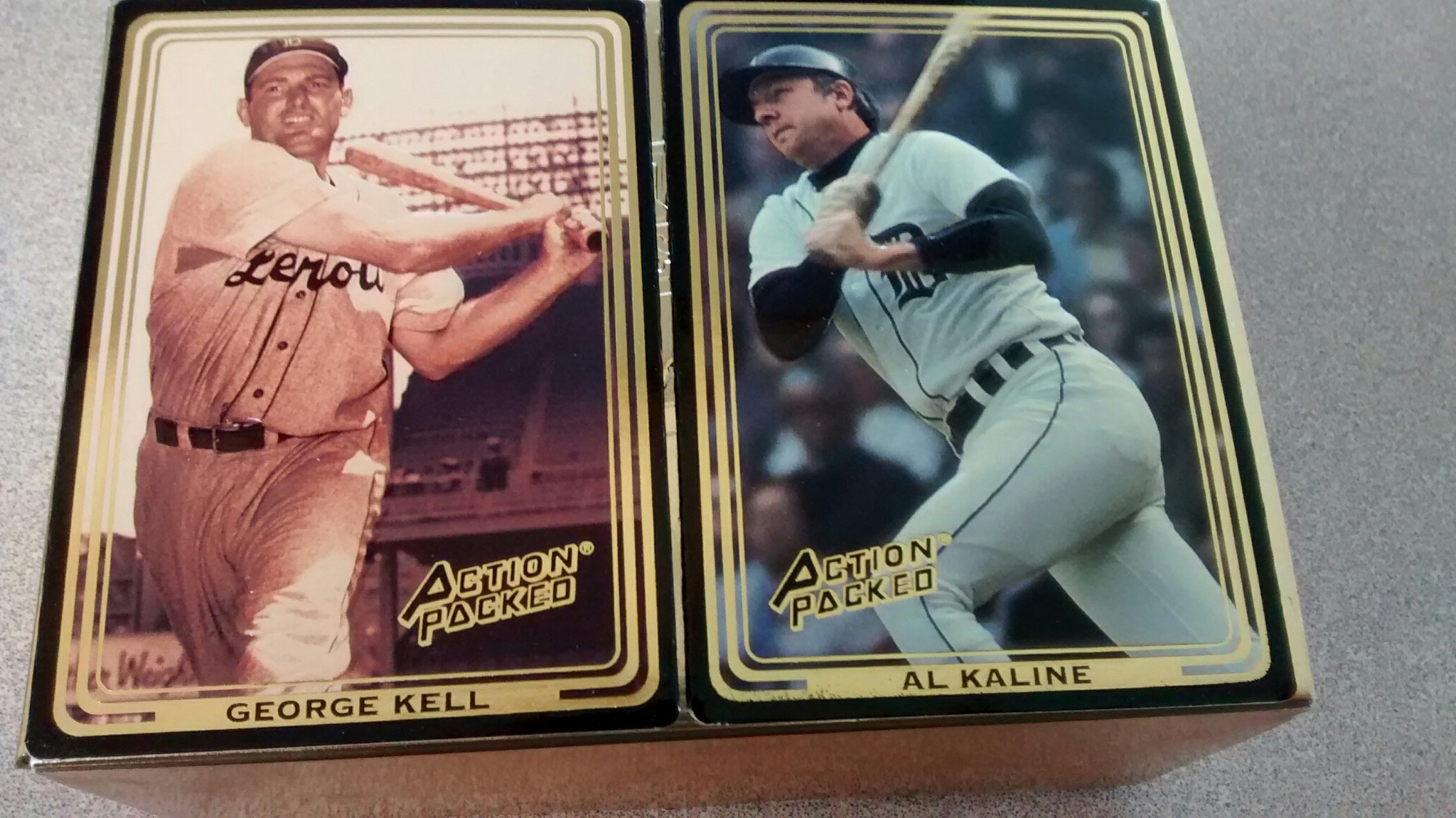
Al Kaline, the legendary Detroit Tigers’ right fielder, passed away on April 6 at his home in Bloomfield Hills, Mich. He was 85. Nicknamed ‘Mr. Tiger’, he played 22 seasons for Detroit. He was selected to 18 All-Star Games, and was inducted into the Baseball Hall of Fame in 1980. 

Immediately after retiring as a player, he joined the Tigers’ television crew,, a position he held until 2002. Kaline worked for the Tigers as a front office official until his passing. His 67 years with one team was one of the longest tenures in MLB history.


TUESDAY, OCTOBER 8, 1968, SPORTS

Copyright 1968/THE TIMES MIRROR COMPANY

JIM MURRAY

Sentiment Aside, Kaline Made for World Series

  When Mayo Smith and the Detroit Tigers announced Al Kaline was going to start the World Series, there wasn’t a dry eye in the state of Michigan.

  It proved baseball had a heart. It was saluted as the sentimental gesture of the ages. Even though it meant taking the best center fielder in the league and making a shortstop out of him, the fans shrugged. No sacrifice was too great to make for “Mr. Heartbreak.”

  Al Kaline was probably the greatest player in baseball never to have played in a World Series. You had to go clear back to Walter Johnson to find a similarly forlorn figure in the grand old game. And, Walter was in his dotage before he finally got to tee it up in a World Series game. One of the sentimental sagas of sport was the day he won his first game. No one could see the field for the teardrops.

  You would have thought Mayo Smith had suited up the statue of St. Francis of Assisi. Of KalineKellcourse, four out of four fans figured Al would suit up, take one or two turns at bat, and then retire to the rocking chair to spend the rest of the Series clapping people on the back.

  It was such a sad story that, if they made it into a movie, Doris Day would spend nine reels crying — as sad as a train whistle on a summer night, “Home On the Range” on a campfire harmonica.

  Albert William Kaline had everything a great ballplayer should have — perfect balance at the plate, perfect stride into the pitch, level swing. He never spent a day in the minor leagues. He was the youngest ever to win the batting title. In the outfield, he could go in for Tris Speaker for defensive purposes. He has hit more than 300 lifetime home runs.

  Yet he spent his career from 43 to 25 games away from the pennant every year. He was like Bernhardt performing in Altoona, card tricks in the dark. Very pretty, too bad nobody was looking. The act was good enough for the Palace but it stayed out in the tents.

  So, when after 16 years of impeccable play, complicated by a succession of injuries, combating a chronically malformed foot, A.W. Kaline finally got in a World Series, the fans could be pardoned for regarding it as a token appearance. I mean, how could he crack an outfield of Stanley, Horton and Northrup? What was he, 49 going on 50? 51? Could he get around on a fast ball anymore? Was the arm gone?

  Actually, Al Kaline is only 33. Actually, Al Kaline may be the best, or second-best active player in the American League. Actually, the St. Louis Cardinals may have wished Detroit hadn’t been so carried away with sentimentality.

  After 2,090 games, Kaline finally got the show on Broadway. They took the sheet off the statue. The monument was out taking its cuts.

  The scene was set for an historical pratfall, for the guy to wait in the wings for 16 years and then come on and forget his lines.

  But Kaline was still under the hill. The perfect swing, the perfect stride got the only extra-base hit off Bob Gibson in Game 1. He represented the high-water mark of the Detroit effort in Game 3 when his two-run homer put the Tigers in front in the Series for the first time. Even the St. Louis track team took no chances with his arm.

  But it might all have come up “Loved him, hated it” for Al in Monday’s game. He was hitting .350, had one hit already in the day, but the Series was on the line with the bases loaded and one out in the seventh. The perfect stride, the perfect balance, and the ball was shot out into center field for a two-run single and Detroit had dodged a bullet and taken the lead.

  Santa Claus had gotten down the chimney. The guy in the white hat got away from the rustlers. Al Kaline finally got in the World Series and showed he belonged there all the time.

Reprinted with the permission of the Los Angeles Times

Jim Murray Memorial Foundation P.O. Box 661532, Arcadia, CA 91066

info@jimmurrayfoundation.org

www.jimmurrayfoundation.org

Mondays With Murray: He Could Have Had More Than Garden of Roses

THURSDAY, OCTOBER 5, 1989, SPORTS

Copyright 1989/THE TIMES MIRROR COMPANY

JIM MURRAY

He Could Have Had More Than Garden of Roses

For of all sad words of tongue or pen, The saddest are these: “It might have been!” — JOHN GREENLEAF WHITTIER

  I was reminded anew of the poet’s lament the other day. I was interviewing this fellow for whom it all went a-glimmering years ago.

  You remember that scene in “On the Waterfront,” where Marlon Brando takes his brother’s hand reproachfully off his arm, looks at him with these big sad eyes and says “I coulda been a contendah! I coulda been somebody!”

  Well, that’s kind of what it was like. Sad. Heart-rending.

  Years ago, this fellow — I will call him George, although I think his nickname was Slick back in those days — was the silkiest-fielding first baseman you ever saw. He could go to mondaysmurray2his right, he could go to his left. You couldn’t throw the ball over him or under him. He had a gun for an arm. He wore the latest thing in equipment, a George McQuinn-model mitt called the Claw.

  He played for Yale but the scouts came around by the score. They hadn’t seen anything this slick around the bag since Hal Chase, Joe Judge, Joe Kuhel. His own idol was Lou Gehrig.

   He had missed a couple of years as a fighter pilot in the Second World War but that only meant he was more mature, steadier, more reliable, not given to anxiety. He could have been great.

 Around first base, he was a combination of Frank Merriwell and Dink Stover. Flawless, graceful, sure-handed. He was left-handed, which is what a first baseman should be.

  At the bat, for some unaccountable reason, he hit right. Maybe it was ideological.

  Whatever it was, he couldn’t hit the curveball.

  Well, look. That can be learned, right? Not everybody rolls out of bed with the ability to hit .350. Not everybody is Ty Cobb. George batted .264 his senior year and helped Yale get to the College World Series, no less.

 Everyone figured a few seasons at Binghamton and Newark and it would be Yankee-Stadium-here-we-come! I mean, the good life. Old Dependable. The new Iron Horse.

  Well, we all know how those things work out. Wife, child. You need a job. You put the dreams on hold.

   Then they want you to go into the family business. Well, in this case, the family business was politics. George’s father was a U.S. Senator. Duty called.

  There was no time to iron out the kinks in the swing, spend the hours in the batting cage, go for the brass ring. It was the salt mines for him. He never got to wear the Yankee pinstripes; he wore the three-piece kind. With the old school tie.

  It was speeches on the hustings, handshakes from the backs of trains, smoke-filled rooms, a stint in the oil business. He had to put away the old uni, hang up the George McQuinn glove, put the old lineup cards in a trunk. Just another guy who never made it to the bigs.

  Oh, he’s not starving, or hanging around bars, telling guys how he went 4-for-5 off Hubbell or took Allie Reynolds downtown.

  He lives in this big white house on Pennsylvania Avenue in Washington, D.C. He has a chauffeur. He has his own airplane. In fact, he has his own air force.

  But, he makes — what? $200,000 a year? Something like that. You think Don Mattingly would play for that? Will Clark makes that in a month.

  In case the guys he used to rob of hits down the line or make the 3-6-3 double play have lost track of him, he has done all right. I mean, it’s not like being the All-Star first baseman or having a locker in Yankee Stadium or your own bubble-gum card but George found work all right.

  He’s the President of the United States.

  Now, that’s an OK job for a guy who was the president of the debating club, or the campus wheeler-dealer. But, George Herbert Walker Bush could have been somebody. He could have been in a lineup with Mickey Mantle, Roger Maris, Whitey Ford, Yogi Berra, Billy Martin.

  Casey Stengel could have been yelling at him: “Hey, Bush! Is that a name or a description? Don’t the Yales throw curveballs?”

  Life could have been a blast.

  You know, when the President of the United States calls, you drop everything and go. I mean, you never know. He may need you. It’s well known that I know exactly what to do about Noriega, the Middle East, the balance of trade. I could handle the Soviets in my sleep.

  I know he’d want to keep my visit a secret. So I slept at the J.W. Marriott instead of the Lincoln bedroom. No use letting Sam Donaldson get wind of it.

  I like it that people don’t know that I’m an expert on international relations.

  They even did a good job of pretending not to know who I was at the White House’s northwest gate, as usual. It was roped off when I got there. The president of Egypt was just leaving.

  There were about 10 of us sportswriter-sportscaster types on hand. I was pretty sure I was the only one who knew what to do about Angola, though.

  With Presidents, you try the oblique approach, though. I cleared my throat. “Mr. President, what did you bat at Yale?” I didn’t want to rush things. Plenty of time to get into Lebanon.

  Well, when I tell you the next 40 minutes were spent in discussing baseball, you have to know our President is a master of camouflage — don’t forget, he used to be head of the CIA — or, and here is the conclusion I came to, he still thinks wistfully of what might have been. He’d rather be running the World Series than the world.

  There have been lots of football players in the White House — Dwight Eisenhower, Ronald Reagan, Gerald Ford. Even a tennis player, Woodrow Wilson, a rail-splitting champion, Abe Lincoln, and a horseback rider-boxer, Teddy Roosevelt. But, there has never been a baseball player.

  It suddenly occurred to me, the President enjoyed the sensation of being asked by a lot of guys with notebooks things like, “What kind of a pitch did you hit?” “Why didn’t you swing at that fastball?”

  He was just like a guy sitting in front of his locker with a beer meeting the sporting press after a game in which he’d just gone 4-for-4— or popped up Ball 4 to lose the game.

  So if you’re stuck in a 9-to-5 job you hate, if you have to run the family business when you would rather run the Dodgers, take heart. George Bush, who was one of the best there ever was at digging out low throws and taking the cutoff to throw the guy out at the plate, spends all day talking to people who never even heard of Lou Gehrig.

  Nicaragua never came up. When someone wanted to know if the government should step into baseball expansion, the President gave the idea short shrift. There are a lot of things wrong with the country, but the Chicago Cubs ain’t one of them, seemed to be his notion.

  And the prisoner of Pennsylvania Avenue was hustled off to talk about the bustout in East Germany. You had the feeling he’d rather stay and talk about the 1953 Yankees. After all, if it weren’t for a lousy break here and there, he could have been one of them. He could have been a star.

Reprinted with the permission of the Los Angeles Times

Jim Murray Memorial Foundation, P.O. Box 60753, Pasadena, CA 91116

Mondays With Murray: In This Corner, With the Pen, is the New Guy

On Feb. 12, 1961, the Los Angeles Times introduced its readers to the new guy — James (Jim) Patrick Murray. He wasn’t a call-up from the minor leagues. He had been honing his craft at places like the Los Angeles Examiner, Time and Life magazines and Sports Illustrated for many years. Jim was very familiar with L.A.; he had covered Hollywood for Time and Life.

For the next 37 years, sports fans from Los Angeles and beyond would form a long-lasting relationship with Jim. Some loved him, some hated him . . . but they all read him.

It all started on that Sunday in February 1961 with today’s column — In This Corner, With The Pen, is the New Guy. If Helen of Troy was the “face that launched a thousand ships” these were the words that launched a million laughs, smiles, frowns, tears and scowls.

ENJOY!

-——

SUNDAY, FEBRUARY 12, 1961, SPORTS

Copyright 1961/THE TIMES MIRROR COMPANY

JIM MURRAY

In This Corner, With the Pen, is the New Guy

  I have been urged by my friends — all of whom mean well — to begin writing in this space without introducing myself, as if I have been standing here all the while only you haven’t noticed. But I don’t think I’ll do that. I think I’ll start off by telling you a little about myself and what I believe in. That way, we can start to fight right away.

  First off, I am against the bunt in baseball — unless they start bunting against the ball John McCraw batted against. The last time the bunt won a game, Frank Chance was a rookie.

  I think the eight-point touchdown has had it. It’s added nothing to the game unless, of course, you count the extra bookkeeping.

  I’m glad the Rams traded Billy Wade. I won’t say Billy was clumsy, but on the way back mondaysmurray2from the line of scrimmage with the ball he bumped into more people than a New York pickpocket. I have seen blockers make ball carriers look bad. Wade was the only ball carrier I ever saw make the blockers look bad. Those poor guys were getting cross-eyed trying to look for him out of both corners of their eyes. They never knew which way he went.

  The play usually ended up with some mastodon of a defensive end holding Billy upside down by the heels and shaking him. Like a father with a kid who’s just swallowed a quarter. Billy gave up more ground, faster, than Mussolini at the end of the war. The Chicago Bears better put his shoes on backward or he’ll dance right out of that little ballpark of theirs. I expect him to be the only quarterback ever tackled for a loss in the seats.

  I think Jim Brosnan is the best writer in baseball. I think Cincinnati would be gladder if he were the best pitcher.

  I know what’s wrong with Eisenhower’s golf swing but I’ll be cussed if I can figure out what to do with that spasm of mine. (Ike lifts his left leg; I think I leave my feet altogether.).

  I’d like once more (if Jimmy Cannon will pardon me) to see Elroy Hirsch and Tommy Fears going out on a pass pattern and looking back for a Waterfield pass. Throw in Jimmy David on defense and I’ll pay double. David was the only guy I ever saw who could maim a guy while pretending to help him up.

  I hope Steve Bilko has lost weight. The last time I saw him in the Coliseum, the front of him got to the batter’s box full seconds before the rest of him. If he were batting left-handed, part of him would be halfway to first base before the pitch came in. Even then, the umpire could beat him down there.

  I don’t think anyone should be surprised at the disappointing showing of our Olympians in the ’60 Games. There is an old adage, “When in Rome, do as the Romans do.” So our boys did. The coaches didn’t like it, but the girls did.

  I think almost every pitcher in the big leagues has a good spitball but I prefer to see Lew Burdette load one up for the batter in a tight situation and then make believe he’s only wiping his chin. The only way you can be sure the ball is wet is if the ump calls for it and Lew rolls it to him.

  I think the Washington Huskies football players were more enterprising than a bunch of Dead-End Kids in an empty candy store. But I still think the guys who are beating Minnesota over the head for claiming (correctly) that it had an edge in the second half in the Rose Bowl are the same guys who would be crying “Washington was robbed” if the roles were reversed in that game.

  I have been held up to you as somewhat of a joke athletically, but I want you to know I had one superlative as a college freshman baseball player. I was the most nervous right fielder our team ever had. Our coach, Ralph Erickson, had only four fingers on his right hand and the prevailing theory was he had the regulation five until he saw us and started biting his nails. I caught a fly once and got so carried away I almost decapitated our first baseman on the throw-in. As I remember the first baseman, it wouldn’t have affected his play much. He didn’t use his head a great deal.

  I won’t say the kids today are softies but I’d like to see them learn to play Little League with the ball I had to play with. This was a “dime rocket,” the cover of which came off after the first solid hit and it had to be wrapped in thick friction tape. I’d like to see Duke Snider throw it out of the Coliseum. In fact, I’d like to see him hit it past the pitcher’s mound on the fly. I have bowled with lighter balls.

  I was gratified by the reaction to the announcement Jim Murray was to write a sports column, an immediate and interested “Who??!” Mel Durslag did throw a bouquet, though. I’ll read the card as soon as I take the brick out.

  I came to Los Angeles in 1944 (the smog and I hit town together and neither one of us has been run out, despite the best efforts of public-spirited citizens) and my biggest sports disappointment was the 1955 Swaps-Nashua race, which I helped arrange. I have never believed Bill Shoemaker was property tied on his mount that day when they sprang the barrier. But I will ask Bill — and believe what he says because his next lie will be his first.

  I really don’t understand why the Angels haven’t signed up Bob Kelley to do their broadcasts. He’s the only guy in town who can prevent Vin Scully from throwing a shutout.

  I hope Bill Hartack, the jockey, continues to take himself off sore horses. I know it irks the stewards but I’d rather have them sore than the horses — especially if I’m betting on the race because if there’s one sore horse in the field, I’m usually on him, handicapping it all the way.

  I couldn’t tell from that letter of Billy Wade’s whether Don Paul wanted Waterfield’s job or just wanted him to eat in his restaurant.

  Every sportswriter is expected to make a prediction and because I would like to leave the game ahead, I will predict the Angels will not win the pennant — this year, anyway. On the other hand, the way they have been messing around with baseball, they just might change the game to loball. Then, the Angels would be a threat. Just my luck.

Reprinted with the permission of the Los Angeles Times

Jim Murray Memorial Foundation, P.O. Box 60753, Pasadena, CA 91116

———

What is the Jim Murray Memorial Foundation? 

  The Jim Murray Memorial Foundation is a 501(c)(3) nonprofit organization, established in 1999 to perpetuate the Jim Murray legacy, and his love for and dedication to his extraordinary career in journalism. Since 1999, JMMF has granted 104 $5,000 scholarships to outstanding journalism students. Success of the Jim Murray Memorial Foundation’s efforts depends heavily on the contributions from generous individuals, organizations, corporations, and volunteers who align themselves with the mission and values of the JMMF.

Like us on Facebook, and visit the JMMF website, www.jimmurrayfoundation.org.

——

A dozen years ago, Linda McCoy-Murray compiled a book of Jim Murray’s columns on female athletes (1961-1998). While the book is idle waiting for an interested publisher, the JMMF thinks this is an appropriate year to get the book on the shelves, i.e., Jim Murray’s 100th birthday, 1919-2019.  

Our mission is to empower women of all ages to succeed and prosper — in and out of sports — while entertaining the reader with Jim Murray’s wit and hyperbole.  An excellent teaching tool for Women’s Studies.

Proceeds from book sales will benefit the Jim Murray Memorial Foundation, a 501(c)(3) not-for-profit organization providing sports journalism scholarships at universities across the country.

Mondays With Murray: Frustrations of Past Count for Something

The NFL has just completed its 100th season. The NFL and Jim Murray were the same age — Jim would have been 100 in December. In honor of Andy Reid’s first Super Bowl victory and the 100th season of the NFL, we bring you a column Jim wrote on Dec. 27, 1988, in which he writes about another head coach who spent 22 years chasing a ring, only to never get it . . . Chuck Knox. Knox passed away on May 12, 2018, at the age of 86.

——

TUESDAY, DECEMBER 27, 1988, SPORTS

Copyright 1988/THE TIMES MIRROR COMPANY

JIM MURRAY

Frustrations of Past Count for Something

  It has no doubt come to your attention that the people most of us consider the eminent historians of our day — the poets of the press box, the knights of the keyboard, the sporting press — have come to the conclusion that the current crop of National Football League playoff teams constitutes an unworthy cast. They are prepared to dispense a flop mondaysmurray2production, devoid of stars, weak in drama. It won’t play Broadway and needs a complete second-act rewrite.

  I mean, we no longer have the Lombardi Packers, the Halas Monsters of the Midway, the Baugh Redskins, the Jim Brown Browns, the Unitas Colts. What we get are a lot of earnest young athletes flawed by the league policy of pulling everyone down to the lowest common denominator, parity.

  Parity is like satire, which in the words of one eminent showman, is what closes on Saturday nights.

 But, it is the notion here that parity on the playing field is not what’s wrong with today’s tournaments. It’s the coaching that ain’t what it used to be.

  Consider not the offensive and defensive platoons on the field or the special teams, consider the leadership on the sidelines.

  Check the AFC. When the final five took their positions at the end of the regular season, these were the five head men on the sidelines: Jerry Glanville of the Houston Oilers, Marty Schottenheimer of the Cleveland Browns, Sam Wyche of the Cincinnati Bengals and Marv Levy of the Buffalo Bills.

  See any Vince Lombardis in there? Where are the Tom Landrys, Don Shulas? Where are the likes of Papa Halas, Weeb Ewbank, Bud Grant, George Allen, Hank Stram? Where’s the big-game experience here?

  You will notice I left out the name of the other AFC coach in the shootout, Chuck Knox. That’s because Chuck Knox is a throwback coach. He belongs in the context of the names of great mentors of football’s past.

  The gamblers say his team doesn’t belong in this postseason crapshoot. I’m not so sure. In the kingdom of the blind, the one-eyed man is king. In the kingdom of the halt, the man who can ride rules.

  Chuck Knox may be the only one in the AFC eliminations with legitimate big-game experience. Knox has been there, as they say. He could be the one on horseback here.

  Chuck Knox is probably the best-coach-who-never-went-to-the-Super-Bowl. And, there’s the rub.

  Chuck Knox is to the Super Bowl what Sam Snead was to a U.S. Open, or Ernie Banks to a World Series. He deserved one, he never got one.

  When Chuck Knox came to the Rams for his first head coaching job, 15 years ago, the league thought it had the new Rockne. His first season was 12-2 (the team had been 6-7-1 the year before). His teams were smart, hard-hitting, resourceful, they didn’t beat themselves. They lost the two games by a total of three points. They were eliminated by the more experienced Staubach-Landry Cowboys in the playoffs, but they chalked that up to a learning process. There’d be plenty of Super Bowls to come.

  Except, there weren’t. The next season, the Rams won the division again (they won it every year Knox coached them) and won the first playoff game (beating the Redskins, 19-10).

  Then came the championship game against the Vikings in frigid Minnesota. Late in the game, with the score Minnesota 14, Rams 10, the Rams had the ball on the Viking 6-inch line. That’s as in a half-a-foot.

  The Vikings’ Alan Page jumped offside to beat the snap. That’s smart football when you can only lose three inches in penalty (half the distance to the goal line).

  Only, the umpire rules that the Rams’ interior lineman, Tom Mack, had moved first.

  The penalty was catastrophic. The Rams were moved back out of line-plunge distance and had to try a pass. It was intercepted. Bye-bye Super Bowl. Minnesota goes.

  To this day, Chuck Knox and Tom Mack insist the Rams lineman never moved. They have the film to prove it. “He never even breathed,” Knox was to say.

  Two years later, the Rams are in Minnesota again. Temperature: 11 degrees at game time.

  The Rams rip through Minnesota as if the Vikings weren’t there. They again have the ball inside the Viking 1. On fourth down, they inexplicably go for a field goal. Minnesota blocks it and defensive back Bobby Bryant scoops it up and runs 99 yards for a touchdown. There goes that Super Bowl.

  The next season, the Rams get a break. The playoff game against Minnesota is not only at home but Minnesota’s quarterback, Fran Tarkenton, is hurt.

  Except, the day-after-Christmas, the worst rainstorm of the year hits. The field is a quagmire. The Rams’ runners perish in it like woolly mammoths in a tar pit.

  Will Chuck Knox ever win a Super Bowl? Will he ever even get to one?

  Whatever fates control the Super Bowl, they have it in for Chuck Knox. Three of the five years he coached the Rams, they played for the Super Bowl. Three of the five, they lost.

  It would give anyone a complex. In sports, it gives rise to that kiss of death — he-can’t-win-the-big-ones.

  Maybe one of those other coaches in this year’s tournament will win it because, like a guy taking up golf, they don’t know how tough it is, yet.

  Chuck Knox knows how tough it is. The gamblers don’t like his chances. Maybe, the gods don’t, either.

  Chuck Knox can be pardoned by going into the playoffs like a guy waiting for a shoe to drop, or listening for a noise in the attic. On the other hand, none of the AFC coaches he has to face to get to Miami reminds you of Pop Warner.

  If a game can be won on the sidelines, he should be the one to do it. All the real coaching experience is in the other conference. He won’t have to face Bill Walsh, Jerry Burns, Mike Ditka or Buddy Ryan till super Sunday. And if he gets there, he’ll finally be in a position where he won’t have to go through life explaining to strangers in bars, “Tom Mack never moved.”

-——

Reprinted with the permission of the Los Angeles Times

Jim Murray Memorial Foundation, P.O. Box 60753, Pasadena, CA 91116

———

What is the Jim Murray Memorial Foundation? 

  The Jim Murray Memorial Foundation is a 501(c)(3) nonprofit organization, established in 1999 to perpetuate the Jim Murray legacy, and his love for and dedication to his extraordinary career in journalism. Since 1999, JMMF has granted 104 $5,000 scholarships to outstanding journalism students. Success of the Jim Murray Memorial Foundation’s efforts depends heavily on the contributions from generous individuals, organizations, corporations, and volunteers who align themselves with the mission and values of the JMMF.

Like us on Facebook, and visit the JMMF website, www.jimmurrayfoundation.org.

——

A dozen years ago, Linda McCoy-Murray compiled a book of Jim Murray’s columns on female athletes (1961-1998). While the book is idle waiting for an interested publisher, the JMMF thinks this is an appropriate year to get the book on the shelves, i.e., Jim Murray’s 100th birthday, 1919-2019.  

Our mission is to empower women of all ages to succeed and prosper — in and out of sports — while entertaining the reader with Jim Murray’s wit and hyperbole.  An excellent teaching tool for Women’s Studies.

Proceeds from book sales will benefit the Jim Murray Memorial Foundation, a 501(c)(3) not-for-profit organization providing sports journalism scholarships at universities across the country.