
Kidney patients and their diet at this time of the year . . . Also, want to be part of an advisory group?

Diet is one of the things that often comes up in conversation when the Kamloops Kidney Support Group gathers. Because Dorothy has experienced pre-dialysis, peritoneal dialysis and a kidney transplant, she often is asked about any dietary restrictions she may have encountered along the way.

These days, with the transplant having occurred more than six years ago, her main concern is that any meat she eats be completely cooked. Yes, we regularly use a meat thermometer. She also is sure to heat any deli meet that she might eat because of the danger of listeria.

Anyway . . . with diet in mind, something that is front and centre at this time of year, here’s a note from June Martin of the Kidney Foundation of Canada, from her Dietitian’s Blog:

“Food is an important part of any holiday or celebration. As I was thinking about what to write about for my Christmas blog post, I was trying to think of how to articulate why food is so important to the holidays and to almost any celebration. For me, Christmas Eve is the smell of tourtiere (and my brother complaining about having to eat it) and Christmas day could never be the same without turkey and stuffing. And regardless of what holiday you celebrate, food plays a huge role. Preparing food and eating together is a part of almost every culture’s rituals for celebration.

“Unfortunately having kidney disease can make celebrating the holidays much more difficult! Trying to maintain family and religious traditions while balancing the sodium, potassium, phosphorus, protein and fluid in your diet takes planning and skill.”

There’s a whole lot more right here, including “a few noteworthy items to watch out for over the holidays.”


Roberts loving her new life after transplant . . . Cypress’ new kidney “doing incredibly well” . . .

Have you ever wondered what life is like for a child before and after a kidney transplant?

Kathleen Roberts knows all about it; she’s 19 now and had a transplant four years ago at BC Children’s Hospital.

“Before the transplant,” she says, “I was going to BC Children’s every few months. I was just sick. I slept 16 to 18 hours a day. I had no appetite. I was 82 pounds and five feet tall. I was severely underweight and severely nauseous. The transplant made a huge difference. I have a normal appetite and I’m not sleeping the day away anymore.”

Take a few minutes and read her story, which is right here.


Cypress Roed, an eight-year-old from Harrison Hot Springs, B.C., continues to make progress after undergoing a kidney transplant on Oct. 24 at BC Children’s Hospital in Vancouver.

Her mother, Chantelle Deley, told me in an email earlier this week that “Cypress is doing well for the most part. She is finally in remission!”

Early on, Cypress had been diagnosed with focal segmental glomerulosclerosis, something that damages the kidneys and prevents the filtering of protein from the urine.

The recovery process hasn’t been without a speed bump or two, the latest of which has been having to deal with migraines. Cypress was back in hospital late last week because the migraines were causing severe nausea.

But, as Chantelle wrote,“she is in remission and that’s a major positive.”

It’s important to note that the new kidney “is doing incredibly well.”

“She is amazingly strong,” Chantelle said of her daughter.

Dorothy, my wife, had some health issues six weeks or so after her transplant and spent most of December 2013 in hospital dealing with them. But, as with Cypress, the new kidney just kept doing its job. Hopefully, that continues with Cypress, who is preparing to spend her third straight Christmas away from home.

Cypress is to turn nine on Jan. 22. Her dream has been to celebrate by going swimming. Here’s hoping she is able to make a big splash.


This was posted on a blog called Andrew Kai’s Adventure in Liverland. It was written by his mother:

“I wrote this in the waiting room after Kai coded. They brought him back 3 times before rushing him to the operating room. The plan was to open him up and remove the bad liver to buy him some time. The new liver was only 4 hours away. He had held on at the top of the list for 2 days. He was first in line for a liver and didn’t get one in time.

“I really believed he would make it. I pushed all the doubts out. I kept saying this over and over to myself, I knew my baby was strong and I had to believe for him.”

The post included a photo of a note on which was written:

“Pieces of me are in you

“Pieces of you are in me

“I am here

“You are here

“Kai will live!!!!”

Below the note was a small stone with a heart etched into it.

Kai’s mother continued:

“The heart stone is what they gave to me, and one to him, so that we would have something to connect us when I had to say goodbye the last time. I placed it over his heart and I haven’t put my stone down since I left him.

“HE WOULD HAVE LIVED IF HE HAD A NEW LIVER. Even if it had been just a few hours earlier.

“DONATE YOUR ORGANS. YOU DON’T NEED THEM AFTER YOU’RE GONE.”

Andrew Kai George was born on April 23, 2019. Without a new liver, he died on Dec. 2, 2019, in Indianapolis, Ind.


Celebrating 40 years with a donated kidney . . . More important news from the Cleveland Clinic

These are the kind of stories we like to read. . . . Tom Mitrovski of Toronto is 72 now. There was a time when he never thought he would see 50.

He underwent a kidney transplant on Nov. 27, 1979, thinking then that he had five to 10 years left. . . . Tom Hayes of Global News has the story right here.


Doctors at the Cleveland Clinic have successfully performed a laparoscopic liver transplant, the second time such an operation has been done in the U.S. . . . Chris Cantergiani of WKYC has more right here, and there is a lot of interesting stuff in the story.

Earlier this year, doctors at the Cleveland Clinic performed the first robotic single-port kidney transplant, doing it all through one small abdominal incision. There’s more on that story right here.


How many B.C. people are alive because of organ transplants? The numbers are in . . .

More numbers from BC Transplant: There are 1,487,323 donors registered in the province’s organ donor registry; there were 406 transplants performed in 2019, to Nov. 1; and there still were 755 patients awaiting transplants. . . . Visit the website at transplant.bc.ca for more information and lots more numbers.


Sean Delaney of Edmonton is the associate director of organ listing and allocation at Canadian Blood Services. Delaney, 48, also has undergone a kidney transplant; in fact, he had one more than 20 years ago when he got one from his brother. . . . Delaney’s story, as told by Moira Wyton of Postmedia, is right here, and it’s an interesting one. . . . “Delaney works to streamline organ donation across the country,” Wyton writes, “and create new ways to help people receive the organs they need to live and thrive.

This has included the creation of a national registry to administer new programs such as the Kidney Paired Donation Program, which has facilitated more than 700 transplants since its founding in 2009.” . . . Through all of this, he now finds himself back on the transplant list because his kidney is in failure, and he is doing peritoneal dialysis.


Check out this story from Cleveland where doctors at a clinic have used a robot to perform a kidney transplant . . . 


Alberta, P.E.I. talking presumed consent . . . Jelly Roll playing the blues, but not singing them

Toby Boulet, whose son, Logan, was killed in the crash of the Humboldt Broncos’ bus, has spoken out about the bill before the Alberta legislature that will permit organ donation unless a person has opted out of the process. . . . Boulet told Bob Weber of The Canadian Press that “there’s way more that needs to be added to the bill.” . . . Logan Boulet’s organs were harvested after his death and six people benefited from them. That turned into a huge story and thousands of people subsequently registered for organ donation, a phenomenon now recognized as the Logan Boulet Effect. . . . Toby and his wife, Bernadine, now speak frequently on organ donation. . . . According to Weber, Toby told him that the bill’s biggest failing is that it can’t address attitudes. “It’s pretty hard, in my opinion, to tell Albertans to do anything,” Boulet told Weber. “Albertans do the right thing. But if you tell them what to do, they don’t do the right thing. If you tell someone you’re going to have presumed consent in a law, that’s not going to go over very well.” . . . Boulet also pointed out that there will be a need to have “surgical teams that are dedicated and ready to go at a moment’s notice. We only have that in Calgary and Edmonton.” . . . Weber’s complete story is right here.

——

On Tuesday, Prince Edward Island moved closer to a system of presumed consent for organ donation, something that is expected to become law in Nova Scotia sometime in 2020. . . . In P.E.I., legislators on Tuesday passed a motion under which a committee “will reconsider the province’s rules concerning organ donation,” reported Kevin Yarr of CBC News. . . . His story is right here.


His name is Kirk Johnson, but he is better known as Jelly Roll Johnson, a top-of-the-line harmonica player. According to Jessica Bliss of the Nashville Tennessean: “He played harmonica on more than 50 gold and platinum albums, including three Grammy-winners by Randy Travis. He appeared on the Late Show, the Tonight Show, the CMA Awards show.” . . . One other thing — he dealt with PKD (polycystic kidney disease) for all of that time, knowing that it had killed his father and at least three other relatives had it. No, he didn’t miss any gigs and he often played at Nashville’s Bluebird Cafe while undergoing dialysis. . . . Eventually, he went through a liver and kidney transplant. . . . His story, as written by Bliss, is right here and it’s well worth a read.


——

Ian Furness, a sportscaster with Sports Radio KJR in Seattle, knows of what he tweets. His son, Kiefer, a high school student and an athlete, has been diagnosed with Type 1 Diabetes.


The latest on Ferris’s situation. . . . Alberta headed to ‘opt out’ donor system

Ferris Backmeyer is a young Kamloops girl in need of a kidney transplant. I wrote about her right here on Oct. 7. . . . It is great to see at least one other outlet pick up on the story. If you click on the link right here you will find a story on Ferris that was written by Karen Edwards of infonews.ca.


A note for transplant recipients as BC Transplant changes brand on immunosuppressive drug

If you have been the recipient of an organ transplant, you need to be aware that BC Transplant, as in the tweet below, “is changing brands of immediate release tacrolimus from Prograf to Sandoz . . .” Tacrolimus is an immunosuppressive drug that works to keep the body from rejecting the new organ that really is from a foreign body. . . . For more information on the change and information sessions that have been scheduled, check the link that is available through this tweet.


Billboards paid off for Calgary teacher. . . . Hemodialysis patients enjoying some exercise

Ryan McLennan, a teacher in Calgary, needed a kidney. So his wife mounted a billboard campaign. . . . Tony Timmons, a FedEx driver, saw one of the billboards. . . . Timmons, originally from Gander, Nfld., answered the call. . . . Shawn Logan of Postmedia has the entire story — and it’s a good one — right here.


I have been hearing about people doing hemodialysis and getting some exercise at the same time for a year or so now. I’m thinking this is going to become more and more common in dialysis units.


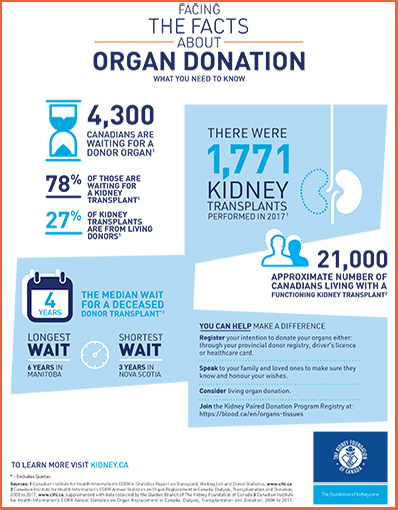
Facing The Facts About Organ Donation 2019


From the website photosforkidneys.com: “If you’re waiting for a kidney transplant, or have had one in the past, or if you’re a kidney donor yourself, please feel free to contact us if you would like to participate in our photo project. We would love to meet you!” 


Kidney donor chosen to take part in Tournament of Roses Parade . . . Philly rapper Freeway talks transplant

I don’t make a habit of watching the annual Tournament of Roses Parade from Pasadena, Calif. But I plan on watching the 131st annual event on New Year’s Day.

Why?

To honour Regina Tanner and all of the other generous folks who have donated kidneys. (Hello, Susan Duncan and Cheryl Vosburgh and Louis (Big Rig) McIvor and so many others.)

Regina, who is from Fresno, Calif., will be in the Parade, walking with the Donate Life Rose Parade float. Regina gave up a kidney in 2016 so that her husband, Cary, could get one via transplant. The two of them ended up part of a paired kidney donation chain that featured 18 people.

There is more on Regina’s story right here.

That piece also includes some interesting facts and statistics regarding organ donation and transplantation.


In Saskatchewan and thinking about being a living kidney donor? . . . Here’s some info for you . . .

Dorothy and I were in Regina the other night to spend time with good friends who lived across the street from us when we lived in the Saskatchewan capital.

Their son, who is experiencing kidney failure and recently began hemo-dialysis, was there, too.

There were a whole lot of questions and answers, and here’s hoping we were able to help.

At the same time, we are hopeful that we were able to start him down the road to a kidney transplant. A friend of his has said that he is more than willing to be a donor in order to help him get a kidney, but neither of them was at all certain about how to begin the process.

So I did a bit of research and found a really good website belonging to the Saskatchewan Health Authority. This site includes an online brochure that features a lot of good information for anyone thinking about being a kidney donor, regardless of their location.

That page is right here and it’s well worth a look.

As well, if you are living in Saskatchewan, and thinking about being a living donor, you may contact:

Saskatchewan Transplant Program

St. Paul’s Hospital

1702 20th Street West 

Saskatoon, SK  S7M 0Z9

1-306-655-5054

Or email: SHAlivingdonation@saskhealthauthority.ca  

——

There also is a Regina office:

Kidney Health Centre

235 Albert St. North

Regina SK, S4R 3C2

1-306-766-6477

——

There also is a blurb on that site that reads:

“About 90 people in Saskatchewan are currently waiting for a kidney transplant. On average, they will wait 2.8 years for a kidney — that’s 437 dialysis treatments per person. Please offer hope by talking to your family about organ and tissue donation.”

If you are considering being a donor, do the research and make a decision. Someone’s life may depend on it.

Also . . . always remember that there isn’t a cure for kidney disease. A transplant isn’t a cure, but it does allow the recipient to have a much better quality of life.