Scattershooting on a Sunday night while wondering what might happen next . . .

Scattershooting

The WHL appears to have bought itself some time this weekend.

It was able to get through the weekend, which included three games in the Seattle area, whlwithout any apparent coronavirus-related difficulties.
On Sunday afternoon, Washington state officials confirmed 136 novel coronavirus cases, while the Seattle Times later reported there have been 19 virus-related deaths. All told, 16 of the deaths have ties to one nursing home, the Life Care Center of Kirkland.

The Everett Silvertips drew 13,161 fans to a pair of weekend games — a 6-0 victory over the Prince George Cougars and a 5-2 loss to the Seattle Thunderbirds on Saturday.

Everett has one home game remaining on its schedule — against the Victoria Royals on March 20.

On Sunday, the announced attendance was 5,255 in Kent, Wash., as the host Thunderbirds dropped a 3-2 decision to the Silvertips.

Seattle has three home games left to play — against the Vancouver Giants on Saturday, the Spokane Chiefs on March 17 and the Portland Winterhawks on March 21.

While the Spokane Chiefs have three home games scheduled this week, on Tuesday, Friday and Sunday, and the Tri-City Americans, who play out of Kennewick, Wash., are at home Friday and Sunday, those areas have avoided positive tests to this point. At the same time, as of Sunday evening, there had been two positive tests in Eastern Washington counties.

Meanwhile, there have been 27 confirmed cases on B.C.’s Lower Mainland, where the Giants play out of the Langley Events Centre. They are at home to Seattle on Friday, and also are to play at home on Sunday (Prince George Cougars), March 18 (Kamloops Blazers) and March 20 (Kelowna Rockets).

As well, health officials in Alberta announced on Sunday that an Edmonton-area man is that province’s first presumptive positive test after travelling with a companion from B.C., who had been on the Grand Princess cruise ship.

——

In California, the Riverside Country Health Department declared a public health emergency for the Coachella Valley after one local confirmed case of the COVID-19 virus. Tennis officials then indefinitely postponed the 2020 BNP Paribas Open, a WTA and ATP event. It was to have opened today (Monday) and run through March 22 at Indian Wells. . . . The tournament brings in more than 400,000 fans annually — it is the best-attended non-major on the tennis schedule — and always gets a lot of TV coverage. . . .

The host Rensselaer Polytechnic Institute (RPI) Engineers and Harvard Crimson are scheduled to play a best-of-three ECAC hockey quarterfinal series this weekend in Troy, N.Y. RPI announced Sunday that it has “enacted social distancing protocols,” meaning that the games will be played without spectators. . . .

Ed Willes, in the Vancouver Province:

“It’s a helpless feeling, sitting, waiting for the next bombshell to drop but it seems inevitable.

“You wish this was as simple as letting the virus run its course but it’s impossible to know where this will end. That’s not being alarmist. That’s being realistic. So you sit and hope. And you ask yourself, will anything ever be the same again?”


Daylight


Scott Ostler of the San Francisco Chronicle was at the Golden State Warriors game on Saturday night:

“Maybe Warriors fans are smart. In a recent national survey, 38% of beer-drinking Americans said they would not drink Corona beer. However, a vendor selling various brands of canned beer on the concourse level Saturday told me Corona sales have not cooled at his cart.

“ ‘I’m selling more Corona!’ said Devaughn McDonald.

“Go figure. Maybe people believe it’s medicine.”

——

More from Ostler:

“The Warriors’ management is doing its best, aggressively scrubbing down Chase Center before and after games. In the media dining room, every table had its own big pump bottle of Purell. I absentmindedly squirted some on my hot dog, but what the heck, you can’t be too safe.”

——

ICYMI, LeBron James of the Los Angeles Lakers said on the weekend that he isn’t interested in playing in empty arenas, should it come to that with the NBA. “We play games without the fans?” he said. “Nah. It’s impossible. I ain’t playin’ . . . That what I play for. I play for my teammates. I play for the fans . . . So if I show to an arena (and) ain’t no fans be there, I ain’t playin’.”

To which Ostler wrote: “The league might have something to say about that. Like, if you ain’t playin’, we ain’t payin.”


patient


Here’s a thought from Patti Dawn Swansson, the River City Renegade: “People poke fun at the Canadian Football League for rewarding failure by giving a single point on a missed field goal. Well, excuse me, but the NHL does that very thing almost nightly with its ridiculous loser point.” . . . As does the WHL and so many other hockey leagues . . .

——

Swansson, once more: “Watched Sports Central on Sportsnet on Friday morning and I didn’t hear one word about the Brier. Nada. They managed to squeeze in highlights of Joey Chestnut pigging out on Big Macs, but the Canadian men’s curling championship wasn’t worthy of their attention. Canada’s #1 Sports Network my ass.”

——

If you haven’t yet seen it, Swansson’s latest contribution to the Internet library is all right here. Pour yourself a cuppa coffee and enjoy.


Visitors


“A quick shoutout to Jerry Jones,” writes Kevin Sherrington in the Dallas Morning News, “who not only ranks as the top dog among local pro sports owners, he’s cracked the top five Dallas-Fort Worth billionaires. According to something called the Hurun Global Rich List, Jerry comes in fourth overall at $7.2 billion, four spots in front of Mark Cuban at $4.8 billion and a dozen yachts and an Airstream or two ahead of the $3.4 billion of the Rangers’ Ray Davis. Throw in Tom Gaglardi’s family, which owns Canada, and it seems safe to say no local owner is going broke anytime soon.”

Gaglardi, of course, owns the NHL’s Dallas Stars and is the majority owner of the WHL’s Kamloops Blazers.


Dwight Perry, in the Seattle Times: “A recent conversation between Pats QB Tom Brady and coach Bill Belichick ‘didn’t go well, according to one report. Apparently Tom grew tired of Belichick continually reminding him to speak into the potted plant.”


If you would like to support my wife, Dorothy, as she takes part in Kidney Walk Kamloops on Sept. 20, you are able to do so right here.

Tri-City goaltender strikes up friendship with youngster with one kidney . . . Ayres’ tour stops in Calgary and Saskatoon

The 2020 Kidney Walk Kamloops is scheduled for Sept. 20 at McDonald Park. My wife, Dorothy, will be three days away from the seventh anniversary of her kidney transplant, as she takes part for a seventh straight year. . . . BTW, she is one of the event’s organizers, and she also is a co-founder of the Kamloops Kidney Support Group. . . . She would never tell you this, but I will — she has been the biggest individual fund-raiser in Kamloops for each of the past six years. . . . If you would like to support her in the 2020 Kidney Walk, you are able to do so right here.


Carson Moore is a huge fan of the Tri-City Americans. He also is a six-year-old who was tri-cityborn with one kidney. According to his mother, Kelli, doctors feel that Carson could need dialysis by the time he reaches puberty and, at some point, he will need a transplant. . . . For now, though, he has a new friend in Talyn Boyko, the Americans’ sophomore goaltender. . . . Their relationship began before Boyko was aware of Carson’s health issues, with the player handing over an autographed stick at one point. Later, Boyko got a note from Kelli telling him about Carson’s situation and just how much the gesture meant to the Moore family. . . . “I’d be lying if I said I wasn’t in tears. It was really special for me to read that,” Boyko told sportscaster Cooper Perkins, who has done up a terrific piece on the relationship that has grown between Moore and Boyko. . . . Check it out right here.


David Ayres was in Calgary on Friday, along with Toby Boulet, as the promotional buildup began for the second annual Green Shirt Day on April 7. This all is in honour of Toby’s son, Logan, who was a victim of the bus crash involving the Humboldt Broncos almost two years ago. . . . Ayres, of course, was the EBUG who played some goal for the NHL’s Carolina Hurricanes on Feb. 22 in a 6-3 victory over the host Toronto Maple Leafs. Ayres had a kidney transplant in 2004, with his mother serving as his donor. . . . Logan Boulet had registered as an organ donor prior to losing his life in the bus crash; his organs went to eight different people. . . . Jason Herring of the Calgary Herald has more right here.

——

Later Friday, David Ayres’ tour took him to Saskatoon where he did some organ donor promotion at the Blades’ game that evening and was at the Saskatoon Rush’s lacrosse game on Saturday night. . . . Kevin Mitchell of the Saskatoon StarPhoenix, one of Canada’s top wordsmiths, caught up with Ayres and wrote this piece right here.


If you are interested in being a living kidney donor, more information is available here:

Living Kidney Donor Program

St. Paul’s Hospital

6A Providence Building

1081 Burrard Street

Vancouver, BC V6Z 1Y6

Tel: 604-806-9027

Toll free: 1-877-922-9822

Fax: 604-806-9873

Email: donornurse@providencehealth.bc.ca

Transplant really a kidney miracle . . . Others, like Zach Tremblay are waiting, hoping . . . Can you help?

Christmas2019
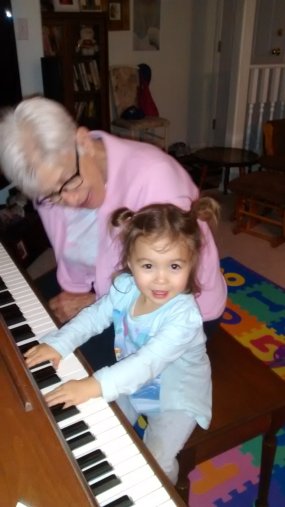
Kara looks over her new piano on Christmas morning, as her Dad and Grandma look on.

If you are a regular here, you will be aware that Dorothy, my wife of 47 years, underwent a kidney transplant on Sept. 23, 2013.

If you’re not, well, here’s the story . . .

We will be forever grateful to the two people most responsible for what really has been a

DandK-20180922
Grandma giving Kara a lesson in September 2018.

new lease on life. Dorothy’s best friend, who has been a bestie for a long, long time, was convinced from the outset that she would be the donor. However, as it turned out, she wasn’t a match for Dorothy.

Still, she wanted to make sure that Dorothy got a new kidney. So they both went into the Living Kidney Donor Program. And that is how Dorothy came to get a new kidney.

Her best friend, who has never wanted attention for what she did, gave a kidney to a stranger, but on the condition that Dorothy get one from someone else, which is what happened. We don’t know who got the friend’s kidney; we don’t know who was Dorothy’s donor.

But as far as Dorothy is concerned, her best friend was her donor.

What has a new kidney meant for Dorothy?

For starters, it got her off dialysis. She had done peritoneal dialysis (PD) for four years prior to the transplant.

Kara-20170413
Kara, with one of her first gifts from Grandma.

It also meant that she was here for the birth of her first grandchild — Kara. She lives with her father, our son Todd, and his wife, Joanna, in Burnaby.

It also has allowed Dorothy to experience, among so many other things, the joy of four Christmases with an energetic and oh, so happy Kara.

Dorothy plays piano by ear and really loves it. She volunteers at a seniors’ residence in Kamloops and often is asked to play piano there. Her love for the piano has meant that her granddaughter has twice received small ones for Christmas, including a toy miniature grand this time around.

What I am trying to say through this meandering message is this: I would hope that you would at least consider being a live kidney donor. The difference such a decision could make in another person’s life is incalculable.

Remember that a transplant isn’t a cure for kidney disease. There quite simply isn’t a cure. Still, a transplant is nothing short of a miracle for the recipient.

Yes, Dorothy and I experienced a miracle more than six years ago and we are thankful every day.

So, please, at least think about it.

——

There are a lot of people out there who are waiting and hoping. They awaken every single day and wonder if this will be the day they get THE phone call . . . a match has been found . . . there’s a date for surgery . . . the load has started to lift.

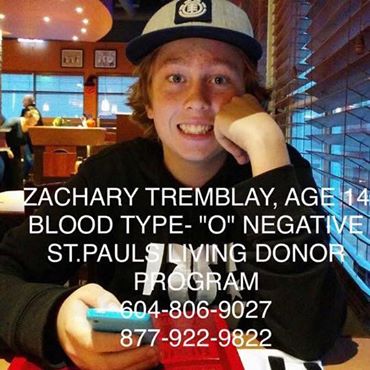
People like Zach Tremblay, a 16-year-old from Robson, B.C., which is across the Columbia River from Castlegar. Zach now spends more than half of every day doing dialysis.

On Saturday, Zach’s mother, Jana, posted this update on Facebook:

“As 2019 draws to a close, and we enter the 5th year of dialysis, I can’t help but be a little sad we are still waiting. So many shares, so many messages from people asking how to be tested, and no matches so far.

“2019 was rough on him. September’s scare and hospital stay being especially trying, and bringing about many changes in his energy level, anxiety and, in turn, his therapy.

“He now does 14 hours of therapy a day. So he spends more than half his 24-hour day doing dialysis. No 16-year-old should be spending the majority of his time doing this.

“Please share his story far and wide and as often as possible and help us make 2020 HIS year.

“May 2020 bring nothing but great things to you all . . . and as always, we appreciate each and every one of you for staying on the ride and loving and supporting our boy and our family.”

(I wrote about Zach in October, and you can find that piece right here.)

——

Joan Alexander, a friend of Jana’s, followed with this:

“As my two-year anniversary as an anonymous kidney donor gets closer, I am beginning Zacha social media blitz to get Zachary Tremblay the kidney he needs!
“My journey began because of Jana Tremblay’s posts about organ donation. As the mother of two healthy sons, I immediately was drawn into this family’s story. Although I was not able to donate to Zach directly, I decided to donate anonymously and someone in British Columbia became my recipient.

“How can you help? Share this post, make (the accompanying two-year-old) photo of Zach your profile pic, learn more (call the St. Paul’s Living Donor Program), get tested, say a prayer or make a wish . . . all of this and more will help.

“It is no small thing to donate an organ. But I would do it again in a heartbeat if I could! Message me if you would like to talk.

“Zach now is 16 years old. He is hooked up to dialysis 14 hours each and every day.”

——

As we prepare to head into a new year, it would be terrific if it really became a year to remember for people like Jana and Zach Tremblay and their family.

If you are interested in more information, here you go:

Living Kidney Donor Program

St. Paul’s Hospital

6A Providence Building

1081 Burrard Street

Vancouver, BC V6Z 1Y6

Tel: 604-806-9027

Toll free: 1-877-922-9822

Fax: 604-806-9873

Email: donornurse@providencehealth.bc.ca

Getting flu shot not about you . . . Some thoughts on being living kidney donor

Every time I see people on social media making mention of how they haven’t had the flu in 1,000 years and have never had a flu shot, well, my blood boils and smoke comes out my ears.

People, people, people. This isn’t about you not getting the flu. A flu shot is to help prevent you, who may be a carrier, from passing it along to someone else, like maybe a transplant recipient who has a suppressed immune system because of the anti-rejection medications that they must take, or maybe a senior citizen — perhaps your own grandmother or grandfather — whose immune system isn’t strong enough to reject a flu bug.

Please, please, please . . . a flu shot isn’t about you; it’s about other people in your community.

Get your flu shot!


There were a couple of things that really jumped out at me when I read the report on organ transplantation in 2018 that was released Thursday by the Canadian Institute of Health Information (CIHI).

Using data from the Canadian Organ Replacement Register, the report included: “There were 40,289 Canadians (excluding Quebec) living with end-stage kidney disease at the end of 2018, an increase of 35 per cent since 2009.”

An increase of 35 per cent in 10 years means that today there will be even more people living with chronic kidney disease (CKD).

That number — 40,289 — jumped off the page when I first read it.

The other note that really hit hard was this: “(In 2018), there were 555 living donors (people who donated a kidney or a lobe of liver) and 762 deceased donors in Canada. The number of deceased donors increased by 56 per cent between 2009 and 2018, whereas the number of living donors remained stable.”

I was more than a little surprised to read the “the number of living donors remained stable.”

More and more people are being impacted by CKD, and everyone needs to realize that there isn’t a cure for it. Once someone is diagnosed with kidney disease, that’s it . . . it’s there and it isn’t going anywhere.

At some point there will dialysis and, hopefully, a transplant.

There are two ways to get a kidney via transplant — from a deceased donor or from a live donor.

The best option, of course, is from a live donor, and people need to understand that you can make sure a recipient gets a kidney even if you don’t have the same blood type.

I am aware of a number of people in Kamloops who are waiting and hoping for transplants — like Julie Dodds, who was featured on CFJC-TV on Thursday; like Vic Morin and John Casey, both of whom are regulars at Kamloops Kidney Support Group meetings; like Ferris Backmeyer, who isn’t yet three years of age but is on dialysis for about 12 hours a day, every day of the year. There’s also Zach Tremblay, a 16-year-old from Robson, B.C., who continues to wait for the phone call.

Let’s say that you are a friend of Julie’s and would love to help, but you aren’t the same blood type. That being the case, you might still be able to give your kidney to someone else — yes, it might even be a complete stranger — while Julie would get a kidney from another person, who might be another stranger.

That is how the Living Kidney Donor Program works — aka Live Donor Exchange Program.

That is exactly how Dorothy, my wife, got her new kidney on Sept. 23, 2013. Her best friend was adamant that she wanted to give a kidney to Dorothy. However, the friend wasn’t a match. Both names went into the exchange program and in time matches were found and transplants were done.

If you are interested in more information, here you go:

Living Kidney Donor Program

St. Paul’s Hospital

6A Providence Building

1081 Burrard Street

Vancouver, BC V6Z 1Y6

Tel: 604-806-9027

Toll free: 1-877-922-9822

Fax: 604-806-9873

Email: donornurse@providencehealth.bc.ca

——

Sam Thompson of Global News has more right here on the CIHI report. He spoke with Dr. Faisal Siddiqui of Transplant Manitoba, who told him that there still is a stigma when it comes to families talking about death and organ donation. “It’s a human nature aspect,” Dr. Siddiqui said, “that we just don’t like sitting around the kitchen table and saying, ‘when I die, this is what I want out of life, or what I want for me.’ ” . . . Dr. Siddiqui also explained that not everyone is able to be an organ donor. . . . That complete story is right here.


I have written here previously on the story involving Catherine Pearlman, and Monica and Eli Valdez. You may recall that Catherine was in a Los Angeles-area coffee shop one day when she saw a flyer that had been placed there by Monica, whose husband, Eli, needed a kidney. . . . Yes, Catherine ended up donating a kidney. . . . If you click right here, you will find a video in which the three of them tell their story. It’s worth the three-plus minutes to give it a watch. (Full disclosure: The video was put together by Hyundai, but it isn’t a commercial. Catherine drives a Hyundai. Oh, so do I.)

BTW, I am aware of two similar stories right here in Kamloops, both of which involve women who each gave a kidney to strangers. Susan Duncan’s story is right here, while Cheryl Vosburgh’s can be found right here.

Kamloops woman looks for kidney as CIHI reports transplants are up but people are dying on waiting lists

Chad Klassen of CFJC-TV stopped by our home on Thursday as he worked on a story involving local reaction to a report from the Canadian Institute for Health Information.

Chad spoke with Dorothy, my wife who had a kidney transplant on Sept. 23, 2013. As you will see by watching his story right here, he also chatted with Julie Dodds of Kamloops.

Julie has a genetic kidney disease — Medullary Kidney Disease Type 1 — and has reached Stage 4 kidney failure. She needs a kidney and is hoping to get one before she has to go on dialysis.

I told her story right here early in August.

——

The Canadian Institute for Health Information issued a report on Thursday that indicates there were 2,782 organ transplants performed in Canada in 2018.

According to the report, which showed a 33 per cent increase in transplants since 2009, the first of 10 years covered here:

“At the end of 2018, there were 4,351 people on wait lists for organ transplants (2,890 active and 1,461 on hold). Additionally, 223 people died that year while on a wait list for an organ transplant.

“The increased need for organ transplantation is in part being driven by the rising rate of Canadians living with end-stage kidney disease, which went up 32 per cent over the 10 years studied.”

Greg Webster, the CIHI’s director of acute and ambulatory care information services, pointed out that “more than 4,000 Canadians are still on a waiting list for a transplant, and many die each year while waiting.

“We know that organ transplants save lives. For most organs, patient survival is greater than 80 per cent after five years.”

Also from the report: “(In 2018), there were 555 living donors (people who donated a kidney or a lobe of liver) and 762 deceased donors in Canada. The number of deceased donors increased by 56 per cent between 2009 and 2018, whereas the number of living donors remained stable.”

Some highlights from the report:

Kidneys (1,706) and livers (533) were the top organs transplanted, followed by lungs (361), hearts (189) and pancreases (57).

As of Dec. 31, 2018, more patients were on wait lists for kidneys (3,150) and livers (527), compared with lungs (270), hearts (157) and pancreases (156).

Of the 762 deceased organ donors, 60 per cent were male. Of the 555 living organ donors, 63 per cent were female.

For deceased donors, the average number of organs used for transplantation was three for all donors and 4 for donors ages 39 and younger.

The complete report is available right here.


A recipient and her best friend — joined at the kidney. . . . To see them together is to marvel

It is after midnight.

The two women sit in the living room in comfortable, soft chairs. One is focussed on a puzzle book — crossword or Sudoku or Kukuru, she does them all. The other is reading a novel.

Rarely do they speak.

They don’t have to talk in order to communicate . . . they are joined at the kidney.

As proof that time waits for no one, more than six years have passed since one of them

DandD 2
Dorothy Drinnan (right) and her best friend, who donated a kidney in order for her to receive one, love being together.

gave up a kidney so that the other could live again.

But their relationship goes back much farther than that, back to the early 1970s when they worked together in a mental health centre, well before people who are much smarter than I am chose to shut it down.

They no longer live in the same community; in fact, they now are separated by more than 1,700 kilometres and a few mountains. No matter. The friendship endures; in fact, now in their 60s, they are closer than they have ever been, seemingly growing even tighter as time races on.

When one of them needed dialysis to help cope with kidney disease, the other was adamant that she would donate a kidney to her friend. The recipient had been diagnosed with kidney disease — it was discovered that she had been born with just one kidney and that it was malformed and slowly starting to fail — more than 30 years before the transplant. Of course, the friend had been saying for more than 30 years that she would donate a kidney when the time came.

And when that time came, she was true to her word.

When it turned out that they weren’t a match, she said that didn’t matter; they would enter the Living Donor Paired Exchange Program. She would give up a kidney, but only if her best friend got one.

It wasn’t quite that simple, but that’s exactly what ended up happening.

As luck would have it, they ended up in the same hospital so were able to check on each other in the days immediately after surgery.

The donor never has said much about what she did. In fact, when she was away from home for a while those six years ago, there were friends and neighbours who didn’t have any idea where she had gone or what she was doing.

She has never wanted attention. Whenever the subject of her sacrifice or generosity — or pick any other word — is mentioned, she simply shrugs it off. Without having to ask, she knows what would have happened had the shoe been on the other foot.

And now they try to spend time together twice a year — once in the spring and again on or about the anniversary of the transplant.

A year ago, it was the fifth anniversary, so the donor and her husband drove through four provinces in order to participate in a Kidney Walk with the recipient and her family.

A year later, they are sitting quietly in a living room, each in her own world, but you know they are in each other’s world at the same time. Earlier, they were baking scones and making conversation as they worked together. Their children are married now. There are young grandchildren. There is lots to talk about, including all that comes with advancing age.

The one thing that never is heard is a discouraging word, nor is there ever a disagreement.

No. They aren’t sisters. They are closer than that.


Ebata2019
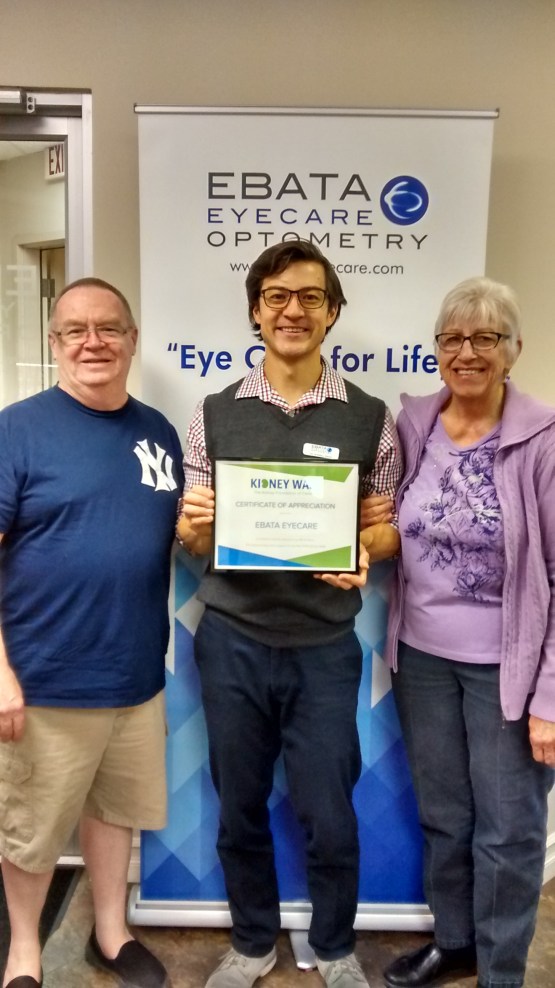
Dr. Russell Ebata (centre), the entire Ebata family and the staff at Ebata Eyecare Optometry, are big supporters of Kidney Walk Kamloops. When Dorothy and I dropped by to thank them the other day, he was adamant that we pose for a photo. Had I known, I would have worn a suit and tie. 

Yes, there is chaos out there. There also are good things happening. . . . Give this tweet and its thread a read; it will make you feel good. . . .


If you are thinking about being a donor, feel free to call the donor nurse co-ordinator at St. Paul’s Hospital (604-806-9027 or 1-877-922-9822), or email donornurse@providencehealth.bc.ca


2019 Kidney Walk: Wet day can’t douse spirits. . . . Goal surpassed. . . . Stop thief!

Registration
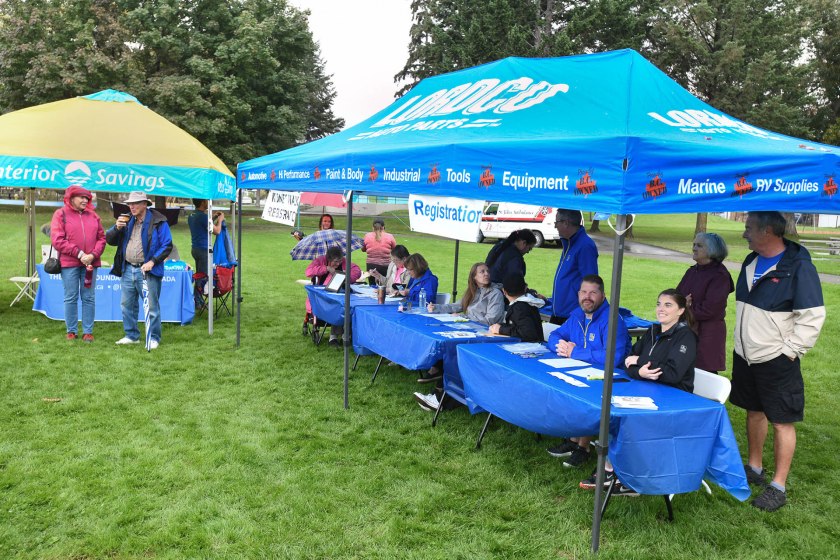
A Kidney Foundation information booth (back left) was set up at Sunday’s Kidney Walk, while beneath the Lordco canopy you were able to find merchandise after first checking in at the registration table. (Photo: Murray Mitchell/Murray Mitchell Photography)

We awoke Sunday to cool weather (12 C) and showers.

The cool wasn’t a problem because warm weather and people with kidney disease aren’t a good match.

But the drizzle . . .

KWlogo2Well, if you have been, or are being, impacted by kidney disease, what’s a little rain? Right?

And so it was that more than 100 people were at McDonald Park on Kamloops’ North Shore on Sunday for the city’s 10th annual Kidney Walk.

Not all of them took part in the walk, which always follows Rivers Trail for more than one kilometre to McArthur Island, but they all were there to show support to people in our community who are dealing with kidney disease or to remember friends and loved ones.

Larry1
Larry Read, the Kidney Walk’s emcee, kept folks informed and everything on time. (Photo: Murray Mitchell/Murray Mitchell Photography)

We couldn’t have done it without Larry Read, the sports information guru for the WolfPack at Thompson Rivers U. He is our emcee, and he brought along six athletes from the WolfPack swim team and, oh boy, what a big help they were. This wasn’t the first time Larry brought volunteers from TRU, and it is a tremendously positive feeling to see these young people so eager to help at an event like this one.

With Larry at the controls, we saluted Hugh McLennan and Louis (Big Rig) McIvor as the honourees for the 2019 Walk. Hugh, a rancher, is the host of the Spirit of the West podcast and a familiar figure in the cowboy world in Alberta and B.C. When he needed a kidney almost two years ago, he got

HughLouis2
Hugh McLennan (left) and Louis (Big Rig) McIvor, the honourees of Kamloops’ 2019 Kidney Walk, address the crowd. (Photo: Murray Mitchell/Murray Mitchell Photography)

one from Big Rig, a long-time friend who is a former long-haul driver and radio personality.

They were introduced by Edna Humphreys, the executive director of the Kamloops chapter of the B.C. and Yukon Branch of the Kidney Foundation of Canada. Hey, if there’s a renal-related event in Kamloops, you can bet that Edna is the push behind it.

We went into this walk with a goal of raising $20,000. By the time the counting is done, we will be somewhere around $24,000, which is unbelievable. In all of our pre-walk chatter, I don’t once remember anything close to that figure being mentioned.

In 2018, we raised $21,764, after bringing in $16,736 in 2017.

——

Allanmoney
Allan Dodds (right) returns money that had been lifted from the Brock Central Lions Club’ breakfast table on Sunday. (Photo: Murray Mitchell/Murray Mitchell Photography)

There was some excitement late in the program, too.

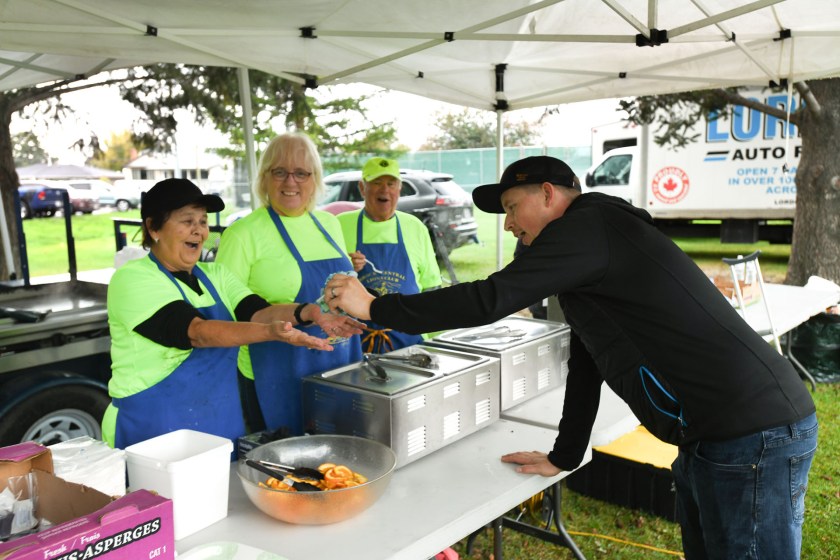
The Brock Central Lions Club was there, again, to provide us with a pancake breakfast, along with sausages and coffee, all by donation.

So with most of the folks already eating and a few in line to fill their plates, a cry went up: “Stop her! Stop her! She took the money box.!!”

It seems that a person had appeared on the scene, got in line for breakfast, then grabbed the cash box and took off on the run.

However, her plan hadn’t accounted for Allan Dodds, who when he isn’t playing Superman works at Lordco in Kamloops. His connection with us? His wife, Julie, has kidney disease and is in need of a transplant.

Anyway . . . Allan took off after the thief, caught up with her and brought back the money.

As Julie wrote on her Facebook page: “My husband not only helped set up . . . and with the delivery of chairs and tables, he helped present a large cheque, and also chased down a would-be thief.”

In the end, the Lions Club raised $326.90, all of which, thanks to Allan, was there to be donated to the Kidney Walk.

If we were to give out an MVP award this year, it would go to Allan. As a member of the Southern Central B.C. branch of the CIM (Canadian Institute of Mining, Metallurgy and Petroleum), he presented the Kidney Walk with a cheque for $5,000 in late August.

Through Lordco, he was able to provide us with a truck with which he picked up tables and chairs from the good folks at TRU. He also supplied, again through Lordco, a large canopy that really came in handy considering the weather.

And, of course, he topped it all off by jumping into a phone booth — OK, there aren’t any of those these days; he just went behind the Lordco truck — where he donned the Superman suit and went on to rescue the money.

Thanks, Allan!

——

DorothyLeona
Dorothy Drinnan (right) and friend Leona Backman enjoy a rainy time during Sunday’s Kidney Walk. (Photo: Murray Mitchell/Murray Mitchell Photography)

Dorothy says: Thank you! Thank you!! Thank you!!!

With help from so many of you, she was able to raise $3,230 for Kamloops’ 10th annual Kidney Walk, which was held on Sunday morning.

With such great support from so many terrific people, she was the leading fund-raiser for a sixth straight year, and she now has raised more than $16,000 in total.


Dodds
Julie Dodds (in red jacket) has kidney disease and is in need of a transplant. She poses with friends and family, all of whom were there to support her at Sunday’s Kidney Walk. (Photo: Murray Mitchell/Murray Mitchell Photography)


DOG
Not all of the participants in Sunday’s Kidney Walk were of the human variety. This pooch got into the spirit of things by donning a Kidney Walk t-shirt, too. (Photo: Murray Mitchell/Murray Mitchell Photography)

Talking kidneys with Freda, Howard, Dorothy and Jill. . . . Update on Vic Morin’s situation. . . . Kamloops Walk on Sunday

With Kamloops’ 10th annual Kidney Walk set for Sunday, my wife, Dorothy, along with friends Freda and Howard Brown, got together with Jill Sperling of Kamloops TV station CFJC on Thursday. OK, I was there, too.

We met at McDonald Park, the site of the Walk, where we chatted about kidneys, transplantation, dialysis and the Kidney Walk.

Dorothy had her transplant six years ago, after almost four years of peritoneal dialysis. Freda recently began doing hemo-dialysis; she does three runs a week at Royal Inland Hospital. Howard was hoping to donate a kidney to his wife and spent the past nine months undergoing all of the necessary tests. However, one of the tests turned up a kidney stone, so he has been disqualified, at least for now.

There’s all that and more in this piece right here.

——

In the TV piece referred to above, Howard Brown points out that if you are considering being a live kidney donor, you shouldn’t wait because the testing process takes some time.

But, at the same time, if the medical team finds any issues with your health, they will be dealt with ASAP. In Howard’s case, he already is being put in touch with a specialist in Kamloops and is hoping to have the kidney stone removed so that he can get back into a process that, hopefully, will end with him being a donor for his wife, Freda.

That brings us to Vic Morin, a friend who lives in the Dallas area of Kamloops and who also is in need of a kidney.

Vic has been a regular at Kamloops Kidney Support Group meetings for a while now, and was preparing to begin peritoneal dialysis (PD) in the near future. That is the same form of dialysis that my wife, Dorothy, did before she was fortunate enough to get a kidney from a live donor.

Because Dorothy had experience with PD, she and Vic have had many conversations over the past months. And we were quite excited to hear last week that he was to have a catheter surgically placed into his peritoneal cavity next week. That meant he was one giant step closer to beginning PD.

(BTW, someone who does PD hooks up to a machine called a cycler and does a fluid exchange seven nights a week while sleeping — toxic fluid out, clean fluid in, to be carried around all day in that cavity.)

Unfortunately, Vic’s kidney function deteriorated so rapidly that he was to begin hemo-dialysis on Friday. However, things now have been moved to Monday. He still is on schedule to have a catheter surgically installed on Wednesday so that he can begin training for peritoneal dialysis.

While all this is happening, the search continues for a live donor.

——

One of the reasons that I stopped writing about hockey here and turned mostly to renal-related items is that a lot of education is needed when it comes to kidney disease, dealing with kidney disease, organ donation and transplantation. . . . If I am able to provide enlightening information in this space I will be more than pleased. . . .

A few things you should know . . .

There is no cure for kidney disease. Once you have been diagnosed, that’s it; it doesn’t go away.

A person who has had a kidney transplant isn’t cured. For example, Dorothy takes anti-rejection drugs twice a day in order to keep her system from rejecting the organ that is foreign to her body. Those drugs also suppress her immune system so there are some precautions that have to be taken as she goes through daily life.

Should you choose to be a live donor, you don’t need to be the same blood-type as the person in need of a kidney. Instead, you are able to donate through the Living Donor Paired Exchange Registry. In short, your kidney goes to someone else, but only on the condition that the person you want to help gets one from another live donor. This is how Dorothy got her kidney — her best friend gave a kidney to someone (neither she nor Dorothy have any idea who it went to), and Dorothy got one from someone else. No, we don’t know a name, nor do we have any idea how many donors and recipients were involved in that particular chain.

If you are being tested and an issue with your health is discovered, it will be dealt with ASAP. In Howard’s case, a doctor at the renal clinic at St. Paul’s Hospital in Vancouver got him in touch with a specialist in Kamloops in short order.

A donor will spend a couple of days in hospital — Dorothy’s friend had surgery on a Monday and was released from hospital on Wednesday. It is suggested that a donor take it easy — no heavy lifting, for example — for up to six weeks and then it’s full-speed ahead. I know of one donor who was back to jogging in three weeks.

A donor also will continue to be monitored by the medical community. Should there be serious issues with the remaining kidney, a donor would automatically go to the top of the transplant list.

And, yes, a person is able to live with one kidney.

I would never pressure anyone to be a donor. If you are at least thinking about it, I would only ask that you do some research.

——

If you are thinking about being a donor, feel free to call the donor nurse co-ordinator at St. Paul’s Hospital (604-806-9027 or 1-877-922-9822), or email donornurse@providencehealth.bc.ca.

Should you make the call and be asked who will be the recipient, feel free to mention Freda Brown or Louis Victor Morin.

Understand, too, that the people who work in renal clinics are big on privacy — I mean, they are really, really big on privacy. Everything you say or do will be kept confidential.

As well, a donor is able to change his/her mind and walk away at any time during the process.


——

Don’t forget that the 10th annual Kidney Walk Kamloops is scheduled for Sunday (Sept. 22) at McDonald Park on the North Shore. . . . We will begin registering folks at 10 a.m.; we will go for a walk at 11.

Larry Read, who is so involved in our community, will be the emcee, again. Hugh KWlogo2McLennan and Louis (Big Rig) McIvor will be in attendance as the honourees for this year’s walk. When Hugh needed a kidney almost two years ago, Louis, his longtime friend, stepped up and gave him one.

As well, the Brock Central Lions Club will be on hand to provide breakfast — pancakes, sausages and coffee — by donation. A year ago, they served more than 100 breakfasts.

The Kidney Walk helps raise awareness about kidney disease and raises funds for important programs and services to help kidney patients in this community and others across BC and the Yukon.

Dorothy will celebrate the sixth anniversary of her transplant on Monday. She will spend part of Sunday taking part in her sixth straight Kidney Walk; she also helps Edna Humphreys and me pull the whole thing together.

If you would like to help out — Vic Morin is part of her support team — you are able to make a donation right here.

RE/MAX, WHL partner again to help Kidney Foundation. . . . Raised more than $460,000 in two seasons

RE/MAX of Western Canada and the WHL are once again getting behind WHL Suits Up with Don Cherry to Promote Organ Donation, the annual promotion that benefits the whlKidney Foundation of Canada and its provincial  branches.

If you aren’t familiar with this promotion, it involves the WHL’s 17 Canadian-based teams, each of whom uses one game each season to help promote organ donation and transplantation.

I don’t have dates for all teams but the B.C. Division games will go like this: Prince George Cougars, Jan. 31; Vancouver Giants, Feb. 8; Kamloops Blazers, March 6; Victoria Royals, March 13; and Kelowna Rockets, March 14.

During the 2017-18 season, the promotion in WHL cities raised more than $265,500, making it the largest public awareness and fundraising campaign in the history of the Kidney Foundation. Last season, the final total raised was $196,600.

In two seasons then, RE/MAX of Western Canada and the WHL have helped raise more than $460,000.


The 10th annual Kidney Walk Kamloops is scheduled for Sunday, Sept. 22, at McDonald Park on the North Shore.

Registration will open at 10 a.m., with the walk to start at 11. And we will walk in the KWlogo2rain if the forecast holds true.

If you would like to join us, you are able to walk all or part of the approximately 2.5-km pathway between McDonald Park and McArthur Island. Or you don’t have to walk at all; you might want to just sit and enjoy the company and festivities, then have breakfast. The Brock Central Lions Club will be on hand to provide breakfast — pancakes, sausages and coffee — by donation.

The Kidney Walk helps the Kidney Foundation raise awareness about kidney disease and raises funds for important programs and services to help kidney patients in this community and others across BC and the Yukon.

My wife, Dorothy, will be celebrating the sixth anniversary of her kidney transplant by taking part in her sixth straight Kidney Walk. In her six walks, she has raised more than $15,000. If you would like to support her — she reached the $3,000 mark on Thursday — you may do so right here.


A note from the Kidney E-News letter of the BC and Yukon Branch of the Kidney Foundation of Canada:

“The BC & Yukon Branch and the Children’s Organ Transplant Society (COTS) were excited to have 43 youth from across BC attend Camp Latona on Gambier Island in August.

“The kids got to enjoy the camp experience with other young people at various stages in their kidney disease/organ transplant journeys. The weather was fantastic and some of highlights included tubing, campfires, extraordinary food, swimming and, of course, making new friends! 

“A huge thank you to all of the gracious donors who made it possible for the kids to attend a cost-free, worry-free camp. We appreciate you!”


More hepatitis C-infected kidneys being transplanted. . . . Disease able to be treated following surgery. . . . Kidney Walk set for Kamloops on Sept. 22

Kidneysign


A study published Thursday in the Journal of the American Society of Nephrology reports that American transplant centres are using three times more hepatitis C-infected kidneys for transplant rather than dispose of them.

There has long been a fear that a transplant receiving a kidney with hepatitis C would become ill. According to this report, medical advancements in treating hepatitis C mean that those recipients won’t become ill.

Jen Christensen of CNN writes:

“Hepatitis C is a viral infection that causes liver inflammation, sometimes leading to serious damage. Prior to 2018, most of the infected organs went to patients who already had hepatitis C. Since 2018, most of these infected kidneys, about 75 per cent, went to patients who did not have the virus.

“Patients who received infected kidneys had nearly the same function as those who received uninfected kidneys, the study said.”

Dr. Vishnu Potluri, the study’s lead author and a nephrology fellow at the U of Pennsylvania, told Christensen:

“The key thing about hepatitis C is that millions of Americans have this infection and most don’t know that they have it, it’s mild and takes many years for it to progress.”

Christensen continued: “Until a few years ago, there weren’t really good options to treat hepatitis C. Now, there are drugs with high cure rates, Potluri said. The transplant community realized that you could transplant a kidney from someone with hepatitis C and start treating them right away, Potluri said, and the early trials found the infection could be cured after the transplant.”

Hopefully, this study will signal a change for the system in the U.S., where nearly 40 per cent of hepatitis C-infected kidneys donated between January 2018 and March 2019 were discarded.

Christensen’s story is right here.


KWlogo2

Don’t forget that Kamloops’ 2019 Kidney Walk is set for Sunday, Sept. 22, at McDonald Park. You are able to register starting at 10 a.m., with the walk to begin at 11.

The Brock Central Lions Club will be on hand to provide breakfast — pancakes, sausages and coffee — by donation.

A few numbers for you: Kidney Walkers in B.C. and Yukon have walked 26 million kilometres over the past 12 years. That is more than 67 return trips to the moon. . . . They have raised more than $2.5 million in support of kidney patients. . . . The Kidney Walk helps the Kidney Foundation raise awareness about kidney disease and raises funds for important programs and services to help kidney patients in this community and others across BC and the Yukon. . . .

As of mid-August, in the region served by Kamloops’ Royal Inland Hospital, there were 1,378 patients with chronic kidney disease being monitored by nephrologists. Of those, 140 had undergone transplants, and 114 were on dialysis. . . . As of Aug. 27, there were 68 people in our area on the pre-transplant list. . . . In 2018, there were 339 kidney transplants performed in B.C., a one-year record.

My wife, Dorothy, will be celebrating the sixth anniversary of her kidney transplant by taking part in her sixth straight Kidney Walk. In her six walks, she has raised more than $15,000. If you would like to support her, you may do so right here.