Scattershooting on a Wednesday while waiting for the rain to stop in New York . . .

Scattershooting

Ahh, yes, the start of the NHL regular season. That means that some viewing choices become a whole lot easier because so many of those TSN and Sportsnet channels are blacked out for many evenings. This all seems to be part of the NHL’s master marketing plan.


Facebook


I don’t know about other Canadians, but I can’t wait until Monday (election day) is over so that our phone will stop ringing. Yes, we have call display. Yes, we have stopped answering it unless we know who is calling. . . . BTW, we both voted on Friday so we don’t want to talk to you anyway.

——

BTW, would the scammer from 778-580-4001 who keeps calling Dorothy’s cell phone either stop calling and leaving a voice message, or come on over and arrest her, as you keep threatening to do. Either way, just go away. . . . And, hey, you at 604-243-2944, either leave a message or stop calling us, too. OK? . . . Oh, and 604-210-7993 and 888-811-2323, you can get outta here, too.


Headline at @SportsPickle: PBA bowling should come out as staunchly pro-Chinese government just to try to get in the news for a few days.


Zebras


If you are a regular viewer of Pardon The Interruption (PTI), you might agree that we are watching Michael Wilbon grow into an angry, yelling old man right before our very eyes.


First, there was this:

——

Later, there was this one:

——

And, Regina, there also was this:


Dwight Perry of the Seattle Times is wondering: “Does Arkansas linebacker Bumper Pool have a brother named Gene?”


If you are of a certain age, we never forget . . . 


ICYMI, the New York Mets will retire the number (36) of former southpaw Jerry Koosman next season. Asked up a speech, Koosman told the St. Paul Pioneer Press: “I’ll just copy Lou Gehrig’s.”


Wondering what Oakland Raiders head coach Jon Gruden thought after the Washington Redskins fired his brother, Jay? “My dad’s been fired. I’ve been fired. Jay’s been fired and . . . welcome to the club, bro,” Jon told reporters.


Psychic

Kidney donor chosen to take part in Tournament of Roses Parade . . . Philly rapper Freeway talks transplant

I don’t make a habit of watching the annual Tournament of Roses Parade from Pasadena, Calif. But I plan on watching the 131st annual event on New Year’s Day.

Why?

To honour Regina Tanner and all of the other generous folks who have donated kidneys. (Hello, Susan Duncan and Cheryl Vosburgh and Louis (Big Rig) McIvor and so many others.)

Regina, who is from Fresno, Calif., will be in the Parade, walking with the Donate Life Rose Parade float. Regina gave up a kidney in 2016 so that her husband, Cary, could get one via transplant. The two of them ended up part of a paired kidney donation chain that featured 18 people.

There is more on Regina’s story right here.

That piece also includes some interesting facts and statistics regarding organ donation and transplantation.


Mondays With Murray: There’s Been No Change of Heart


SUNDAY, OCTOBER 24, 1982, SPORTS

Copyright 1982/THE TIMES MIRROR COMPANY

JIM MURRAY

There’s Been No Change of Heart

  When Lefty Gomez was going in for open-heart surgery, the old Yankees pitcher was worried. He wanted to know which way to bet, as usual. “What are my chances?” he asked. “Aw, don’t sweat it, Lefty,” the doctor told him. “A piece of cake. We have a 98 percent success rate.”

  Suddenly, Lefty went home. Almost immediately, his phone began to ring. His cousin from Visalia called. Her brother had the operation, and he was out climbing mountains. mondaysmurray2A neighbor called. Same thing. His father had the operation and he was years younger. An old friend called from New York. He had come through with flying colors. An ex-teammate called. He had it and was OK.

  Suddenly, Lefty broke into a cold sweat anyway. “I suddenly realized I was up to 68 percent. Two more phone calls and I was an underdog. I shut off the phone.”

  I bring this up because, I, too, recently had heart surgery. But it wasn’t well-meaning friends who gave me sleepless nights. It was the medics. For openers, the surgeon, Dr. Jack Matloff, the old Yale football player, came in the night before and told me all the things that could go wrong. He made it sound as if I should get points in this game. “First of all,” he said, “you could die.” And that was the good news.

  Part of the bad news was, they were going to replace my worn-out valve with a pig’s valve. My doctor, Gary Sugarman, was quick to see the obstacles in this. “That means you’re ‘trafe,’ ” he said. “That means you can never go in a Beverly Hills delicatessen again as long as you live.”

  “In that case,” I told him, “this will be the first operation in history to save a heart and a gallbladder at the same time. Irving Caesar used to say that pastrami killed more Jews than the Pharaohs.”

  Another doctor on the case, Jeffrey Helfenstein, was even more helpful. “Look at it this way: When your readers write in that you’re a pig, they’ll be part right.”

  But, my problems were more metaphysical than medical. What I was worried about was the big picture, the effect all this would have on my career. I reasoned this way: The heart is the seat of the emotions, right? Now that I had a new set of emotions, how would this affect my whole approach to life? I mean, would I now become Mr. Nice Guy? No more Mr. McNasty? Would I now start seeing two sides to every story? Would I start to admit it when I was wrong? Would I stop being an opinionated jerk? Would I get that fatal columnists’ disease, fairness? Would I start to like Cincinnati?

  The thought was too appalling to contemplate. Would they scalpel malice right out of my system, and leave me a journalistic eunuch? One of those guys who says, “On the other hand . . .?”

  You know, when I went in for the operation, a lot of the wags were ready: “Jim Murray had a six-hour heart surgery. Took ‘em one hour to fix it and five hours to find it.” And so on.

  You know, when I first came to California way back in ’43, I realized I would have to guard against the local diseases — cheerfulness, optimism, tolerance, sympathy, orange juice poisoning of the brain, kind of like you watch out for malaria in the tropics. I guarded against the symptoms night and day. When I covered the movies, for instance, I didn’t like any of them. I even ripped Academy Award performances. Especially Academy Award performances. I only liked pictures nobody went to see. If Spencer Tracy wasn’t in it, I knocked it.

  Then, when I got into sports, I was horrified at the attitude of the fans out here. They were, if you can believe it, well — “understanding” is the word. Patient. Sympathetic. Terrible flaws in a sports fan.

  I used to sit behind them and heard them implore: “Please, Steve, don’t strike out.” Good Lord! This is no way to spectate. Brought up in the Polo Grounds and Ebbets Field, I knew the real procedure: “Hey, Steve, strike out so they’ll know you! I hear you’re writing a book, ‘My Greatest Days in Baseball.’ It’ll be thinner than the Texas social register. Hey, Steve, is your nickname ‘Popeye’ or ‘Pop Fly?’ Hey, Steve, one more strikeout and that school they named after you is ‘Lincoln Junior High’ once again. Can they carry out decimals in that school far enough to find your batting average? Hey, Steve, does your Rolls Royce have stained-glass windows — or just a chair in the back and incense? Do they call you ‘goody, goody’ because you’re bucking for saint or because that’s what the pitchers say when you come up? The next time you go to Lourdes, bring your bats.”

  You can sit there, as fans do here, and murmur encouragements like, “We’re with you, Fernando, baby!” You have to go for the jugular, shake him up. “Hey, Fernando, show us how to throw a home run. Hey, Fernando, who takes care of your pet gopher when you’re on the mound? Hey, Fernando, two more pounds and they have to tether you. They’ll put a propeller on you and take pictures over the Rose Bowl next New Year’s. Hey, Fernando, the movies want you! They’re doing a remake of the Hindenburg disaster. You’re gonna play the Hindenburg. Hey, Fernando, how do you say ‘ball four’ in Spanish? Better learn, you’re gonna be saying it a lot!”

  In horse racing, the accepted form of cheering in the stretch here is, “Come on sweetheart, stay there! Only an eighth of a mile, you can do it, baby!” The universal hate form on the other hand is, “Don’t die now, you damn dog, you got all my money ridin’ on ya! Hold on, you bucket o’ glue! Jockey, hit that snivelling quitter — or are you in on the fix, too?!”

  Soft-heartedness is the graveyard of sportswriting, too. The minute you think, let alone write, “Well, the poor fellow was doing his best,” you are through. The instant you lead off with “Steve Garvey gave it his all yesterday, but took a called third strike to write finish to the Dodgers’ pennant race,” you are ready for the copy desk and the condo in Chula Vista. You have lost the hop on your hard one.

  If life, they say, “No news is good news.” In journalism, they say, “Good news is no news.” You have to put a stone in your heart and a sneer on your lips and write, “Steve Garvey liked the pitch so much he couldn’t bear to bruise it. So he stood there like a guy getting his first look at the Mona Lisa, overcome with awe and admiration. He looked as if he had come to paint it, not hit it. Of course, the Philistines were screaming, ‘Swing, ya dummy! It’s a strike, not a work of art!’ But what do they know of works of art?”

  I took up the problem with Dr. Sugarman, when he found fluid around the heart. “You don’t think it’s the milk of human kindness, do you?” I wondered anxiously. Gary shook his head. “No,” he said.

“You can tell that from the stethoscope?” I pressed.

“No,” he said, “from the column you wrote about the St. Louis Cardinals.”

Reprinted with the permission of the Los Angeles Times

Jim Murray Memorial Foundation, P.O. Box 60753, Pasadena, CA 91116

———

What is the Jim Murray Memorial Foundation? 

  The Jim Murray Memorial Foundation is a 501(c)(3) nonprofit organization, established in 1999 to perpetuate the Jim Murray legacy, and his love for and dedication to his extraordinary career in journalism. Since 1999, JMMF has granted 104 $5,000 scholarships to outstanding journalism students. Success of the Jim Murray Memorial Foundation’s efforts depends heavily on the contributions from generous individuals, organizations, corporations, and volunteers who align themselves with the mission and values of the JMMF.

Like us on Facebook, and visit the JMMF website, www.jimmurrayfoundation.org.

——

A dozen years ago, Linda McCoy-Murray compiled a book of Jim Murray’s columns on female athletes (1961-1998). While the book is idle waiting for an interested publisher, the JMMF thinks this is an appropriate year to get the book on the shelves, i.e., Jim Murray’s 100th birthday, 1919-2019.  

Our mission is to empower women of all ages to succeed and prosper — in and out of sports — while entertaining the reader with Jim Murray’s wit and hyperbole.  An excellent teaching tool for Women’s Studies.

Proceeds from book sales will benefit the Jim Murray Memorial Foundation, a 501(c)(3) not-for-profit organization providing sports journalism scholarships at universities across the country.

Meet Zach Tremblay, an active teenager from Robson, B.C., who needs a kidney . . .

By day, Zach Tremblay is your typical 16-year-old.

He is a Grade 11 student at Stanley Humphries Secondary School in Castlegar, B.C., just across the Columbia River from his family’s home in Robson in the West Kootenays. He plays basketball and likes to bowl. He spends time skateboarding, and hanging with buddies.

By night, however, Zach is anything but typical.

As he gets ready for bed every night — every single night . . . EVERY SINGLE NIGHT . . .

ZachTremblay
Zach Tremblay is 16 now, and he still needs a kidney. The phone numbers will get you to the Live Donor Exchange Program at St. Paul’s Hospital in Vancouver.

there aren’t any nights off — he hooks up to a machine called a ‘cycler’ that, while he is sleeping, uses fluids to drain toxins from his body. For most of us, our kidneys take care of these toxins.

However, Zach was diagnosed with chronic kidney disease at birth. While he was younger, medications helped control things. As he grew older, the medications weren’t enough. He now has been doing peritoneal dialysis (PD) for almost five years.

There was a brief interruption in the middle of 2017 when he underwent a live donor transplant at B.C. Children’s Hospital in Vancouver.

But, as his mother, Jana, wrote, “Unfortunately it did not work out, and was removed 24 hours and four surgeries later. An absolutely heartbreaking moment for all of us, but mostly him.”

On Sunday, Jana told me that “because of the donor tissue being inside him, he has developed very high antibodies, so finding his match has proven to be a huge challenge.”

After the transplant didn’t work out, it was back home. Back on PD. Back waiting and hoping for a live donor to be found.

In September 2017, about three months after the transplant had failed, Jana took to her Facebook page in an attempt to add some momentum to the search.

“Zachary Tremblay is a 14-year-old boy from Robson, B.C., Canada,” she wrote. “He was born with CKD, Hypoplasia-Dysplasia with reflux. After 12 long years of battle, he has been put on PD and is awaiting a kidney transplant. Zachary is an O negative, but the donor can be O, O- or O+– The RH Factor is irrelevant, and can be controlled by meds.

Each family member has been tested with no matches. We are now reaching out to you, the public, our friends, families, neighbours and strangers. Our boy needs a kidney, and every kid deserves a chance at a healthy life. Please consider being tested for him.”

Four months ago, Jana updated the situation for the first time in six months:

“Six long months have passed since our last update. Six more long months of dialysis, meds, appts, lab draws, injections, supply orders and dump runs ( medical waste builds up SO fast!)

“We are still sharing, waiting, hoping and praying our boy gets his gift. We will never give up on that! In the meantime, we promote organ donation and ensure people who want to be are signed up.”

Last summer, Jana was asked to address the gathering at the annual Kidney Walk in Trail, B.C. Her father was ill, so she wasn’t able to make it, but she put together an emotional piece that was read to the crowd that day. More than anything, this spells out the impact that kidney disease has on a family. Some excerpts follow . . .

Shortly after birth, doctors discovered that Zach “was in complete renal failure and would need immediate intervention at B.C. Children’s Hospital if he was to have any chance at survival. . . .

“Zach, myself and his Dad spent the next six weeks in hospital. We slept side-by-side on an old metal cot beside his crib, in the corner of his room, so we could be there no matter what happened.

“He had very high potassium, and they were worried his heart would be damaged or, worse, would just stop.

“Many long nights, painful tests, blood draws, treatments, ultra sounds, and IV’s later, our baby was stable, and we were able to bring him home. I remember excitedly asking our doctor, ‘What now? What do we do now? What will happen to him and where do we go from here.’ His response shook me to my core. He very quietly and calmly said: ‘Take him home and enjoy him, because this baby is not going to live.’ . . .

“Not only did our son survive, he surpassed any expectation they had for him. He grew and thrived and required very little intervention, aside from vitamins and phosphate binders, until his 11th year.

In September 2012, he went into sudden decline, and by December he required surgery to place a peritoneal dialysis catheter (into his peritoneal cavity). After the holidays and some healing, we spent the next two weeks training in Vancouver to learn to give our son dialysis at home. We had to learn to look after our son, and give him his therapy, distribute his meds, care for his site, and watch for signs of issues or infection. . . .

“We have spent the past 15 years traveling back and forth to Vancouver. While people were setting money aside for their next family holiday or big vacation, we were saving for our next trip to Vancouver. . . .

“This disease affects the whole family. My other son, Mason, has spent a good deal of his life, also going back and forth, attending appointments and supporting his brother. He has been afraid, lonely, scared and angry. . . .

“There are few people in this world I look up to more than my kids. Zach has endured more than any kid should have to. He has handled it with a maturity and grace not seen in most his age. While most kids are worrying about homework, social media, friends, etc., he has all that, plus the added pressure of this disease. He has to remember to take meds. He has to take his BP everyday. He has worries, fears and responsibilities most adults couldn’t adhere to. He shouldn’t have to.”

The Tremblay family, including Jana and her husband, Dan, live in Robson. There is an older brother, Taylor, and an older sister, Kailie, both of whom have partners and children. There are other family members in the area and in the Okanagan; the support system, Jana said, is strong.

The family has learned to take life one day at a time as they wait. Hoping. Praying. Zach hooks up to his cycler EVERY SINGLE NIGHT as he, too, plays a waiting game.

On Thursday, Jana posted a brief message on Facebook. It read: “Thursday seems like a great day to find a kidney!”

I’m thinking that the Tuesday after a Thanksgiving weekend would be a great day to find a kidney, too.

——

If you are interested in more contact information, here you go:

Living Kidney Donor Program

St. Paul’s Hospital

6A Providence Building

1081 Burrard Street

Vancouver, BC V6Z 1Y6

Tel: 604-806-9027

Toll free: 1-877-922-9822

Fax: 604-806-9873

Email: donornurse@providencehealth.bc.ca

About pediatric kidney transplants, flu shots, curried turkey casserole . . .

I wrote earlier this week about Ferris Backmeyer, and you may be wondering how in the world someone who is only 2-1/2 years of age is able to undergo a kidney transplant.

Ferris, who lives in Kamloops with her mother, father and two sisters, has kidney disease. She has been doing peritoneal dialysis at home for 18 months now.

Her mother, Lindsey, recently revealed on Facebook that they have been given the OK to

Ferris
Ferris Backmeyer, 2-1/2 years old, needs a kidney transplant. (Photo: Lindsey Backmeyer/Facebook)

look for a living kidney donor for Ferris.

“We have been told the donor process can take just as long as the transplant workup for Ferris,” Lindsey wrote, “so starting the search now is recommended.”

Obviously, Ferris isn’t going to get a kidney from a three-year-old living donor. So let’s look at a few things . . .

First, from the Kidney Foundation of Canada (kidney.ca):

“A living kidney donation comes most often from a family member such as a parent, child, brother or sister. A donor can also be a spouse, friend or co-worker. Or it can be a stranger. A genetic link between donor and recipient, although beneficial, is not always required. This is largely due to improved anti-rejection medications.

“A good living donor candidate is someone who is healthy, well-informed and makes a voluntary decision to donate one of their kidneys. Living donors must be over 18 and usually less than 70 years of age. They must be in good general health . . .”

So if you are older than 18, you are eligible to be a kidney donor.

While it is preferred that donors be under the age of 70, there are stories of donors who have been older. Health, both physical and mental, plays a huge role in donor eligibility, no matter the age.

When it comes to children, it would seem that having a live donor is the best option.

A 1982 report published in The Journal of Pediatrics reached this conclusion:

“We conclude that because of donor availability, capacity for good donor-recipient matching, and minimization of time on dialysis, transplantation of adult kidneys into pediatric patients is preferable to awaiting the relatively uncommon pediatric cadaver donor. We further conclude that the procedure is warranted.”

Despite the passage of time, it doesn’t seem that there has been any change to that conclusion.

Meanwhile, there is this from webmd.com:

“The reason most hospitals suggest an age minimum of 18 for kidney donors isn’t because a young kidney is too small. Studies have shown that a kidney from a six-year-old is all right to transplant into an adult.

“Instead, the main reason is that people under 18 are minors and can’t legally give their ‘informed consent’ proving that they agree to the procedure. Also, some genetic kidney diseases won’t have started to cause symptoms yet in young children and teenagers, so it’s hard to know if their kidneys may be affected by disease. . . .

“Kidneys from younger donors seem to work better over the long term. But people who get older kidneys are just as likely to be alive five years after a transplant as those who receive younger kidneys. Plus, the chances of complications from the procedure, and of organ rejection — when someone’s immune system attacks their new kidney — are the same with kidneys from all age groups.

“The takeaway from these studies is that kidneys from older donors can work, but younger people in need of a kidney may want to consider being matched with younger donors.”

There also is this, from stanfordchildrens.org: “A child older than age two can generally receive an adult kidney. There is usually enough space in the child’s belly for the new kidney to fit.”


Yes, it is that time of the year, again.

I am married to a woman who had a kidney transplant on Sept. 23, 2013. That doesn’t mean she has been cured of kidney disease; there isn’t a cure.

Having had a transplant, she must take anti-rejection medications in order to keep her system from rejecting the foreign object that now lives in the lower right side of her abdomen. Some of those medications — she takes them every 12 hours — are immunosuppressants, so her immune system is compromised.

So, yes, I get an annual flu shot. In fact, I got poked on Friday.

You have no idea how many people who are walking around out there have suppressed immune systems or are unable to get a flu shot for medical reasons.

Here is Nicole Basta of the U of Minnesota, the senior author of a study on “herd immunity,” in a story by Lisa Rapaport of Reuters:

“The more people who are vaccinated in a community, the lower the risk that influenza will be able to spread even if the vaccine does not perfectly protect against the disease.

“Influenza spreads by creating chains of transmission whereby one infected person infects additional people and those individuals infect others with whom they come in contact.”

Rapaport’s story is right here.

Flushot


Scattershooting on a Tuesday night as Cranbrook celebrates the birth of the Bucks . . .

Scattershooting

As of Saturday evening, Const. Mike Seel of the Regina Police Service Traffic Unit, who goes by the nickname Hawkeye, had written 1,097 cell-phone related tickets in 2019 and, he told me via Twitter, “over 1,500 total tickets for the year.” Think about those numbers for a moment. . . . What’s with the nickname? According to a story by Michaela Solomon of CTV News Regina, it was “given to him by the former face of RPS traffic, Const. Curtis Warnar, for his ability to catch drivers on their cell phones.” . . . Meanwhile, more than 2,000 speeding tickets were handed out to drivers in Regina school zones in the month of September, with the speed limit having been dropped from 40 km/h to 30. . . . “It is ridiculously high,” Sgt. Rob Collins of the RPS’s Traffic Safety Unit told Lynn Giesbrecht of the Regina Leader-Post. “In all reality, most of the tickets that I’ve seen issued would’ve been a ticket even if it was still 40, so we’ve still got a lot of work to do.” . . . It seems the drivers of Regina have a lot of work to do, too.


If you are a follower of the WHL, there was good news on Friday when Corey Graham revealed via Twitter that “I’m back calling Edmonton Oil Kings home games on TSN 1260.” . . . Graham, who continues his recovery from some major health issues, will handle home games, with Andrew Peard providing analysis. Peard will call the play of all road games. . . . Graham added that he is “really excited to get back in the booth!” . . . Corey, we’re all excited for you. Welcome back!


YogiFork


“Jim (Mattress Mack) McIngvale, owner of Gallery Furniture in Houston, placed a $3.5-million bet on the Astros to win the World Series,” reports Dwight Perry of the Seattle Times. “And, doubling down, he rolled out his latest mattress, the George Springer.”

——

Perry, again: “Scientists at the National Defense Medical College in Japan say they’ve created artificial blood that works better than the real stuff. Didn’t pro rasslers already do that?”


Is the WHL thumbing its nose at Hockey Canada, while at the same time inviting 15-year-whlolds to come to its teams and play at least 30 games? . . . According to a story by Jason Bell of the Winnipeg Free Press, the WHL has granted an exemption to the Winnipeg Ice so that F Matt Savoie, 15, can play 34 games this season. Ordinarily, 15-year-olds are allowed to play five games before their club team’s season ends, at which time they may join the WHL team on a full-time basis. . . . Prior to this season, Hockey Canada rejected the Savoie family’s application for exceptional status. . . . Savoie played his third WHL game of this season on Friday night; he wasn’t in the lineup on Saturday.


The Winnipeg Ice played two home games, its second and third of this season, last weekend. The announced attendances were 1,373 (7-0 loss to the Edmonton Oil Kings) and 1,327 (4-0 loss to the Vancouver Giants). . . . In its home-opener, the Ice announced 1,621 for a 4-2 loss to the Brandon Wheat Kings. . . . If you were wondering, the Kootenay Ice announced crowds of 2,862, 2,375 and 2,287 for its first three home games last season. . . . You remember the Kootenay team, don’t you? It played out of Cranbrook.


Bucks1 2
The brand new Cranbrook Bucks of the BCHL have merchandise ready for fans at Western Financial Place.
Bucks2
The Kootenay Ice sign on a wall at Western Financial Place in Cranbrook is gone, marking the end of an era.
Bucks3 2
Hockey fans in Cranbrook gathered Tuesday morning to welcome the junior A Bucks to their Kootenay community. (Photos: Darren Cottingham/Taking Note)

Speaking of Cranbrook, a group headed by former WHL G Nathan Lieuwen announced Tuesday that it will bring the junior A BCHL to the city next season when the Bucks begin operation. . . . In reading the story by Trevor Crawley of the Cranbrook Townsman, I was struck by this: “The city was left reeling after a messy break-up with the WHL’s Kootenay Ice last January. After 21 years in Cranbrook, new ownership relocated the team to Winnipeg and still (has) an outsanding lease agreement valid until 2023. (Mayor Lee) Pratt confirmed the city remains in negotiations with the Ice over the agreement.” . . . The WHL and the Ice announced on Jan. 29 that the franchise was relocating to Winnipeg. Of course, observers had realized long before then that the Ice owners were going through the motions and that they were done with Cranbrook. . . . Here we are, almost nine months later, and the lease still hasn’t been settled. You are free to wonder if anyone in the WHL is embarrassed by any of this.


Hey, Edmonton, that 100 km/h speed limit on Anthony Henday Drive . . . that’s not the speed limit; it’s a guideline. Right?


After driving more than 4,000 km through the Prairies and back, I can tell you that the Kamloops-Thompson-Cariboo riding contains far more election signage than any other one we passed through. . . . Yes, it’s all a blight on the scenery.


After the Chicago Cubs dumped manager Joe Maddon, Bob Molinaro of the Norfolk Virginian-Pilot pointed out just what a horrid job Maddon had done: “In five seasons under Maddon, Chicago won 58 percent of its games, reached the playoffs four times and celebrated a long-awaited World Series victory. What a failure he was.”


ToryDeer
OH DEER! Bob Tory, the GM of the WHL’s Tri-City Americans, posted the evidence on his Facebook site after hitting a couple of deer while on a scouting trip.

A note from Bob Tory, the general manager of the WHL’s Tri-City Americans, to accompany a couple of photos that he put on his Facebook page: “That time of year. Two deer down. One car down.” . . . Thankfully, Tory wasn’t injured in the collision. Word is that Trader Bob, as he once was known, did put brothers John and Jim Deer on the trade wire, though. No word yet on whether he found any takers.


Saw this in a column by Steve Simmons of Postmedia: “If Guy Carbonneau is going to the Hockey Hall of Fame, why not Dale Hunter? And if you want to go back a few years, why not 86-year-old Claude Provost, who won more and scored more playing a defensive role with the great Montreal Canadiens teams back when the Canadiens were great.” . . . I was absolutely flabbergasted to realize that Provost isn’t an honoured member of the Hall. Seriously. Had there been a Frank J. Selke Trophy back in the day, Provost would have owned it.


Headline from @SportsPickle: Have to think we could be a game or two away from Odell Beckham demanding a trade to the Giants.


If you aren’t a fan of the analytics that are sweeping through the world of sports, you just might be a fan of Bill Belichick. Asked the other day how much of a role analytics play in his game-planning, the New England Patriots head coach replied: “Less than zero.”


Mondays With Murray: Magazine Illustrated Sports’ Importance

Sports Illustrated cut more than 40 members of its staff on Thursday, Oct. 3, as part of a restructuring plan. There is more right here.

Jim Murray, who worked as a California correspondent for Time and Life, was reassigned to New York in 1953 to help produce that new magazine, Sports Illustrated.

Magazine magnate Henry Luce, who was called “the most influential private citizen” in the America of his day, launched and closely supervised a stable of magazines that transformed journalism and the reading habits of millions of Americans. Time summarized and interpreted the week’s news; Life was a picture magazine of politics, culture, and society that dominated American visual perceptions in the era before television; Fortune reported on national and international business; and Sports Illustrated explored the world of sports. 

Luce chose Jim Murray because he had written profiles of actors and athletes in the California bureau. Murray’s career at Sports Illustrated ran from 1953-61 where, in SI’s infancy, he sold ads, created dummy layouts, reported/wrote and promoted the magazine. SI saw itself as being high quality letters — Hemingway, for instance, wrote for the magazine from time to time.

——

OCTOBER 19, 1997, SPORTS

Copyright 1997 /THE TIMES MIRROR COMPANY

JIM MURRAY

Magazine Illustrated Sports’ Importance

   When Sports Illustrated first came out, it had a hard time identifying with the hardcore sports public. I know. I was there.

   Dan Jenkins, who later rode to its rescue, dismissed its early editions as “a slick cookbook for your basic two-yacht family.” Still others saw it as “a coffee table item for mondaysmurray2polo players’ living rooms.” A colleague wondered when we would publish a lead story, “Falcons Are Fun,” referring to the peregrine kind, not the Atlanta football team.

   An editor at Hearst’s Cosmopolitan, Jack O’Connell, used to ask us regularly at the bar at Toots Shor’s: “When are you going to stop wasting Harry Luce’s money on jock straps?”

   Even in the company (Time Inc.), the chorus of doom was deafening. The

editor first tapped to get it off the ground, Ernie Havemann, gave up on it and wrote a 26-page memo, intending to inter it.

   Only two men believed in it: Sid James, who came down from the flagship of the Time Inc. fleet, LIFE magazine, to take over from Havemann. And Harry Luce.

   Luce had learned the hard way that sports were important. Though sports illiterate himself — he was raised in China — he grew vexed when top-level dinner talks with prime ministers and foreign ministers turned to sport.

   “If it’s that damn important, why don’t we have a magazine on it?” he

demanded.

   The extraordinary story of the watershed magazine is explored in a new book, The Franchise, a 434-page history of the 43-year old magazine,

written by Michael MacCambridge after detailed research.

   It’s impossible to downplay the importance of the magazine on the incredible explosion in sports in the last half of the 20th century. Consider that one player, the great Joe DiMaggio, was paid as much as $100,000 in that benighted era. Today, high school kids make more than any Rockefeller then.

   Sports Illustrated came out in the era and the aura of television, the great Aztec god of games. I remember some of us were leery of the challenge. TV already had begun to bring down the cash cow of the company. LIFE, whose still pictures couldn’t compete with T V ’s moving, talking pictures.

   James was reassuring.

   “TV will show them how they won. We’ll tell them why,” he said.

   I was right in one exchange with early days management. The assistant publisher, Dick Neale, told me confidently one day why the mag would be a success.

   “We can buy the subscription lists of the New Yorker and the Saturday Evening Post and find the readers,” he said.

   I was dubious, warning, “You better be sure the writing is of a high order.”

   It was. The publication reached out and found the country — and the world — awash with poets of the playing fields. It mined Texas and found the incomparable Jenkins in Fort Worth, giving the country a writer comparable and in every way the equal of Ring Lardner.

   Quoting Jenkins’ leads of one-liners became a favorite indoor sport of a

thousand locker rooms. He became the signature hole of the magazine. He

verified it, put the stamp of literature on it the New Yorker might envy.

   He was followed by others. Today a Jenkins clone, Rick Reilly, anchors the tradition.

   But MacCambridge’s book lists the casualties of that never-ending war between talented editors and talented writers, nuclear outbursts that no one won — and the world and the magazine lost.

   When Jenkins and editor Gil Rogin got in each others’ gun sights, they both wound up in orbit, Jenkins going to a golf magazine and his novels, Rogin to wandering, bewildered, in the corporate halls, finding no place to light.

   The book is replete with office gossip, scorecards on the pitting of one editor against another in an obscene public struggle for one job. Management called them “bakeoffs” but they resembled nothing so much as replays of the Christians versus the lions, with the publisher playing Nero.

   As someone wrote, the talent was so Vesuvian, it’s no surprise that the lid blew off periodically and the editorial offices got covered with lava.

   The cast of characters of the men in charge ranged from James, without whose optimism and dogged spadework the magazine would have died in its crib, to Andre Laguerre, a Frenchman who had been Gen. de Gaulle’s first lieutenant, to Mark Mulvoy, a stage Irishman with a sure instinct for what the fan on the street wanted from S.I.

   Pro football was a presence but not a religion when Sports Illustrated hit the scene. Major league baseball was declining precipitously in attendance, going from 21 million in 1948 to 14 million in ‘54 when S.I. hit the newsstands. Last year, attendance was 29,718,093 in the American League and 30,379,288 in the National.

   Pro basketball was an acquired taste, like the olive martini, before S.I., and college basketball was attended only by students — usually for the dance afterward.

   We all played a part in making golf a sport that Tiger Woods could come along and take over, but none more than S.I. It did more for golf than Arnold Palmer.

   How much did one magazine play in the boom? Plenty, thinks MacCambridge. It has survived, even thrived, in a field since saturated with T V. When we started it, we were afraid we might not even meet the 350,000 in circulation that was guaranteed advertisers. Last time I looked, its weekly circulation was 3.2 million.

   On my wall in my living room is one of my prized possessions. It’s a letter from Henry Luce, sent me the day after Christmas, 1953, just after we had pulled together the first three advertising dummies for the new magazine.

   He wrote: “Fingers must always be crossed but it does indeed look as if we had a good magazine coming up.”

   We sure did, Harry.

Reprinted with the permission of the Los Angeles Times

Jim Murray Memorial Foundation, P.O. Box 60753, Pasadena, CA 91116

———

What is the Jim Murray Memorial Foundation? 

  The Jim Murray Memorial Foundation is a 501(c)(3) nonprofit organization, established in 1999 to perpetuate the Jim Murray legacy, and his love for and dedication to his extraordinary career in journalism. Since 1999, JMMF has granted 104 $5,000 scholarships to outstanding journalism students. Success of the Jim Murray Memorial Foundation’s efforts depends heavily on the contributions from generous individuals, organizations, corporations, and volunteers who align themselves with the mission and values of the JMMF.

Like us on Facebook, and visit the JMMF website, www.jimmurrayfoundation.org.

——

A dozen years ago, Linda McCoy-Murray compiled a book of Jim Murray’s columns on female athletes (1961-1998). While the book is idle waiting for an interested publisher, the JMMF thinks this is an appropriate year to get the book on the shelves, i.e., Jim Murray’s 100th birthday, 1919-2019.  

Our mission is to empower women of all ages to succeed and prosper — in and out of sports — while entertaining the reader with Jim Murray’s wit and hyperbole.  An excellent teaching tool for Women’s Studies.

Proceeds from book sales will benefit the Jim Murray Memorial Foundation, a 501(c)(3) not-for-profit organization providing sports journalism scholarships at universities across the country.

Kamloops family given OK to search for kidney donor for daughter . . . Ferris Backmeyer, at 2-1/2, in need of transplant

Faceoff2
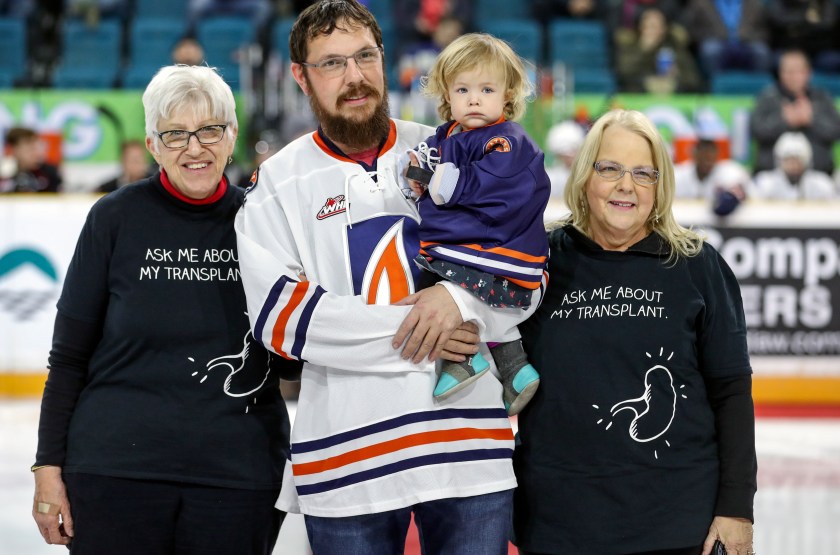
Ferris Backmeyer joined her father, Pat, along with Dorothy Drinnan (left) and Margaret Thompson for the ceremonial faceoff at a Kamloops Blazers game on Feb. 1. (Photo: Allen Douglas/Kamloops This Week)

If you were in attendance on Feb. 1 as the Kamloops Blazers played host to the Prince George Cougars, you may have seen Ferris Backmeyer at centre ice.

Ferris took part in the ceremonial face-off prior to what was the second annual RE/MAX Presents: WHL Suits Up with Don Cherry to Promote Organ Donation game.

Ferris and her father, Patrick, were at centre ice, along with Dorothy Drinnan and Margaret Thompson, two women who have grown to be close friends since both have had kidney transplants.

Ferris and her family are hopeful that she soon will join that club, too.

Yes, Ferris, who is 2-1/2 years of age, needs a kidney, and her mother, Lindsey, has turned to Facebook to announce that the search for a donor officially is underway. In other words, potential donors now are able to contact the Living Kidney Donor Program at St. Paul’s Hospital in Vancouver

Ferris
Ferris Backmeyer, at 2-1/2 years of age, is in need of a kidney transplant. (Photo: Lindsey Backmeyer/Facebook)

First, though, you should get to know Ferris, who made quite an impression when she and her father joined us a while back for a gathering of the Kamloops Kidney Support Group.

Michael Potestio of Kamloops This Week wrote about Ferris in April 2018.

“A few weeks after she was born,” Potestio wrote, “Ferris, now 14 months old, was informally diagnosed with Mainzer-Saldino syndrome, a disorder characterized by kidney disease, vision loss and misshapen bones.

“The disease is caused by gene mutations and is so rare there are only about 20 known cases, according to the U.S. National Library of Medicine.
“After she was born, Ferris wasn’t gaining weight and subsequent blood work showed abnormalities with her kidneys and liver.”

At that time, Lindsey told Potestio:

“The scariest part in the first few weeks was we didn’t know what was going on. And she was admitted to (B.C.) Children’s Hospital back when she was three weeks old and nobody really knew what was going on.

“It’s a bit disconcerting when the medical professionals can’t give you a diagnosis for your kid.”

Genetic testing later confirmed the diagnosis, and it wasn’t long before Ferris’s kidneys failed.

The Backmeyers, who also have two older daughters, have spent a lot of time at BCCH in Vancouver with Ferris, especially in the early days of kidney failure as medical staff got her started on dialysis. She has been doing peritoneal dialysis (PD) and it took a lot of testing to see just how much of the dialysis fluid her body comfortably could hold. Ferris now has been doing PD at home for 18 months.

In PD, the patient is hooked up to a cycler every night — yes, seven nights a week — and fluids are used to absorb and drain toxins from the body via a catheter that is implanted in the peritoneal cavity. The patient carries fluid all day in that cavity, then repeats the draining process nightly.

Ferris has struggled to gain weight, which has complicated her situation. She needs to get to 10 kilograms before a transplant can take place.

But now it seems that she is making progress in that area.

Lindsey recently posted this on Facebook:

“We just got back from B.C. Children’s Hospital from one of our biggest trips ever and it was the first time I didn’t have (husband) Pat with me the whole time and first solo trip back with a 2 year old that doesn’t nap!

“She let them do all the things and the only tears we saw were with labs. She had the patience of a saint and literally seemed to be handling things better than I was. Hours of different consultations, 2 sets of labs, a bunch of X-rays, a dentist appointment and a hearing test!

“The initial screening for kidney transplant has officially begun!

“Little miss remains on the lowest side for weight and height that they will transplant, and growth has slowed again considerably. Praying for more growth!

“As for the donor part of things, we have been given the go-ahead to have any interested donors contact the St. Paul’s living donor program at 604-806-9027, citing Ferris as the intended donor.

“Her blood type is ‘B’ but they encourage all interested donors to contact St. Paul’s directly. They then mail out a package.

“Ferris’s side of the process is completely separate from the donor side and the donor side is 100 per cent up to the donor. We have been told the donor process can take just as long as the transplant workup for Ferris, so starting the search now is recommended.

“I am sharing this publicly because I want to get the word out. She deserves to live a healthy life and we are sooo ready to move on to the next phase. Social media has proven to be successful and altruistic donors is totally a thing! So let’s do it!! Let’s find Ferris a kidney!!”

Understand that you don’t have to be a match in order to help Ferris get a kidney. If you aren’t a match, the Living Donor Paired Exchange program will be used to match you with another donor/recipient pair in a similar situation.

The age and size of a donor isn’t a big deal, either. What is important is the health of the donor and his/her kidneys.

There is more information available right here at Providence Health Care’s website.

If you are interested in more contact information, here you go:

Living Kidney Donor Program

St. Paul’s Hospital

6A Providence Building

1081 Burrard Street

Vancouver, BC V6Z 1Y6

Tel: 604-806-9027

Toll free: 1-877-922-9822

Fax: 604-806-9873

Email: donornurse@providencehealth.bc.ca

In Saskatchewan and thinking about being a living kidney donor? . . . Here’s some info for you . . .

Dorothy and I were in Regina the other night to spend time with good friends who lived across the street from us when we lived in the Saskatchewan capital.

Their son, who is experiencing kidney failure and recently began hemo-dialysis, was there, too.

There were a whole lot of questions and answers, and here’s hoping we were able to help.

At the same time, we are hopeful that we were able to start him down the road to a kidney transplant. A friend of his has said that he is more than willing to be a donor in order to help him get a kidney, but neither of them was at all certain about how to begin the process.

So I did a bit of research and found a really good website belonging to the Saskatchewan Health Authority. This site includes an online brochure that features a lot of good information for anyone thinking about being a kidney donor, regardless of their location.

That page is right here and it’s well worth a look.

As well, if you are living in Saskatchewan, and thinking about being a living donor, you may contact:

Saskatchewan Transplant Program

St. Paul’s Hospital

1702 20th Street West 

Saskatoon, SK  S7M 0Z9

1-306-655-5054

Or email: SHAlivingdonation@saskhealthauthority.ca  

——

There also is a Regina office:

Kidney Health Centre

235 Albert St. North

Regina SK, S4R 3C2

1-306-766-6477

——

There also is a blurb on that site that reads:

“About 90 people in Saskatchewan are currently waiting for a kidney transplant. On average, they will wait 2.8 years for a kidney — that’s 437 dialysis treatments per person. Please offer hope by talking to your family about organ and tissue donation.”

If you are considering being a donor, do the research and make a decision. Someone’s life may depend on it.

Also . . . always remember that there isn’t a cure for kidney disease. A transplant isn’t a cure, but it does allow the recipient to have a much better quality of life.


Scattershooting on a Wednesday night and, hey, it’s George Reed’s birthday . . .

Scattershooting

Hey, we’re scattershooting from the road so we’re doing some catching up . . .


You know that you might be in Regina when you pick up a copy of The Leader-Post and the major headline above the fold reads: RIDER LEGEND HITS 80. . . . And the sports section front and second page are both all George Reed all the time. . . . Hey, not complaining. Just sayin’ . . . Hey, George, happy birthday and here’s to many more!


Brad Flynn is an assistant coach with the WHL’s Red Deer Rebels. His fiancee, Christine, was diagnosed with breast cancer in April and is undergoing treatment. The other day, all of the Rebels players had their heads shaved in a show of support for her. Well done, Rebels! Well done! You can bet that really means a lot of Christine and Brad.


When old friend Bob Ridley walked into the broadcast booth in the ENMAX Centre in Lethbridge a couple of Friday’s ago, he began his 50th season of calling the play-by-play of games involving the WHL’s Medicine Hat Tigers. . . . Going into the game, the Tigers had played 3,936 regular-season, playoff and Memorial Cup games, and Ridley had been on the air for 3,935 of them. (Yes, there’s a story behind the game he missed and it involves women’s curling. Ask him about it the next time you see him.) . . . As blogger Darren Steinke points out, “If you called 80 games a season . . . for 49 campaigns, you would still fall short of Ridley’s current total.” . . . And let’s not forget that Ridley was the Tigers’ bus driver for the vast majority of those seasons, too. . . . Steinke has more right here in a blog posting.


Here’s a plug for old friend Dickson Liong’s podcast — Two Peas in a Pod . . . cast. He and Jon Guarin talk about, in Liong’s own words, “topics that society is afraid to talk about, including mental health, relationships and everyday struggles.” . . . Check it out right here.


Headline at TheOnion.com: Tearful Justify holds press conference blaming failed drug test on contaminated salt lick.


IceCream


Thanks to Rod Pedersen, whose new show is available via Facebook, for the kind words: “The WHL and CFL lost two huge media figures when Gregg Drinnan and Drew Edwards walked away from their blogs (Taking Note and 3DownNation). They left for different reasons, but now a huge hole has been created in coverage of both leagues. 3DownNation will be okay because Justin Dunk has assumed control but as far as the Dub goes, there will never be another Gregg Drinnan. He doesn’t just belong in a Hall of Fame for WHL Writers; it should be named after him. Teams and head offices sometimes saw these guys as a pain, but we’re going to see now why the media is so important to what happens on the field, the ice, in the stands and at the turnstiles.”


From Dwight Perry of the Seattle Times: “For you big believers in Bad Things Happen in Threes, Ben Roethlisberger (elbow) is out for the Steelers, Drew Brees (thumb) is out for the Saints and Christie Brinkley (broken arm) is out for Dancing With The Stars.”

——

One more from Perry: “The Cowboys opened as 20-point favorites over the Dolphins earlier this season— the largest opening spread in 30 years. Stealing a page from the college-football book, Miami asked to be paid a $950,000 appearance fee.”

——

Perry, again: “The NCAA banned Georgia Tech’s basketball team from postseason play for one year because boosters provided impermissible benefits to a recruit — including clothing and a strip-club visit. Which certainly puts a whole new spin on ‘shirts and skins’.”


Can anyone explain how ex-Chicago Cubs manager Joe Maddon became so dumb so quickly? As Jack Finarelli, aka The SportsCurmudgeon, writes: “Joe Maddon’s teams in Chicago accumulated a five-season record of 471-340, which is a winning percentage of .581. To put that in perspective, there are 25 managers in the Baseball Hall of Fame whose career records are below .581.”

——

If you haven’t already read it, Steve Greenberg of the Chicago Sun-Times spells out right here what went wrong at Wrigley Field.


Headline at TheOnion.com: Overwhelmed Dolphins GM asks players to please use automated email form when making trade requests.